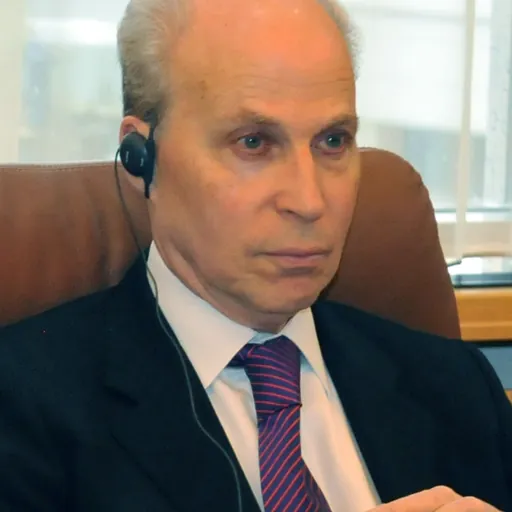
About Roger D. Kornberg
Born 1947. Roger D. Kornberg is an American biochemist, chemist, university teacher and biologist, known for DNA.
Roger David Kornberg (born April 24, 1947) is an American biochemist and professor of structural biology at Stanford University School of Medicine. Kornberg was awarded the Nobel Prize in Chemistry in 2006 for his studies of the process by which genetic information from DNA is copied to RNA, "the molecular basis of eukaryotic transcription."
Early life and education Kornberg was born in St. Louis, Missouri, into a Jewish family, the eldest son of biochemist Arthur Kornberg, who won the Nobel Prize, and Sylvy Kornberg who was also a biochemist. He earned his bachelor's degree in chemistry from Harvard University in 1967 and his Ph.D. in chemical physics from Stanford in 1972 supervised by Harden M. McConnell. From 2004-2026, Kornberg was the editor of the Annual Review of Biochemistry. He serves on the Board of Directors of Annual Reviews.
Research
Roger D. Kornberg (third from left) with Andrew Fire, George Smoot, Dick Cheney, Craig Mello and John C. Mather
Kornberg identified the role of RNA polymerase II and other proteins in DNA transcription, creating three-dimensional images of the protein cluster using X-ray crystallography.
Kornberg and his research group have made several fundamental discoveries concerning the mechanisms and regulation of eukaryotic transcription. While a graduate student working with Harden McConnell at Stanford in the late 1960s, he discovered the "flip-flop" and lateral diffusion of phospholipids in bilayer membranes. Meanwhile, as a postdoctoral fellow working with Aaron Klug and Francis Crick at the MRC in the 1970s, Kornberg discovered the nucleosome as the basic protein complex packaging chromosomal DNA in the nucleus of eukaryotic cells (chromosomal DNA is often termed "chromatin" when it is bound to proteins in this manner). Within the nucleosome, Kornberg found that roughly 200 bp of DNA are wrapped around an octamer of histone proteins. With Yahli Lorch, Kornberg showed that a nucleosome on a promoter prevents the initiation of transcription, leading to the recognition of a functional role for the nucleosome, which serves as a general gene repressor.
Kornberg's research group at Stanford later succeeded in the development of a faithful transcription system from baker's yeast, a simple unicellular eukaryote, which they then used to isolate in a purified form all of the several dozen proteins required for the transcription process. Through the work of Kornberg and others, it has become clear that these protein components are remarkably conserved across the full spectrum of eukaryotes, from yeast to human cells.
Using this system, Kornberg made the major discovery that transmission of gene regulatory signals to the RNA polymerase machinery is accomplished by an additional protein complex that they dubbed Mediator. As noted by the Nobel Prize committee, "the great complexity of eukaryotic organisms is actually enabled by the fine interplay between tissue-specific substances, enhancers in the DNA and Mediator. The discovery of Mediator is therefore a true milestone in the understanding of the transcription process."
At the same time as Kornberg was pursuing these biochemical studies of the transcription process, he devoted two decades to the development of methods to visualize the atomic structure of RNA polymerase and its associated protein components. He has recently extended these studies to obtain structural images of RNA polymerase associated with accessory proteins. Through these studies, Kornberg has created an actual picture of how transcription works at a molecular level. According to the Nobel Prize committee, "the truly revolutionary aspect of the picture Kornberg has created is that it captures the process of transcription in full flow. What we see is an RNA-strand being constructed, and hence the exact positions of the DNA, polymerase and RNA during this process."
Lipids membrane As a graduate student at Stanford University, Kornberg's studied the rotation of phospholipids and defined for the first time the dynamics of lipids in the membrane. Kornberg called the movement of lipid from one leaflet to the other flip-flop because he had studied only a few years before electronic circuit elements called flip-flops. The term gave rise to the naming of proteins called flippases and floppases.
Industrial collaborations Kornberg has served on the Scientific Advisory Boards of the following companies: Cocrystal Discovery, Inc (Chairman), ChromaDex Corporation (Chairman), StemRad, Ltd, Oplon Ltd (Chairman), and Pacific Biosciences. Kornberg has also been a director for the following companies: OphthaliX Inc., Protalix BioTherapeutics, Can-Fite BioPharma, Ltd, Simploud and Teva Pharmaceutical Industries, Ltd.
Awards and honors Kornberg has received the following awards:
1981: Eli Lilly Award in Biological Chemistry 1982: Passano Award from the Passano Foundation 1990: Ciba-Drew Award 1997: Harvey Prize from the Technion – Israel Institute of Technology 2000: Gairdner Foundation International Award 2001: Hoppe-Seyler Award, Society for Biochemistry and Molecular Biology, Germany 2001: Welch Award in Chemistry 2002: ASBMB-Merck Award 2002: Pasarow Award in Cancer Research 2002: Grand Prix Charles-Leopold Mayer 2003: Elected to EMBO Membership 2003: Massry Prize from the Keck School of Medicine, University of Southern California 2005: General Motors Cancer Research Foundation’s Alfred P. Sloan, Jr. Prize 2006: Dickson Prize from University of Pittsburgh 2006: Nobel Prize in Chemistry 2006: Louisa Gross Horwitz Prize from Columbia University 2008: American Philosophical Society Membership 2009: Elected a Foreign Member of the Royal Society (ForMemRS) 2012: Honorary Fellow, Ruppin Academic Center
Don’t just read it —
keep it.
Full-length biographies made to live with: read them, listen on the way to work, watch them tonight.
- E-book
- Audio
- Video
Instant download · yours to keep · every purchase keeps this site free
Important facts
People in Roger D. Kornberg's life
Named in this biography and alive at the same time



Related people
Same field, nearest in time

Contemporaries
People whose lives overlapped Roger D. Kornberg's


Frequently asked questions
Who is Roger D. Kornberg?
American biochemist
When was Roger D. Kornberg born?
Roger D. Kornberg was born on 24 April 1947 in St. Louis.
What is Roger D. Kornberg's occupation?
Roger D. Kornberg is a biochemist, chemist, university teacher and biologist.
What is Roger D. Kornberg known for?
Roger D. Kornberg is known for DNA.
What nationality is Roger D. Kornberg?
Roger D. Kornberg is American.
Sources & further reading
· Wikipedia: Roger D. Kornberg
Cite this page
APA: Biography.guide. (2026). Roger D. Kornberg. https://biography.guide/roger-d-kornberg/
MLA: "Roger D. Kornberg." Biography.guide, https://biography.guide/roger-d-kornberg/.
Chicago: "Roger D. Kornberg." Biography.guide. https://biography.guide/roger-d-kornberg/.
Data last updated: 2026-09-20 · Spot an error? Report a correction.
Portrait: Wikimedia Commons · author & licence
Page generated 2026-09-27 04:58 UTC