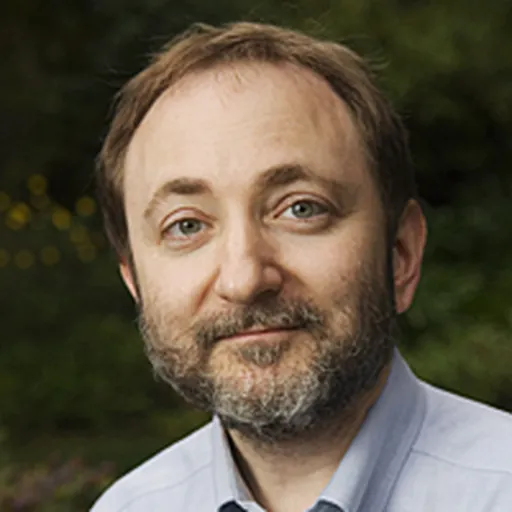
About Andrew Fire
Born 1959. Andrew Fire is an American biologist, geneticist, physician, physicist, pathologist and academic, known for RNA interference.
Andrew Zachary Fire (born April 27, 1959) is an American biologist and professor of pathology and of genetics at the Stanford University School of Medicine. He was awarded the 2006 Nobel Prize in Physiology or Medicine, along with Craig C. Mello, for the discovery of RNA interference (RNAi). This research was conducted at the Carnegie Institution of Washington and published in 1998.
Biography Andrew Z Fire was born in Palo Alto, California and raised in Sunnyvale, California in a Jewish family. He graduated from Fremont High School. He attended the University of California, Berkeley for his undergraduate degree, where he received a B.A. in mathematics in 1978 at the age of 19. He then proceeded to the Massachusetts Institute of Technology, where he received a Ph.D. in biology in 1983 under the mentorship of Nobel laureate geneticist Phillip Sharp.
Fire moved to Cambridge, England, as a Helen Hay Whitney Postdoctoral Fellow. He became a member of the MRC Laboratory of Molecular Biology group headed by Nobel laureate biologist Sydney Brenner.
From 1986 to 2003, Fire was a staff member of the Carnegie Institution of Washington’s Department of Embryology in Baltimore, Maryland. The initial work on double stranded RNA as a trigger of gene silencing was published while Fire and his group were at the Carnegie Labs. Fire and Mello, along with colleagues SiQun Xu, Mary Montgomery, Stephen Kostas, and Sam Driver, reported that tiny snippets of double-stranded RNA (dsRNA) effectively shut down specific genes, driving the destruction of messenger RNA (mRNA) with sequences matching the dsRNA. As a result, the mRNA cannot be translated into protein. Fire and Mello found that dsRNA was much more effective in gene silencing than the previously described method of RNA interference with single-stranded RNA. Because only small numbers of dsRNA molecules were required for the observed effect, Fire and Mello proposed that a catalytic process was involved. This hypothesis was confirmed by subsequent research.
The Nobel Prize citation, issued by Sweden's Karolinska Institute, said: "This year's Nobel Laureates have discovered a fundamental mechanism for controlling the flow of genetic information." The British Broadcasting Corporation (BBC) quoted Nick Hastie, director of the Medical Research Council's Human Genetics Unit, on the scope and implications of the research:
Awards and honors Fire has received the following awards and honors: (By chronological year of award ) Meyenburg Prize in 2002 Co-recipient (with Craig Mello) of National Academy of Sciences Award in Molecular Biology in 2003 Co-recipient (with Craig Mello, Thomas Tuschl and David Baulcombe) of the Wiley Prize in the Biomedical Sciences from Rockefeller University in 2003 Elected member National Academy of Sciences in 2004 Co-recipient (with Victor Ambros, Craig Mello, and Gary Ruvkun) of Brandeis University's Lewis S. Rosenstiel Award for Distinguished Work in Medical Research in 2005 Co-recipient (with Craig Mello) of the Gairdner Foundation International Award in 2005 Co-recipient (with Craig Mello and David Baulcombe) of the Massry Prize in 2005 Co-recipient (with Craig Mello) of the Paul Ehrlich and Ludwig Darmstaedter Prize in 2006 Co-recipient (with Craig Mello) of the Nobel Prize in Physiology or Medicine in 2006
Don’t just read it —
keep it.
Full-length biographies made to live with: read them, listen on the way to work, watch them tonight.
- E-book
- Audio
- Video
Instant download · yours to keep · every purchase keeps this site free
Important facts
People in Andrew Fire's life
Named in this biography and alive at the same time




Related people
Same field, nearest in time

Contemporaries
People whose lives overlapped Andrew Fire's



Frequently asked questions
Who is Andrew Fire?
American biologist
When was Andrew Fire born?
Andrew Fire was born on 27 April 1959 in Palo Alto.
What is Andrew Fire's occupation?
Andrew Fire is a biologist, geneticist, physician, physicist, pathologist and academic.
What is Andrew Fire known for?
Andrew Fire is known for RNA interference.
What nationality is Andrew Fire?
Andrew Fire is American.
Sources & further reading
Cite this page
APA: Biography.guide. (2026). Andrew Fire. https://biography.guide/andrew-fire/
MLA: "Andrew Fire." Biography.guide, https://biography.guide/andrew-fire/.
Chicago: "Andrew Fire." Biography.guide. https://biography.guide/andrew-fire/.
Data last updated: 2026-09-20 · Spot an error? Report a correction.
Page generated 2026-09-27 05:09 UTC