
About Victor Ambros
Born 1953. Victor Ambros is an American geneticist, university teacher and biologist.
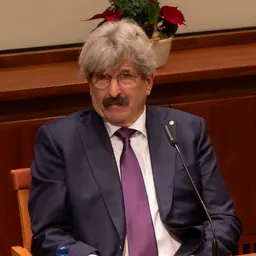
Victor Robert Ambros (born December 1, 1953) is an American developmental biologist of Polish descent, who discovered the first known microRNA (miRNA). He is a professor at the University of Massachusetts Medical School. He completed both his undergraduate and doctoral studies at the Massachusetts Institute of Technology. Ambros received the Nobel Prize in Physiology or Medicine in 2024 for his research on microRNA.
Biography
Early life and education Ambros was born in New Hampshire. His father, Longin Ambros, attended Sigismund Augustus Gymnasium in Vilnius 1937-1939 and was a Polish World War II refugee. In 2026, Victor Ambros began applying for Polish citizenship. Victor grew up on a small dairy farm in Hartland, Vermont, in a family of eight children and attended Woodstock Union High School.
From the Massachusetts Institute of Technology, Ambros received a Bachelor of Science with a major in biology in 1975 and a Doctor of Philosophy in biology in 1979. His doctoral supervisor was David Baltimore, a 1975 Nobel laureate in Physiology or Medicine. Ambros continued his research at MIT as the first postdoctoral fellow in the lab of future Nobel laureate H. Robert Horvitz.
Career Ambros became a faculty member at Harvard University in 1984. However, Harvard denied tenure to Ambros shortly after he discovered what is now known as microRNA. About this, Baltimore later said in 2008: "They lost a potential Nobel laureate because they simply didn't see in him the potential that he had ... It's the nature of a seminal discovery that it's seminal in retrospect. You can't know ahead of time."
Research In 1993, Ambros and his co-workers Rosalind Lee and Rhonda Feinbaum reported in the journal Cell that they had discovered single-stranded non-protein-coding regulatory RNA molecules in the organism C. elegans. Previous research, including work by Ambros and Horvitz, had revealed that a gene known as lin-4 was important for normal larval development of C. elegans, a nematode often studied as a model organism. Specifically, lin-4 was responsible for the progressive repression of the protein LIN-14 during larval development of the worm; mutant worms deficient in lin-4 function had persistently high levels of LIN-14 and displayed developmental timing defects. Ambros and colleagues hypothesized and later determined that lin-4 could regulate LIN-14 through binding of lin-4S to these sequences in the lin-14 transcript in a type of antisense RNA mechanism.
In 2000, another C. elegans small RNA regulatory molecule, let-7, was characterized by the Ruvkun lab and found to be conserved in many species, including vertebrates. These discoveries, among others, confirmed that Ambros had in fact discovered a class of small RNAs with conserved functions, now known as microRNA.
Ambros was elected to the United States National Academy of Sciences in 2007. He was elected a Fellow of the American Academy of Arts and Sciences in 2011. In 2024 he shared the Nobel Prize in Physiology and Medicine with Gary Ruvkun "for the discovery of microRNA and its role in post-transcriptional gene regulation". 2004: Lewis S. Rosenstiel Award for Distinguished Work in Medical Research of Brandeis University (co-recipient with Craig Mello, Andrew Fire, and Gary Ruvkun) 2006: Genetics Society of America Medal for outstanding contributions in the past 15 years 2008: Benjamin Franklin Medal in Life Science of The Franklin Institute (co-recipient with Gary Ruvkun and David Baulcombe) 2009: Dickson Prize from University of Pittsburgh in medicine 2009: Louisa Gross Horwitz Prize from Columbia University (co-recipient with Gary Ruvkun) 2016: March of Dimes Prize in Developmental Biology (co-recipient with Gary Ruvkun) 2024: Nobel Prize in Physiology or Medicine (co-recipient with Gary Ruvkun)
Don’t just read it —
keep it.
Full-length biographies made to live with: read them, listen on the way to work, watch them tonight.
- E-book
- Audio
- Video
Instant download · yours to keep · every purchase keeps this site free
Important facts
People in Victor Ambros's life
Named in this biography and alive at the same time





Related people
Same field, nearest in time





Contemporaries
People whose lives overlapped Victor Ambros's




Frequently asked questions
Who is Victor Ambros?
American developmental biologist
When was Victor Ambros born?
Victor Ambros was born on 1 December 1953 in Hanover (NH).
What is Victor Ambros's occupation?
Victor Ambros is a geneticist, university teacher and biologist.
What nationality is Victor Ambros?
Victor Ambros is American.
Sources & further reading
Cite this page
APA: Biography.guide. (2026). Victor Ambros. https://biography.guide/victor-ambros/
MLA: "Victor Ambros." Biography.guide, https://biography.guide/victor-ambros/.
Chicago: "Victor Ambros." Biography.guide. https://biography.guide/victor-ambros/.
Data last updated: 2026-09-22 · Spot an error? Report a correction.
Portrait: Wikimedia Commons · author & licence
Page generated 2026-09-27 05:01 UTC