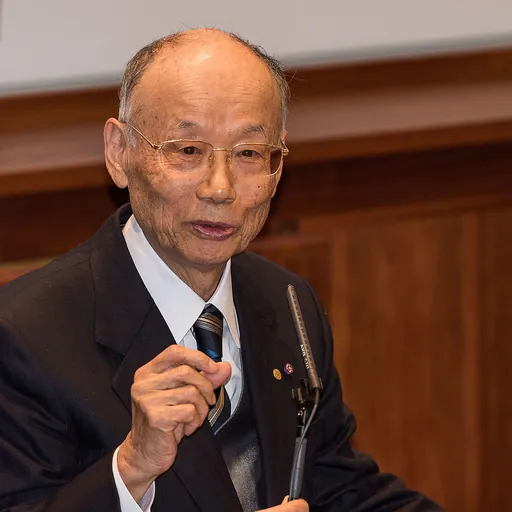
Satoshi Ōmura
Japanese biochemist, microbiologist, and university teacher (born 1935)
About Satoshi Ōmura
Born 1935. Satoshi Ōmura is a Japanese biochemist, chemist, microbiologist, director, school teacher and botanist, known for Avermectin and Ivermectin.
is a Japanese biochemist. He is known for the discovery and development of hundreds of pharmaceuticals originally occurring in microorganisms. In 2015 he shared the Nobel Prize in Physiology or Medicine with Tu Youyou and with William C. Campbell for their role in the discovery of the world's first endectocide, ivermectin, a safe and highly effective microfilaricide. From 1970 to 1990, he also became a part-time lecturer at Tokyo University of Science.
In 1971 while he was a visiting professor at Wesleyan University, Ōmura was considering continuing his research in the United States, but ultimately he decided to return to Japan.
In 1973, he became a director of the antibiotic laboratory at Kitasato University, and he also started collaborative research with Merck & Co.
In 1975, he became professor of Kitasato University School of Pharmacy. Meanwhile, the Ōmura laboratory raised many researchers and produced 31 university professors and 120 doctors.
At present date, Ōmura is professor emeritus at Kitasato University and Max Tishler Professor of Chemistry at Wesleyan University. Research
Satoshi Ōmura is known for the discovery and development of various pharmaceuticals originally occurring in microorganisms. He was awarded the 2015 Nobel Prize in Physiology or Medicine jointly with William C. Campbell for discoveries concerning a novel therapy against infections caused by roundworm parasites. More precisely, his research group isolated a strain of Streptomyces avermitilis that produce the anti-parasitical compound avermectin. Campbell later acquired these bacteria and developed the derived drug ivermectin that was commercialised for veterinary use in 1981, later put to human use against Onchocerciasis in 1987–88 with the name Mectizan,
Since the 1970s, Ōmura has discovered more than 480 new compounds, of which 25 kinds of drugs and reagents are in use. Examples include andrastin, herbimycin, neoxaline as well as: a specific inhibitor of protein kinase named staurosporine; a proteasome inhibitor named lactacystin; a fatty acid biosynthesis inhibitor named cerulenin;
Furthermore, compounds having a unique structure and biological activity discovered by Omura are drawing attention in drug discovery research, and new anticancer drugs and the like have been created.
Selected publications
Social role Ōmura served as deputy director and director at the Kitasato Institute. He was devoted to rebuild the laboratory and promoting the establishment of the medical center that is now Kitasato University Medical Center. Meanwhile, he established a path to rebuilding of the corporate school juridical person, which has integrated with the School corporation Kitasato Gakuen. He succeeded in establishing a new "School corporation Kitasato Institute". In addition, he served as president of the School corporation Joshibi University of Art and Design twice, and served as the honorary school chief of the School corporation Kaichi Gakuen. In 2007, he established the Nirasaki Omura Art Museum on his collection.
Awards and honors Satoshi Ōmura (left) and William C. Campbell (right) in Stockholm, December 2015. Statues of children leading adults blinded by onchocerciasis, outside Kitasato University buildings, were produced by sculptors of Burkina Faso in honor of Ōmura's invention of avermectin and ivermectin, a symbol of the campaign to eradicate onchocerciasis. Similar life-sized bronze statues were erected at World Health Organization (WHO) headquarters in Geneva, Carter Center, Merck & Co., World Bank Headquarters, and Burkina Faso's World Health Organization Africa Onchocerciasis Control Program.
1985 – Hoechst-Roussel Award 1986 – The Pharmaceutical Society of Japan Award 1998 – Prince Mahidol Award 2012 – Person of Cultural Merit 2015 – Asahi Prize
Honorary doctorates List of honorary doctorates: 1992 – Lajos Kossuth University, Hungary 1994 – Wesleyan University, USA 2016 – Shanghai Jiao Tong University, China 2018 – University of St Andrews, Scotland
Learned societies membership
1992 – Academy of Sciences Leopoldina 1999 – National Academy of Sciences 2001 – Japan Academy 2002 – Académie des sciences 2005 – Russian Academy of Sciences 2005 – Royal Society of Chemistry 2005 – Academia Europaea 2006 – Chinese Academy of Engineering 2009 – Japan Society for Bioscience, Biotechnology and Agrochemistry 2014 – 2016 – Japan Pharmaceutical Association 2016 – Japan Society of Synthetic Organic Chemistry 2016 – Japan Society of Chemotherapy
Don’t just read it —
keep it.
Full-length biographies made to live with: read them, listen on the way to work, watch them tonight.
- E-book
- Audio
- Video
Instant download · yours to keep · every purchase keeps this site free
Important facts
more
Ōmura, Ōmura S, Ōmura S., S. Omura, S Omura, Omura, Omura S, Omura S.People in Satoshi Ōmura's life
Named in this biography and alive at the same time


Related people
Same field, nearest in time




Contemporaries
People whose lives overlapped Satoshi Ōmura's





Frequently asked questions
Who is Satoshi Ōmura?
Japanese biochemist, microbiologist, and university teacher (born 1935)
When was Satoshi Ōmura born?
Satoshi Ōmura was born on 12 July 1935 in Kamiyama.
What is Satoshi Ōmura's occupation?
Satoshi Ōmura is a biochemist, chemist, microbiologist, director, school teacher and botanist.
What is Satoshi Ōmura known for?
Satoshi Ōmura is known for Avermectin and Ivermectin.
What nationality is Satoshi Ōmura?
Satoshi Ōmura is Japanese.
Sources & further reading
Cite this page
APA: Biography.guide. (2026). Satoshi Ōmura. https://biography.guide/satoshi-omura/
MLA: "Satoshi Ōmura." Biography.guide, https://biography.guide/satoshi-omura/.
Chicago: "Satoshi Ōmura." Biography.guide. https://biography.guide/satoshi-omura/.
Data last updated: 2026-09-21 · Spot an error? Report a correction.
Portrait: Wikimedia Commons · author & licence
Page generated 2026-09-27 04:59 UTC