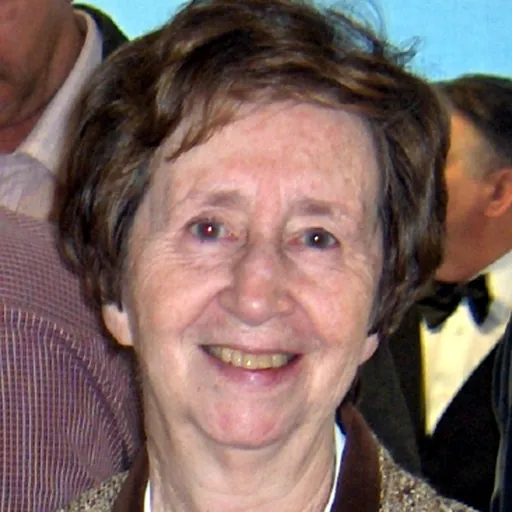
About Margarita Salas
Lived 1938 – 2019 (aged 80). Margarita Salas was a Spanish biochemist, molecular geneticist, university teacher, molecular biologist, geneticist and scientist, known for Molecular genetics.
Margarita Salas Falgueras, 1st Marchioness of Canero (30 November 1938 – 7 November 2019) was a Spanish scientist, medical researcher, and author in the fields of biochemistry and molecular genetics.
She started developing molecular biology in Spain and also worked as an honorary associate professor of CSIC, at the Severo Ochoa Biology Center (UAM). In 2016 she became the first women ever to receive the Echegaray Medal, that was given to her by the Royal Academy of Exact, Physical and Natural Sciences (Real Academia de Ciencias Exactas, Físicas y Naturales).
Salas' discovery of the bacterial virus Φ29 DNA polymerase was recognized by the Spanish National Research Council as the highest-grossing patent in Spain.
She was the first scientific woman ever elected to the Royal Spanish Academy.
Early life and career Margarita Salas Falgueras was born on 30 November 1938 in Canero, a parish of Valdés, Asturias, Spain. She was the daughter of José Salas Martínez (1905–1962), a psychiatric doctor who influenced her, encouraging her interest in science, and Margarita Falgueras Gatell (1912/1913-2014), a teacher. On their return to Spain, Salas and her husband established a laboratory to research molecular biology at the Center for Biological Research in Madrid. Salas was a professor of molecular genetics at the Complutense University Faculty of Chemistry from 1968 to 1992. She then served as the director of the Foundation for Biomedical Research at the Gregorio Marañón Hospital (2001–2004), and of the Institute of Spain (1995–2003). She was responsible for promoting Spanish research in the fields of biochemistry and molecular biology. She was an honorary professor at the Spanish National Research Council (CSIC) in the field of biotechnology.
On November 7, 2019, she died of a cardiac arrest after a complication of a digestive ailment from which she was to be operated.
Scientific career Salas was the first scientific woman elected in the Royal Spanish Academy. She was appointed on 20 December 2001, and took up her seat on 4 June 2003. On 11 July 2008, Salas was raised into the Spanish nobility by King Juan Carlos I with the hereditary title of Marchioness of Canero. She supervised more than 40 doctoral students and published over 200 scientific articles.thumb
Early work After obtaining an undergraduate degree in chemistry, Margarita Salas joined the laboratory of Alberto Sols, where she completed her doctoral thesis on the anomeric specificity of glucose-6-phosphate isomerase. She then worked as a postdoctoral researcher in the United States for three years (1964–1967) at New York University with Severo Ochoa. She also discovered and characterized the Φ29 phage DNA polymerase, which has biotechnological applications due to its high DNA amplification properties. Her research allowed trace amounts of DNA to be replicated more quickly and reliably, making DNA analysis accessible in fields such as archaeology and forensics, where only trace amounts may be retrieved, and in oncology.
In 2012 she was professor ad honorem at the Center for Molecular Biology Severo Ochoa, The patent relating to her discovery of Φ29 generated more royalties for the Spanish National Research Council than any of its other patents, with 50% of its patent royalty income between 2003 and 2009 deriving from it. She was the director of the (Institute of Spain) in the period 1995–2003.
She also directed the Severo Ochoa Foundation y and the annual course of the School of Molecular Biology “Eladio Viñuela” of the Menéndez Pelayo International University in Santander.
She was a member of the Royal Academy of Exact, Physical and Natural Science, and of the American Academy of Arts and Sciences, among others.
In addition, she was named honorary doctorate by the following universities: Rey Juan Carlos, University of Oviedo, Extremadura, Murcia, Politécnica de Madrid, Jaén, Cádiz, Málaga, That same year the CSIC Biological Research Center was renamed the Margarita Salas Biological Research Center.
In 2020, a new species of gastropod discovered in waters of the Canary islands, Rissoella salasae, was named after her.
Her role as a woman in science
Salas was known for her work as a mentor of many scientists such as María Blasco, Marisol Soengas and Jesús Ávila de Grado.
Personal life In 1963, she married Eladio Viñuela [es].
Awards and honors Salas won the L'Oréal-UNESCO Awards for Women in Science in its first year, 2000. She was a member of Spanish Royal Academy of Sciences, She was awarded honorary doctorates by the University of Oviedo, University of Extremadura, University of Murcia and the University of Cádiz. 2001: Selected among the 100 women of the twentieth century that paved the way for equality in the XXI Century by the Council of Women of the Community of Madrid. 2002: Isabel Ferrer Award of the Generalitat Valenciana. 2002: Gold Medal of the Community of Madrid. 2007: First Spanish woman to become a member of the National Academy of Sciences (United States). 2009: Gold Medal of the College of Veterinarians of the Principality of Asturias. 2009: Title of Honorary Ambassador of the Spain Brand, category of Science and Innovation, which fails Leading Brands of Spanish Forum with the approval of the Ministry of Foreign Affairs and Cooperation. 2009: Women Leader Award 2009, awarded by the Rafael del Pino, Aliter and Merck Foundation. 2009: Award "An entire professional life" of the Mapfre Foundation. 2014: Chemistry Excellence Award, awarded by the General Council of Associations of Chemists of Spain. 2016: Medalla Echegaray, the highest award from the Spanish Royal Academy of Sciences 2017: Nature's Lifelong Mentoring Award 2018: ManchaArte Award 2018 2019: European Inventor Award Lifetime Achievement Award and Audience Award by European Patent Office
Don’t just read it —
keep it.
Full-length biographies made to live with: read them, listen on the way to work, watch them tonight.
- E-book
- Audio
- Video
Instant download · yours to keep · every purchase keeps this site free
Important facts
People in Margarita Salas's life
Named in this biography and alive at the same time






Related people
Same field, nearest in time






Contemporaries
People whose lives overlapped Margarita Salas's


Frequently asked questions
Who was Margarita Salas?
Spanish biochemist (1938-2019)
When was Margarita Salas born?
Margarita Salas was born on 30 November 1938 in Caneiru.
When did Margarita Salas die?
Margarita Salas died on 7 November 2019 in Madrid.
What was Margarita Salas's occupation?
Margarita Salas was a biochemist, molecular geneticist, university teacher, molecular biologist, geneticist and scientist.
What was Margarita Salas known for?
Margarita Salas was known for Molecular genetics.
What nationality was Margarita Salas?
Margarita Salas was Spanish.
Sources & further reading
Cite this page
APA: Biography.guide. (2026). Margarita Salas. https://biography.guide/margarita-salas/
MLA: "Margarita Salas." Biography.guide, https://biography.guide/margarita-salas/.
Chicago: "Margarita Salas." Biography.guide. https://biography.guide/margarita-salas/.
Data last updated: 2026-09-22 · Spot an error? Report a correction.
Portrait: Wikimedia Commons · author & licence
Page generated 2026-09-27 05:04 UTC