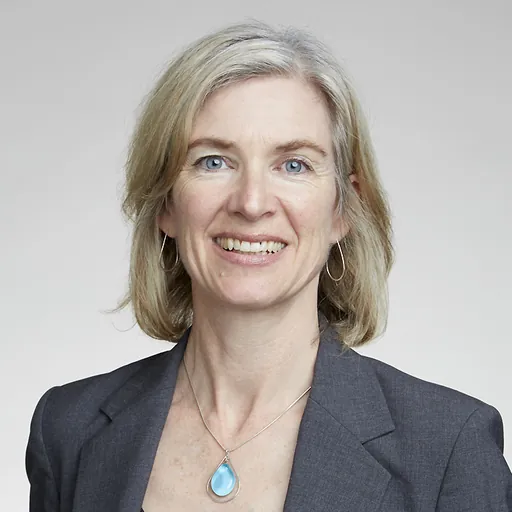
About Jennifer Doudna
Born 1964. Jennifer Doudna is an American biochemist, molecular biologist, university teacher, chemist and crystallographer, known for CRISPR and RNA interference.
Jennifer Anne Doudna (; born February 19, 1964) is an American biochemist who has pioneered work in CRISPR gene editing, and made other fundamental contributions in biochemistry and genetics. She received the 2020 Nobel Prize in Chemistry, with Emmanuelle Charpentier, "for the development of a method for genome editing." She is the Li Ka Shing Chancellor's Chair Professor at the University of California, Berkeley. She has been an investigator with the Howard Hughes Medical Institute since 1997.
In 2012, Doudna and Emmanuelle Charpentier were the first to propose that CRISPR-Cas9 (enzymes from bacteria that control microbial immunity) could be used for programmable editing of genomes, Since then, Doudna has been a leading figure in what is referred to as the "CRISPR revolution" for her fundamental work and leadership in developing CRISPR-mediated genome editing.
Doudna's awards and fellowships include the 2000 Alan T. Waterman Award for her research on the structure of a ribozyme, as determined by X-ray crystallography and the 2015 Breakthrough Prize in Life Sciences for CRISPR-Cas9 genome editing technology, with Charpentier. She has been a co-recipient of the Gruber Prize in Genetics (2015), the Tang Prize (2016), the Canada Gairdner International Award (2016), and the Japan Prize (2017). She was named one of the Time 100 most influential people in 2015,
Early life and education Jennifer Doudna was born February 19, 1964, in Washington, D.C., as the daughter of Dorothy Jane (Williams) and Martin Kirk Doudna. Her father received his Ph.D. in English literature from the University of Michigan, and her mother held a master's degree in education.
While she attended Hilo High School, Doudna's interest in science was encouraged by her 10th-grade chemistry teacher, Jeanette Wong, whom she has cited as a significant influence in her choice to pursue science. A visiting lecturer on cancer cells further encouraged her pursuit of science as a career choice.
Doudna was an undergraduate student at Pomona College in Claremont, California, where she studied biochemistry. She chose Harvard Medical School for her doctoral study and earned a Ph.D. in biological chemistry and molecular pharmacology in 1989. Her Ph.D. dissertation was on a system that increased the efficiency of a self-replicating catalytic RNA and of 134 according to Scopus.
Research on ribozyme structure and function Early in her scientific career, Doudna worked to uncover the structure and biological function of RNA enzymes or ribozymes. She left Genentech after two months and returned to Berkeley with the help of colleague Michael Marletta, canceling all of her obligations to study CRISPR. Doudna holds the Li Ka Shing Chancellor's Professorship in Biomedicine and Health, and is the chair of the Chancellor's Advisor Committee on Biology. In 2012, Doudna and her colleagues made a new discovery that reduces the time and work needed to edit genomic DNA. Their discovery relies on a protein named Cas9 found in the Streptococcus bacterial "CRISPR" immune system that cooperates with guide RNA and works like scissors. The protein attacks its prey, the DNA of viruses, and slices it up, preventing it from infecting the bacterium. This system was first discovered by Yoshizumi Ishino and colleagues in 1987 and later characterized by Francisco Mojica, but Doudna and Emmanuelle Charpentier showed for the first time that they could use different RNAs to program it to cut and edit different DNAs. Their discovery has since been further developed by many research groups Doudna supports the usage of CRISPR in somatic gene editing, gene alterations which do not get passed to the next generation, but not germline gene editing.
The CRISPR system created a new straightforward way to edit DNA and there was a rush to patent the technique. UC Berkeley appealed on grounds that they had clearly discussed and spelled out how to do the application the Broad had pursued. In September 2018, the appeals court decided in favor of the Broad Institute's patent. Meanwhile, UC Berkeley and co-applicants' patent to cover the general technique was also granted. To further cloud the issue, in Europe the claim of the Broad Institute, to have initiated the research first, was disallowed. Doudna cofounded Caribou Biosciences, a company to commercialize CRISPR technology, in 2011. In September 2013, Doudna cofounded Editas Medicine with Zhang and others despite their legal battles, but she quit in June 2014; Charpentier then invited her to join CRISPR Therapeutics, but she declined following the "divorce"-like experience at Editas. Doudna is also a cofounder of Caribou spin-off Intellia Therapeutics and Scribe Therapeutics, which pioneered CasX, a more compact, next-generation Cas9 which can efficiently cut DNA.
In 2017, with Samuel H. Sternberg, she co-authored A Crack in Creation: Gene Editing and the Unthinkable Power to Control Evolution,
In addition to the CRISPR breakthrough, Doudna has discovered that the hepatitis C virus utilizes an unusual strategy to synthesize viral proteins.
"I have so much optimism about what CRISPR can do to help cure unaddressed genetic diseases and improve sustainable agriculture, but I'm also concerned that the benefits of the technology might not reach those who need it most if we're not thoughtful and deliberate about how we develop the technology," Doudna said.
Mammoth Biosciences In 2017, Doudna co-founded Mammoth Biosciences, a San Francisco-based bioengineering tech startup. Initial funding raised $23 million, with a series B round of funding in 2020 raising $45 million. The business is focused on improving access to bio sensing tests which address "challenges across healthcare, agriculture, environmental monitoring, biodefense, and more." This center processed over 500,000 patient samples from UC Berkeley students, staff and faculty as well as members of the surrounding community and farm workers in the Salinas area. Mammoth Biosciences announced a peer-reviewed validation of a rapid, CRISPR-based point of need COVID-19 diagnostic which is faster and less expensive than qRT-PCR based tests.
Other activities She is also the founder and chair of the governance board of the Innovative Genomics Institute, which she co-founded in 2014. In 2025, a new supercomputer named after Doudna was announced for the National Energy Research Scientific Computing Center at LBNL, intended as the successor to the Perlmutter supercomputer.
Doudna is on the scientific advisory boards of the companies that she cofounded, such as Caribou, Intellia, Mammoth, and Scribe; as well as others such as Altos Labs, Isomorphic Labs, Johnson & Johnson, Synthego, Tempus AI, and Welch Foundation. She joined Sixth Street Partners in 2022 as its chief science advisor, to guide investment decisions related to CRISPR.
Personal life Doudna's first marriage was in 1988 to a fellow graduate student at Harvard named Tom Griffin, but they divorced a few years later. Griffin wanted to move to Boulder, Colorado, where Doudna was also interested in working with Thomas Cech. As a postdoctoral researcher at the University of Colorado, Doudna met Jamie Cate, then a graduate student. They worked together on the project to crystallize and determine the structure of the Tetrahymena Group I intron P4-P6 catalytic region. Doudna brought Cate with her to Yale, and they married in Hawaii in 2000. Cate later became a professor at the Massachusetts Institute of Technology and Doudna followed him to Boston at Harvard, but in 2002 they both accepted faculty positions at Berkeley and moved there together; Cate preferred the less formal environment on the West Coast from his earlier experiences at the University of California, Santa Cruz and the Lawrence Berkeley National Laboratory, and Doudna liked that Berkeley is a public university. Cate is a Berkeley professor and works on gene-editing yeast to increase their cellulose fermentation for biofuel production. Doudna and Cate have a son born in 2002 who attends UC Berkeley, studying electrical engineering and computer science.
Awards and honors
Doudna was a Searle Scholar and received the 1996 Beckman Young Investigators Award. In 2000, she was awarded the Alan T. Waterman Award, the National Science Foundation's highest honor that annually recognizes an outstanding researcher under the age of 35, for her structure determination of a ribozyme. In 2016, together with Charpentier, Feng Zhang, Philippe Horvath and Rodolphe Barrangou, she received the Canada Gairdner International Award. She has also been a co-recipient of the Gruber Prize in Genetics (2015), the Tang Prize (2016), In 2018, Doudna was awarded the NAS Award in Chemical Sciences, the Pearl Meister Greengard Prize from the Rockefeller University, and a Medal of Honor from the American Cancer Society. Also in 2018, she was awarded the Kavli Prize in Nanoscience (jointly with Emmanuelle Charpentier and Virginijus Šikšnys). In 2019, she received the Harvey Prize of the Technion/Israel for the year 2018 (jointly with Emmanuelle Charpentier and Feng Zhang) and the LUI Che Woo Prize in the category of Welfare Betterment. In 2020, she received the Wolf Prize in Medicine (jointly with Emmanuelle Charpentier). Also in 2020, Doudna and Charpentier were awarded the Nobel Prize in Chemistry "for the development of a method for genome editing." and was named the recipient of the 2026 Priestley Medal by the ACS. She was elected a member of the National Academy of Engineering in 2026.
She was elected to the National Academy of Sciences in 2002, the National Academy of Medicine in 2010 and the National Academy of Inventors in 2014. She was elected a Foreign Member of the Royal Society (ForMemRS) in 2016. In 2017, Doudna was awarded the Golden Plate Award of the American Academy of Achievement. In 2020, she was awarded a Guggenheim Fellowship. In 2021 she received the Award for Excellence in Molecular Diagnostics from the Association for Molecular Pathology. In 2021, Pope Francis appointed Doudna, and two other women Nobel laureates Donna Strickland and Emmanuelle Charpentier, as members of the Pontifical Academy of Sciences.
She along with Charpentier was named one of the Time 100 most influential people in 2015, and she was a runner-up for Time Person of the Year in 2016 alongside other CRISPR researchers. In 2018 and 2023, she received honorary Doctor of Science degrees from USC and Harvard, respectively.
Don’t just read it —
keep it.
Full-length biographies made to live with: read them, listen on the way to work, watch them tonight.
- E-book
- Audio
- Video
Instant download · yours to keep · every purchase keeps this site free
Important facts
more
J Doudna, Doudna, Doudna J, Doudna J., Doudna J. A., Doudna JAPeople in Jennifer Doudna's life
Named in this biography and alive at the same time







Related people
Same field, nearest in time
Contemporaries
People whose lives overlapped Jennifer Doudna's


Frequently asked questions
Who is Jennifer Doudna?
American biochemist
When was Jennifer Doudna born?
Jennifer Doudna was born on 19 February 1964 in Washington, D.C..
What is Jennifer Doudna's occupation?
Jennifer Doudna is a biochemist, molecular biologist, university teacher, chemist and crystallographer.
What is Jennifer Doudna known for?
Jennifer Doudna is known for CRISPR and RNA interference.
What nationality is Jennifer Doudna?
Jennifer Doudna is American.
Sources & further reading
Cite this page
APA: Biography.guide. (2026). Jennifer Doudna. https://biography.guide/jennifer-doudna/
MLA: "Jennifer Doudna." Biography.guide, https://biography.guide/jennifer-doudna/.
Chicago: "Jennifer Doudna." Biography.guide. https://biography.guide/jennifer-doudna/.
Data last updated: 2026-09-21 · Spot an error? Report a correction.
Portrait: Wikimedia Commons · author & licence
Page generated 2026-09-27 05:00 UTC