
Aaron Klug
British chemist and biophysicist
About Aaron Klug
Lived 1926 – 2018 (aged 92). Aaron Klug was a British biochemist, molecular biologist, university teacher, chemist and biophysicist, known for Electron crystallography.
Sir Aaron Klug (11 August 1926 – 20 November 2018) was a British biophysicist and chemist. He was a winner of the 1982 Nobel Prize in Chemistry for his development of crystallographic electron microscopy and his structural elucidation of biologically important nucleic acid-protein complexes.
Early life and education
Klug was born in Želva, in Lithuania, to Jewish parents Lazar, a cattleman, and Bella (née Silin) Klug, with whom he emigrated to South Africa at the age of two. He was educated at Durban High School. Paul de Kruif's 1926 book, Microbe Hunters, aroused his interest in microbiology.
He started to study microbiology, but then moved into physics and maths, graduating with a Bachelor of Science degree at the University of the Witwatersrand, in Johannesburg. He studied physics under Reginald W. James and obtained his Master of Science degree at the University of Cape Town. He was awarded an 1851 Research Fellowship from the Royal Commission for the Exhibition of 1851,
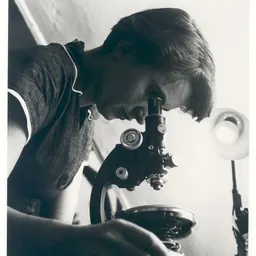
Career and research Following his PhD, Klug moved to Birkbeck College in the University of London in late 1953, and started working with chemist and X-ray crystallographer Rosalind Franklin in the lab of crystallographer John Bernal. This experience aroused a lifelong interest in the study of viruses, and during his time there he made discoveries in the structure of the tobacco mosaic virus. In 1962 he moved to the newly built Medical Research Council (MRC) Laboratory of Molecular Biology (LMB) in Cambridge. Over the following decade Klug used methods from X-ray diffraction, microscopy and structural modelling to develop crystallographic electron microscopy in which a sequence of two-dimensional images of crystals taken from different angles are combined to produce three-dimensional images of the target. He studied the structure of transfer RNA, and found what is known as zinc fingers as well as the neurofibrils in Alzheimer's disease.
Also in 1962, Klug became a Fellow of Peterhouse, Cambridge. He was later made an Honorary Fellow of the college. He also served on the Board of Scientific Governors at The Scripps Research Institute. He and Dai Rees approached the Wellcome Trust to found the Wellcome Sanger Institute, which was a key player in the Human Genome Project. In 1969 he was elected a Fellow of the Royal Society (FRS), the oldest national scientific institution in the world. He was elected its President (PRS) from 1995 to 2000. He was appointed to the Order of Merit in 1995 – as is customary for Presidents of the Royal Society. His certificate of election to the Royal Society reads:
Klug was a member of the American Academy of Arts and Sciences and the American Philosophical Society
In 2000, Klug received the Golden Plate Award of the American Academy of Achievement. In 2005, he was awarded South Africa's Order of Mapungubwe (gold) for exceptional achievements in medical science. He was elected a Fellow of the Academy of Medical Sciences (FMedSci), also in 2005.
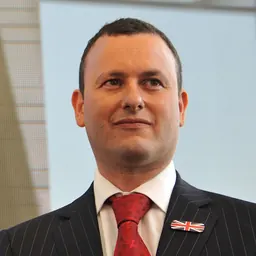
In 2013, Israel's Ben-Gurion University of the Negev dedicated their centre for structural biology in Klug's name, Aaron Klug Integrated Centre for Biomolecular Structure. He, his family and the then-British Ambassador to Israel Matthew Gould, were in attendance. Klug was associated with the university and the town of Be'er Sheva, having visited them numerous times.
Personal life Klug married Liebe Bobrow in 1948;
Though Klug had faced discrimination in South Africa, he remained religious and according to Sydney Brenner, he became more religious in his older age.
Don’t just read it —
keep it.
Full-length biographies made to live with: read them, listen on the way to work, watch them tonight.
- E-book
- Audio
- Video
Instant download · yours to keep · every purchase keeps this site free
Important facts
People in Aaron Klug's life
Named in this biography and alive at the same time





Related people
Same field, nearest in time




Contemporaries
People whose lives overlapped Aaron Klug's



Frequently asked questions
Who was Aaron Klug?
British chemist and biophysicist
When was Aaron Klug born?
Aaron Klug was born on 11 August 1926 in Želva.
When did Aaron Klug die?
Aaron Klug died on 20 November 2018 in Cambridge.
What was Aaron Klug's occupation?
Aaron Klug was a biochemist, molecular biologist, university teacher, chemist and biophysicist.
What was Aaron Klug known for?
Aaron Klug was known for Electron crystallography.
What nationality was Aaron Klug?
Aaron Klug was British.
Sources & further reading
Cite this page
APA: Biography.guide. (2026). Aaron Klug. https://biography.guide/aaron-klug/
MLA: "Aaron Klug." Biography.guide, https://biography.guide/aaron-klug/.
Chicago: "Aaron Klug." Biography.guide. https://biography.guide/aaron-klug/.
Data last updated: 2026-09-20 · Spot an error? Report a correction.
Page generated 2026-09-27 05:32 UTC