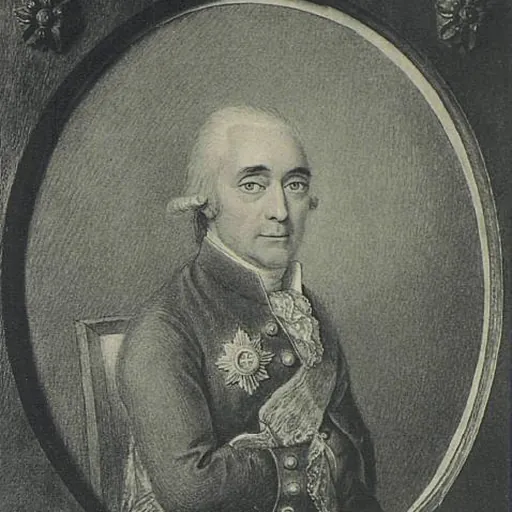
About Yury Neledinsky-Meletsky
Lived 1752 – 1829 (aged 76). Yury Neledinsky-Meletsky was a Russian poet.
Yury Aleksandrovich Neledinsky-Meletsky (; 1751–1828) was a Russian poet, soldier, senator and a cabinet secretary during the reign of Paul I of Russia.
Biography His father was of the Neledinsky-Meletsky noble family (descended from a Polish nobleman of the Mielec family), his mother was a princess (Kurakina). His mother died early and his father was abroad, so he grew up with his paternal grandmother in Moscow and later, at age 13, he moved to his maternal grandmother, Aleksandra Kurakina, in Petersburg, where he came under the influence of the European Enlightenment and became acquainted with the future tsar Paul.
In 1769, he went to the University of Strasbourg, where he studied French, Italian and German. In 1770, he entered the Russian army, participating in the siege of Bender and the Crimea campaign in the Russo-Turkish War of 1768–1774. His first published poem was dedicated to the generals under whom he served, Petr Panin and Vasily Dolgoruky. In 1773, he served under Mikhail Kamensky and rose to the rank of 2nd major. After the war, he served under Nicholas Repnin. He retired from the army in 1785 with the rank of colonel.
In 1786, he married princess Ekaterina Khovanskaya (1762–1813), with whom he had a son and two daughters, and began to dedicate himself to literature. With the accession of his childhood friend as Paul I in 1796, Neledinsky was given the rank of state councillor, but due to a court intrigue he was removed from office and two years later made senator in Moscow. In 1813, he again moved to Petersburg and became a senator there. Over the next ten years, he was under the protection of empress Maria Feodorovna and became well known as a court poet.
He retired in 1826 and moved to Kaluga, where he died two years later.
Legacy The works of Neledinsky-Meletsky were edited together with those of Anton Delvig in 1850 by A.F. Smirdin. He is not now remembered as a great Russian author of his time; the Brockhaus and Efron Encyclopedic Dictionary calls him a "gifted amateur", judging that his works are now only of interest to literary historians, while emphasizing his popularity among his contemporaries; he was praised by Pushkin, and Konstantin Batyushkov called him "the Anacreon and Chaulieu of our time", setting him above Ippolit Bogdanovich. Among his works that remain known in modern Russia is the "folk style" poem Песня ("A Song", 1796; incipit "When I go down to the river").
Don’t just read it —
keep it.
Full-length biographies made to live with: read them, listen on the way to work, watch them tonight.
- E-book
- Audio
- Video
Instant download · yours to keep · every purchase keeps this site free
Important facts
People in Yury Neledinsky-Meletsky's life
Named in this biography and alive at the same time



Related people
Same field, nearest in time

Contemporaries
People whose lives overlapped Yury Neledinsky-Meletsky's






Frequently asked questions
Who was Yury Neledinsky-Meletsky?
Russian poet (1752-1829)
When was Yury Neledinsky-Meletsky born?
Yury Neledinsky-Meletsky was born on 6 September 1752 in Moscow.
When did Yury Neledinsky-Meletsky die?
Yury Neledinsky-Meletsky died on 13 February 1829 in Kaluga.
What was Yury Neledinsky-Meletsky's occupation?
Yury Neledinsky-Meletsky was a poet.
What nationality was Yury Neledinsky-Meletsky?
Yury Neledinsky-Meletsky was Russian.
Sources & further reading
· Wikipedia: Yury Neledinsky-Meletsky
· DBpedia: Yury Neledinsky-Meletsky
Cite this page
APA: Biography.guide. (2026). Yury Neledinsky-Meletsky. https://biography.guide/yury-neledinsky-meletsky/
MLA: "Yury Neledinsky-Meletsky." Biography.guide, https://biography.guide/yury-neledinsky-meletsky/.
Chicago: "Yury Neledinsky-Meletsky." Biography.guide. https://biography.guide/yury-neledinsky-meletsky/.
Data last updated: 2026-09-22 · Spot an error? Report a correction.
Portrait: Wikimedia Commons · author & licence
Page generated 2026-09-27 05:04 UTC