
About Nicholas Repnin
Lived 1734 – 1801 (aged 67). Nicholas Repnin was a Russian diplomat, politician, military officer, civil servant and general field marshal.
Prince Nikolai or Nicholas Vasilyevich Repnin (; – ) was a Russian statesman and general from the Repnin princely family who played a key role in the dissolution of the Polish–Lithuanian Commonwealth; the leading figure in the Repnin Sejm, the victor at Măcin.
Early life and education Born in Saint Petersburg, his parents were Prince Vasily Anikitovich Repnin and Daria Fedorovna Makarova. He was the grandson of Anikita Ivanovitch Repnin, who served during the reign of Emperor Peter I the Great.
Catherine II appointed him director of the Land Noble Corps, and a few months later sent him to Poland, where he was to assist the Russian envoy, Count Hermann Carl von Keyserling, in seeking equal rights with Catholics for so-called dissidents (Orthodox and Protestants). After Keyserling's death in 1764, Repnin became minister plenipotentiary and began actively intervening in the country's internal affairs and promoting the elevation of Stanisław Poniatowski to the vacant Polish throne following the death of king Augustus III, a position that completely satisfied the Saint Petersburg court.
Due to the level of Russian control of the Polish government, Repnin was the effective ruler of the country, with special instructions to form a pro-Russian faction from among the various Protestants, who were to receive equal rights with the Catholics. Repnin believed that the Protestants were not significant enough to benefit Russia; at the same time, the Protestant community itself petitioned Empress Catherine, requesting not to be involved.
Repnin convinced himself that the dissidents were too poor and insignificant to be of any real support to Russia, and that the whole agitation in their favour was factitious. At last, indeed, the dissidents themselves even petitioned the empress to leave them alone. It is clear from his correspondence that Repnin, a singularly proud and high-spirited man, much disliked the very dirty work he was called upon to do. Nevertheless he faithfully obeyed his instructions, and, by means more or less violent or discreditable, forced the Sejm of 1768 to concede everything. — Józef Andrzej Załuski and Wacław Rzewuski. The immediate result was the formation of the Bar Confederation, which practically demolished the ambassador's strategy.
The Ottoman Empire declared war on Russia. Repnin was removed from his Warsaw post and sent to fight the Osmans. However, according to French diplomat, Baron Marie Daniel Bourrée de Corberon (1748–1810), not everyone at the Saint Petersburg court was impressed by the results of his mission to Warsaw:"Possessing a rather lively but superficial mind, he pleases women, but is also completely subservient to them; pleasure is the sole motive for all his actions. Everyone here is dissatisfied with his work in Poland, as he has only muddled matters to Russia's disadvantage. He was in love with the wife of Adam Czartoryski, the Russians' most feared enemy. Submitting to this woman, he is said to have paid her for a night of patronage for the Bar Confederation, contrary to the interests of his court. This grave mistake left such a bad impression here that the question arose of whether Repnin should be recalled under the pretext that he had gone mad."
Military career Nikolai Repnin resigned his post as Russian envoy to lead troops against the Ottoman Empire in the Russo-Turkish War. Having settled his urgent affairs in Warsaw, Repnin left Poland, where he had been the de facto "king" for six years, and joined Prince Alexander Mikhailovich Golitsyn's forces, then stationed near Khotyn. The siege dragged on sluggishly. Participating in repelling repeated Turkish attempts to cross the Dniester throughout August, which limited his combat activities, Repnin languished in inaction, a state especially acute after the turbulent Polish life of recent years. On 9 September 1769, Khotyn was cleared by the Turks.
At the head of an independent command in Moldavia and Wallachia, he prevented a large Ottoman army from crossing the River Prut in 1770, distinguished himself at the actions of battle of Larga and Kagul, and captured Izmail and Kiliia.
A quarrel with the commander-in-chief, Count Pyotr Rumyantsev, who blamed him for the Turkish occupation of the fortress of Giurji, abandoned by the Russians. Insulted, Repnin requested leave from the army to go abroad, allegedly under the pretext of "poor health" in 1771. Between 1771 and 1774 he was on sick leave and resting. October 1, 1771 Repnin left for Germany. In the summer of 1772, he enjoyed the spas at Spa. In the autumn of 1772, Princess Izabela Czartoryska was in London, where Repnin traveled with her. For almost the entire year, Repnin was faced with the difficult task of organizing his financial affairs, which had by this time fallen into such disarray that a large loan seemed the only way to avoid complete ruin. Repnin planned to secure this loan in Holland, from the renowned banker Gop, for 120,000 rubles, with a 20-year repayment period. Count, Minister of foreign affairs, Nikita Panin was also brought in to assist with the arrangements. Repnin personally traveled to The Hague on this matter.
In 1774 he participated in the capture of Silistria and in the negotiations which led to the treaty of Küçük Kaynarca. In 1775–1776 Repnin and his factotum, Yakov Bulgakov, represented Russian interests at the Porte. On the outbreak of the War of the Bavarian Succession he led 30,000 men to Breslau, and at the subsequent congress of Teschen, where he was Russian plenipotentiary, compelled Austria to make peace with Prussia.
During the Russo-Turkish war (1787–1792) Repnin was, after Alexander Suvorov, the most successful of the Russian commanders. He defeated the Ottomans at Salcia, captured the whole camp of the seraskier, Cenaze Hasan Pasha, shut him up in Izmail, and was preparing to reduce the place when he was forbidden to do so because of his indecisiveness at the siege in 1789. After another unsuccessful siege by Pavel Potemkin, Samoylov, and de Ribas, Suvorov, appointed by Grigori Alexandrovich Potemkin, stormed Izmail. He was ambassador to the Ottoman Empire (1775–1776).
On the retirement of Potemkin in 1791, Repnin succeeded him as commander-in-chief, and immediately won the Battle of Măcin. The Ottomans signed the truce of Galaţi on 31 July (O.S. 11 August) 1791.
Declining years The gates leading to Repnin's country residence Vorontsovo near Moscow.
After the Second Partition of Poland, Repnin was made governor-general of the newly acquired Lithuanian provinces, where he also commanded the Russian forces during the Kościuszko Uprising. Emperor Paul I raised him to the rank of field marshal in 1796, and in 1798 sent him on a diplomatic mission to Berlin and Vienna to detach Prussia from France and unite the Habsburg monarchy and Prussia against the First French Republic. Unsuccessful, upon his return to Saint Petersburg, Emperor Paul I dismissed him on November 30, 1798, from active service with the right to wear the general army uniform.
He died of a stroke at the age of 67 on 24 May 1801 in the village of Vorontsovo, Moscow district, Moscow province.
A major landowner and soul (serf) owner, in 1794 he owned 4,500 male peasants and was the founder of the Vorontsovo estate near Moscow. He was awarded the Order of St. Alexander Nevsky (1768), the Order of St. Andrew the First-Called (1780; diamond insignia were added to it in 1784), and the Order of St. Vladimir, 1st Class (1782), among others.
Issue Nikolai Repnin had two illegitimate sons, poet Ivan Pnin and military commander, governor and senator Stepan Ivanovich Lesovsky (1781 or 1782–1839) from his relationship with Anastasia Nikolaevna Neledinskaya-Meletskaya, née Golovina (1754–1803). It was widely rumored that Prince Adam Jerzy Czartoryski (born January 1770) was the fruit of a liaison between Repnin and the married Princess Izabela Czartoryska.
Repnin's legitimate children from his marriage in 1754 with Princess Natalya Aleksandrovna Kurakina (1737–1798) were three daughters Praskovya (1756–1784), Alexandra (1757–1834), Daria (1769–1812) and a boy Ivan, who died in 1774 at the age of nine, from dropsy. Alexandra was married to Prince Grigory Semyonovich Volkonsky, Praskovya to Prince Fyodor Nikolaevich Golitsyn, and Daria (later) to Baron Kalenberg. He outlived his wife by three years, who died on November 22, 1798, in Vilnius.
Upon his death, as the male Repnin line became extinct, Emperor Alexander I permitted in July 1801 Repnin's grandson prince Nikolai Repnin-Volkonsky to assume the Repnin name and his grandfather's coat-of-arms.
Don’t just read it —
keep it.
Full-length biographies made to live with: read them, listen on the way to work, watch them tonight.
- E-book
- Audio
- Video
Instant download · yours to keep · every purchase keeps this site free
Important facts
People in Nicholas Repnin's life
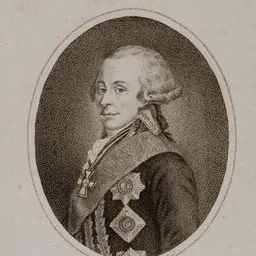
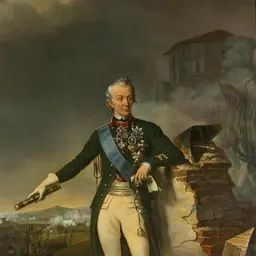
Named in this biography and alive at the same time





Related people
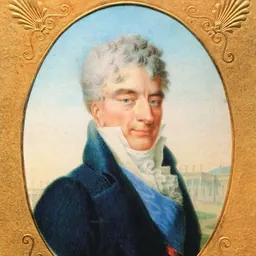
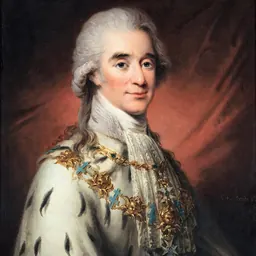
Same field, nearest in time


Contemporaries
People whose lives overlapped Nicholas Repnin's





Frequently asked questions
Who was Nicholas Repnin?
Russian statesman and general (1734–1801)
When was Nicholas Repnin born?
Nicholas Repnin was born on 22 March 1734 in Saint Petersburg.
When did Nicholas Repnin die?
Nicholas Repnin died on 24 May 1801 in Riga.
What was Nicholas Repnin's occupation?
Nicholas Repnin was a diplomat, politician, military officer, civil servant and general field marshal.
What nationality was Nicholas Repnin?
Nicholas Repnin was Russian.
Sources & further reading
· DBpedia: Nikolai Vasilyevich Repnin
Cite this page
APA: Biography.guide. (2026). Nicholas Repnin. https://biography.guide/nicholas-repnin/
MLA: "Nicholas Repnin." Biography.guide, https://biography.guide/nicholas-repnin/.
Chicago: "Nicholas Repnin." Biography.guide. https://biography.guide/nicholas-repnin/.
Data last updated: 2026-09-20 · Spot an error? Report a correction.
Page generated 2026-09-27 05:26 UTC