
About Christoph Martin Wieland
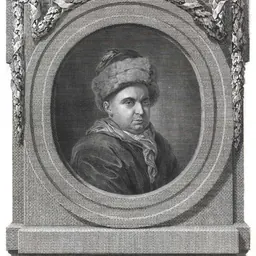
Lived 1733 – 1813 (aged 79). Christoph Martin Wieland was a poet, translator, writer, university teacher, poet lawyer and english–German translator.
Christoph Martin Wieland (; ; 5 September 1733 – 20 January 1813) was a German poet and writer, representative of literary Rococo. He is best-remembered for having written the first Bildungsroman (Geschichte des Agathon), as well as the epic Oberon, which formed the basis for both Friederike Sophie Seyler's opera of the same name and Carl Maria von Weber's opera of the same name. His thought was representative of the cosmopolitanism of the German Enlightenment, exemplified in his remark: "Only a true cosmopolitan can be a good citizen." He was a key figure of Weimar Classicism and a collaborator of Abel Seyler's theatre company.
Biography Christoph Martin Wieland was born in Oberholzheim (now part of Achstetten), half of which then belonged to the Free Imperial City of Biberach an der Riss and the other half to Gutenzell Abbey in the south-east of the modern-day state of Baden-Württemberg.
His father, who was pastor in Oberholzheim and subsequently in Biberach, took great pains with his son's education. From the town school of Biberach, he passed on at the age of twelve to the Kloster Berge gymnasium, near Magdeburg. He was a precocious child, and when he left school in 1749 was widely read in the Latin classics and the leading contemporary French writers; amongst German poets his favourites were Brockes and Klopstock.
During the summer of 1750, he fell in love with a cousin, Sophie Gutermann, and this love affair inspired him to plan his first ambitious work, Die Natur der Dinge (The Nature of Things, 1752), a didactic poem in six books. In 1750 he went to the University of Tübingen as a student of law, but his time was mainly taken up with literary studies. The poems he wrote at the university—Hermann, an epic (published by F. Muncker, 1886), Zwölf moralische Briefe in Versen (Twelve Moral Letters in Verse, 1752), Anti-Ovid (1752)—are pietistic in tone and dominated by the influence of Klopstock. and in the Comische Erzählungen (1765) he gave his extravagant imagination only too free a rein. With the poems Musarion oder die Philosophie der Grazien (1768), Idris (1768), Combabus (1770), Der neue Amadis (1771), Wieland opened the series of light and graceful romances in verse which appealed so irresistibly to his contemporaries and acted as an antidote to the sentimental excesses of the subsequent Sturm und Drang movement.
Wieland married Anna Dorothea von Hillenbrand (July 8, 1746 – November 9, 1801) on October 21, 1765. They had 14 children. Wieland's daughter Sophia Catharina Susanna Wieland (October 19, 1768 – September 1, 1837) married philosopher Karl Leonhard Reinhold (1757–1823) on May 18, 1785.
Between 1769 and 1772, Wieland was a professor of philosophy at the University of Erfurt.
In 1773, he founded Der teutsche Merkur, which under his editorship (1773–1789) became the most influential literary review in Germany. At least three of his works, Geschichte des Agathon, Der goldene Spiegel oder die Könige van Scheschian, and Beiträge zur geheimen Geschichte des menschlichen Verstandes und Herzens, found themselves on the official Bavarian Illuminati reading list. Wieland also explored the role of secret societies in Enlightenment thought in Das Geheimnis des Kosmopoliten-Ordens (1788). This work examines the political and philosophical implications of clandestine organizations, particularly their potential to form a "state within a state". A modern English edition, The Secret of the Order of Cosmopolitans, was published in 2025, making the text accessible to a wider audience.
He was also a librettist for the Seyler theatrical company of Abel Seyler. Of his later writings the most important are the admirable satire on German provinciality—the most attractive of all his prose writings—Die Abderiten, eine sehr wahrscheinliche Geschichte (A very probable history of the Abderites, 1774), (translated into French by Antoine Gilbert Griffet de Labaume) and the charming poetic romances, Das Wintermärchen (1776), Das Sommermärchen (1777), Geron der Adelige (1777), Pervonte oder die Wünsche (1778), a series culminating with Wieland's poetic masterpiece, the romantic epic of Oberon (1780).
Works Wieland was a prolific writer, publishing novels, poetry, plays, and philosophical treatises. His works contributed significantly to the literary and intellectual movements of the Enlightenment and Weimar Classicism.
Major works Der geprüfte Abraham (1753) Geschichte des Agathon (1766–1767) Don Sylvio von Rosalva (1764) Musarion oder die Philosophie der Grazien (1768) Der neue Amadis (1771) Die Abderiten, eine sehr wahrscheinliche Geschichte (1774) Oberon (1780) Dschinnistan (1786–1789) Das Geheimnis des Kosmopoliten-Ordens (1788) → The Secret of the Order of Cosmopolitans Aristipp und einige seiner Zeitgenossen (1800–1802)
Collected editions Wieland's complete works were widely republished in collected editions, some of which included critical annotations and commentary.
Sämtliche Werke Sämtliche Werke (1794–1802, 45 vols.) – Edited by Ludwig Wieland (1815) and H. Gessner (1815–1816) Later editions: 1818–1828, 53 vols. 1839–1840, 36 vols. 1853–1858, 36 vols. 1879–1882, 40 vols. (edited by H. Düntzer) Selected works published in Kürschner's Deutsche Nationalliteratur (vols. 51–56, 1883–1887), edited by Heinrich Pröhle Further selections by F. Muncker (6 vols., 1889) and W. Bolsche (4 vols., 1902)
Gesammelte Schriften Edited by Deutsche Kommission der Königlich Preußischen Akademie der Wissenschaften (1909–1975) Two sections: Abt. I: Werke Abt. II: Übersetzungen Later edited by the German Academy of Sciences at Berlin (1945), Akademie der Wissenschaften der DDR (1969), Hans Werner Seiffert, and others. Includes volumes with and without commentary. Some volumes remain missing from the edition.
Correspondence and critical editions Wielands Briefwechsel (20 volumes, 1963–2007) – Edited by the German Academy of Sciences at Berlin, later by Berlin-Brandenburgische Akademie der Wissenschaften Wielands Werke. Historisch-kritische Ausgabe (since 2008) – Edited by Klaus Manger and Jan Philipp Reemtsma, published in Berlin/New York.
Don’t just read it —
keep it.
Full-length biographies made to live with: read them, listen on the way to work, watch them tonight.
- E-book
- Audio
- Video
Instant download · yours to keep · every purchase keeps this site free
Important facts
People in Christoph Martin Wieland's life
Named in this biography and alive at the same time




Related people
Same field, nearest in time
Contemporaries
People whose lives overlapped Christoph Martin Wieland's





Frequently asked questions
Who was Christoph Martin Wieland?
German poet and writer (1733–1813)
When was Christoph Martin Wieland born?
Christoph Martin Wieland was born on 5 September 1733 in Biberach an der Riß, Oberholzheim.
When did Christoph Martin Wieland die?
Christoph Martin Wieland died on 20 January 1813 in Weimar.
What was Christoph Martin Wieland's occupation?
Christoph Martin Wieland was a poet, translator, writer, university teacher, poet lawyer and english–German translator.
What nationality was Christoph Martin Wieland?
Christoph Martin Wieland's recorded nationality: Biberach an der Riß.
Sources & further reading
· Wikipedia: Christoph Martin Wieland
· DBpedia: Christoph Martin Wieland
Cite this page
APA: Biography.guide. (2026). Christoph Martin Wieland. https://biography.guide/christoph-martin-wieland/
MLA: "Christoph Martin Wieland." Biography.guide, https://biography.guide/christoph-martin-wieland/.
Chicago: "Christoph Martin Wieland." Biography.guide. https://biography.guide/christoph-martin-wieland/.
Data last updated: 2026-09-20 · Spot an error? Report a correction.
Page generated 2026-09-27 05:25 UTC