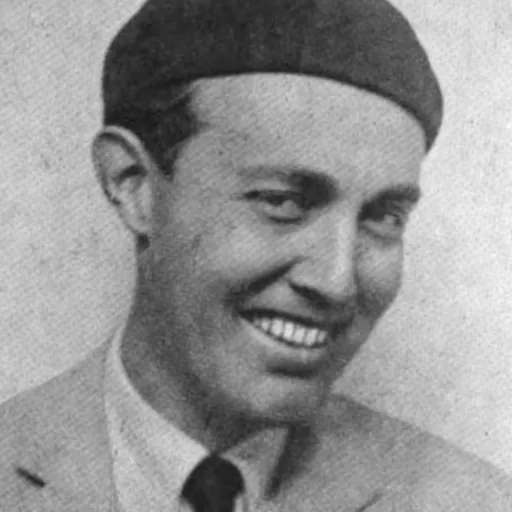
About Thayaht
Lived 1893 – 1959 (aged 65). Thayaht was an Italian designer, sculptor, painter, photographer and fashion designer.
Thayaht was the pseudonym of artist and designer Ernesto Michahelles (1893–1959) best known for his revolutionary design of the TuTa and his involvement with the Italian Futurist movement.
Early life A mixture of British, German, Swiss and American origins, Thayaht was born in Florence, Italy and was related to American artist Hiram Powers. He studied painting at the Académie Ranson in Paris, as well as scientific dyes and dynamic structure at Harvard University. He adopted the pseudonym "THAYAHT" around 1919; when written entirely in uppercase letters, it is a "bifrontal" palindrome, meaning it's visually symmetrical and can be read from right to left, left to right, and as its own reflection.
Biography Thayaht was a sculptor, painter, designer, goldsmith and inventor.
Michahelles, also known as Thayaht, was born in Florence on August 21, 1893, and spent his childhood and youth in the villa of his great grandfather, American neoclassical sculptor Hiram Powers, at the Poggio Imperiale. He began his studies in Florence, and continued his education at the Technical Institute, where he was encouraged in the artistic work.
He continued his education, joining the office of the painter Filippo Marfori Savini and the school of the American painter Julius Rolshoven, located in the Castello del Diavolo. He had already displayed his works under the pseudonym of "Cheak", deciding to dedicate himself to the art thoroughly. Due to a severe hepatic disease, the artist was forced to interrupt his research, until 1919, when he moved to Paris urged by Diaghilev and Massine. In this occasion, he initiated contacts for an occasional cooperation with the famous fashion house of Madeleine Vionnet, in Rue de Rivoli, for which he created the logo.
In 1920, Thayaht started designing his most famous piece. The TuTa, which Thayaht called "the most innovative, futuristic garment ever produced in the history of Italian fashion" was an early example of what we now know as coveralls, intended to revolutionize fashion and create a modern and particular Italian style. With help from his artist brother RAM, he launched the new design in 1920, and the pattern was published by the newspaper "La Nazione" so that the TuTa was accessible to all. Intended as a practical item of clothing for the everyday, it was instead adopted as a fad by high Florentine society. In the same year, he adopted his pseudonym, the palindrome "Tayat", later changing into "Thayaht". In this period, he cooperated with the Florentine Art Gallery Cavalensi and Botti and attended the gallery-bookshop of Errante Gonnelli, the core of the cultural and artistic avant-garde in Florence.
In 1921, following the success of his personal exhibition, he left for the United States where he spent a short time in Boston and Cambridge. He attended courses at Harvard University on the colour technique, dynamic symmetry and the numeric absolute. The following year, he reconfirmed his collaboration with The Atelier of Madame Vionnet, the couturière credited with introducing the bias-cut to Parisian fashion who offered the artist a contract as designer to assure the exclusive use of his creations. He started out by designing the logo for the Maison Vionnet and quickly became responsible for the graphic presentation of her new models, many published in the magazine "Gazzette du Bon Ton". Thayaht also developed numerous patterns for printing on fabric that Vionnet used for her dresses and designed some original models. This collaboration lasted until December 12, 1924.
In 1922, Thayaht helped the creation of "Corporazione delle Arti Decorative" in Florence, to promote the collaboration between artists and artisans, and the following year, participated in the "1st International Exposition of Decorative and Industrial Modern Arts" in Monza, with an array of furniture projected by himself and displayed along with Antonio Maraini's sculptures. Meanwhile, he purchased a house in Marina di Pietrasanta, naming it "Casa gialla".
In 1924-25, he participated with his brother RAM at the formation of the First Guild of Fine Arts of Florence, creating its own crest and they won the National Contest of Stage Design for the new staging of the "Aida".
In 1927, he participated in the "III Esposizione Internazionale delle Arti Decorative e Industriali Moderne" of Monza and, the following year, he was chosen by the "National Fascist Group of Straw", as designer for new models of hats for men and women.
From 1929, he published his projects on "Moda", official magazine for the "National Fascist Federation of Clothing Industry", and in the same year, he met Marinetti introduced by Primo Conti. In this occasion, Thayaht presented the steel-iron effigy of the "Dux" as a gift to Mussolini, officially joining the Futurist movement. In October of the same year, he joined the exhibition "Trentatré Futuristi", at the Galleria Pesaro in Milan, with three sculptures and fifteen paintings. He took part in the "1929 Barcelona International Exposition", winning the gold medal for his invention of taiattite – an alloy of silver and aluminium.
In 1930 he participated in the "IV Esposizione Triennale Internazionale delle Arti Decorative ed Industriali Moderne" in Monza, exposing furniture and items made of taiattite. Meanwhile, at the "XII Biennale Internazionale d'Arte" of Venice, he exhibited six sculptures in the futurist room. He also took part in the "Mostra Internazionale dell'Orafo" where he presented a showcase with jewelry in taiattite.
In 1931, he was invited to the "Ist Quadriennal of National Art in Rome", where he exposed his first aerosculpture, "Victory of the Air". Then, he organized along with Marasco, the "Futurist Exhibition of Painting, Sculpture, Aeropainting, Decorative Arts, Architecture" at the Art Gallery of Florence for the Tuscan Futurist group and joined the "First Aeropainting Exhibition" along with the likes of Balla, Ballelica, Benedetta, Diulgheroff, Dottori, Fillia, Prampolini, Somenzi and Tato, organized by the Gallery "La camerata degli Artisti" in Rome. On April 10 of that year, he replied on the newspaper of Genova "Indice" to an article of Ezra Pound about futurist sculpture, where the artist claimed that there is a chance to represent an object in a plane in three dimensions thanks to a new technique, described as "Traiettiva".
In 1932, he joined the exhibition "Enrico Prampolini et les Aeropeintres Futuristes Italiens" at the Galerie de la Renaissance in Paris. In May of 1932, he showed his sculpture "The Diving" at the "XVIII Biennale di Venezia". His first monography was published in Florence and presented by Marinetti, Antonio Maraini and Fortunato Bellonzi. At last, along with his brother RAM, he elaborated in 1932 the "Manifesto per la trasformazione dell’abbigliamento maschile".
In the following years, he participated in the "Biennale di Venezia" in 1934 and then in 1936.
Later life In the mid-1930s, Thayaht retired to Marina di Pietrasanta, where he concentrated on studying science and astronomy. After WWII, he founded the CIRNOS (independent station for the recording of space information) with the aim of recording and providing proof of UFOs.
Death Thayaht died in Marina di Pietrasanta (LU) on April 29, 1959, and was buried in the Cimitero Evangelico degli Allori in the southern suburb of Florence, Galluzzo (Italy).
Don’t just read it —
keep it.
Full-length biographies made to live with: read them, listen on the way to work, watch them tonight.
- E-book
- Audio
- Video
Instant download · yours to keep · every purchase keeps this site free
Important facts
People in Thayaht's life
Named in this biography and alive at the same time



Related people
Same field, nearest in time

Contemporaries
People whose lives overlapped Thayaht's


Frequently asked questions
Who was Thayaht?
Italian artist and designer (1893-1959)
When was Thayaht born?
Thayaht was born on 21 August 1893 in Florence.
When did Thayaht die?
Thayaht died on 29 April 1959 in Pietrasanta.
What was Thayaht's occupation?
Thayaht was a designer, sculptor, painter, photographer and fashion designer.
What nationality was Thayaht?
Thayaht was Italian.
Sources & further reading
Cite this page
APA: Biography.guide. (2026). Thayaht. https://biography.guide/thayaht/
MLA: "Thayaht." Biography.guide, https://biography.guide/thayaht/.
Chicago: "Thayaht." Biography.guide. https://biography.guide/thayaht/.
Data last updated: 2026-09-20 · Spot an error? Report a correction.
Portrait: Wikimedia Commons · author & licence
Page generated 2026-09-27 04:57 UTC