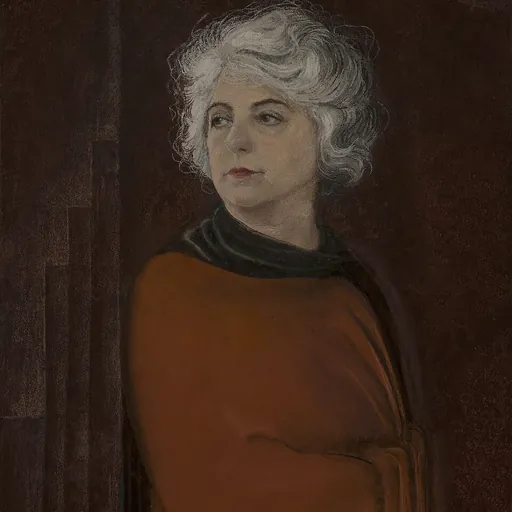
About Madeleine Vionnet
Lived 1876 – 1975 (aged 98). Madeleine Vionnet was a French businessperson, fashion designer and fashion Design.
Madeleine Vionnet (; June 22, 1876 – March 2, 1975) was a French fashion designer best known for being the "pioneer of the bias cut dress". Vionnet trained in London before returning to France to establish her first fashion house in Paris in 1912. Although it was forced to close in 1914 at the outbreak of the First World War, it re-opened after the war and Vionnet became one of the leading designers of 1920s-30s Paris. Vionnet was forced to close her house again in 1939 at the start of the Second World War and she retired in 1940. into a poor family in Chilleurs-aux-Bois, Loiret, Vionnet's parents separated when she was very young and she moved with her father, a toll collector, to Aubervilliers, Seine-Saint-Denis, at the age of five. Having already left school, Vionnet began her apprenticeship at age twelve as a seamstress alongside members of the garde champêtre. After a brief marriage at age 18 – and the loss of her young child – she left her husband and went to London to work as a hospital seamstress. While in London, Vionnet worked as a fitter for Kate Reily.
Vionnet eventually returned to Paris, working for six years in the fashion house Callot Soeurs as a toile maker. After a disagreement with a manager of the house, Vionnet threatened to leave her post. She was convinced to stay by the eldest of the Callot sisters, Marie Callot Gerber, after being offered a promotion that would mean improvising draped designs on a live model with Gerber herself. Her desire for simplicity was ultimately at odds with the characteristic lacy frills of the fashion house. Her use of barefoot models and design of loose robes clashed with the style of the house. In 1925, Vionnet's fashion house expanded with premises on Fifth Avenue in New York City. She sold designs purchased off the peg and adapted to the wearer. setting trends with her sensual gowns worn by such internationally known actresses as Marlene Dietrich, Katharine Hepburn, Joan Crawford and Greta Garbo. Vionnet was not concerned with being the "designer of the moment", preferring to remain true to her own vision of female beauty.
Styles and technique
The bias of a textile runs at 45 degrees to both the warp and weft threads. Alongside Coco Chanel, Vionnet is credited with a move away from stiff, formalised clothing to sleeker, softer clothes. Unlike Chanel, Vionnet had little appetite for self-promotion; her retirement in 1940 marginalised her contribution to the wider movement. Eschewing corsets, padding, stiffening, and anything that distorted the natural curves of a woman's body, she became known for clothes that accentuated the natural female form. Like Duncan, Vionnet was inspired by ancient Greek art, in which garments appear to float freely around the body rather than distort or mold its shape. Her style changed relatively little over her career, although it became a little more fitted in the 1930s.
Vionnet's use of the bias cut to create a sleek, flattering, body-skimming look revolutionized women's clothing and carried her to the top of the fashion world. Although sometimes credited with its invention, Vionnet claimed to have applied the technique, already used in skirts, trims, and embellishments, to full-body dresses. As an expert couturier, Vionnet knew that textiles cut on the bias could be draped to match the curves of a woman's body and express fluidity of motion. She used the cut to promote the potential for expression and motion, integrating comfort and movement as well as form into her designs.
Vionnet's apparently simple styles involved a lengthy preparation process, including cutting, draping, and pinning fabric designs on miniature dolls. She recreated full garments in chiffon, silk, or Moroccan crepe on life-size models. Vionnet used materials such as crêpe de chine, gabardine, and satin to make her clothes; fabrics that were unusual in women's fashion of the 1920s and 30s.
She ordered fabrics two yards wider than necessary to accommodate draping, creating clothes – particularly dresses – that were luxurious and sensual but also simple and modern. Characteristic Vionnet styles that clung to and moved with the wearer included the handkerchief dress, cowl neck, and halter top.
Influence on later designers Madeleine Vionnet is considered one of the most influential fashion designers of the 20th century. Both her bias cut and her urbanely sensual approach to couture remain a strong and pervasive influence on contemporary fashion, as evidenced by the collections of such past and present-day designers as Ossie Clark, Halston, John Galliano, Comme des Garçons, Azzedine Alaïa, Issey Miyake and Marchesa. Miyake once remarked that on seeing Vionnet's work for the first time, "the impression was similar to the wonder one feels at the sight of a woman emerging from bathing, draped only in a single piece of beautiful cloth."
Vionnet inspired fashion designers such as Marcelle Chaumont, mother of French author Madeleine Chapsal. She served as godmother to Chapsal.
Don’t just read it —
keep it.
Full-length biographies made to live with: read them, listen on the way to work, watch them tonight.
- E-book
- Audio
- Video
Instant download · yours to keep · every purchase keeps this site free
Important facts
People in Madeleine Vionnet's life
Named in this biography and alive at the same time








Related people
Same field, nearest in time

Contemporaries
People whose lives overlapped Madeleine Vionnet's
Frequently asked questions
Who was Madeleine Vionnet?
French fashion designer (1876–1975)
When was Madeleine Vionnet born?
Madeleine Vionnet was born on 22 June 1876 in Chilleurs-aux-Bois.
When did Madeleine Vionnet die?
Madeleine Vionnet died on 2 March 1975 in 16th arrondissement of Paris.
What was Madeleine Vionnet's occupation?
Madeleine Vionnet was a businessperson, fashion designer and fashion Design.
What nationality was Madeleine Vionnet?
Madeleine Vionnet was French.
Sources & further reading
· Wikipedia: Madeleine Vionnet
Cite this page
APA: Biography.guide. (2026). Madeleine Vionnet. https://biography.guide/madeleine-vionnet/
MLA: "Madeleine Vionnet." Biography.guide, https://biography.guide/madeleine-vionnet/.
Chicago: "Madeleine Vionnet." Biography.guide. https://biography.guide/madeleine-vionnet/.
Data last updated: 2026-09-23 · Spot an error? Report a correction.
Portrait: Wikimedia Commons · author & licence
Page generated 2026-09-27 05:06 UTC