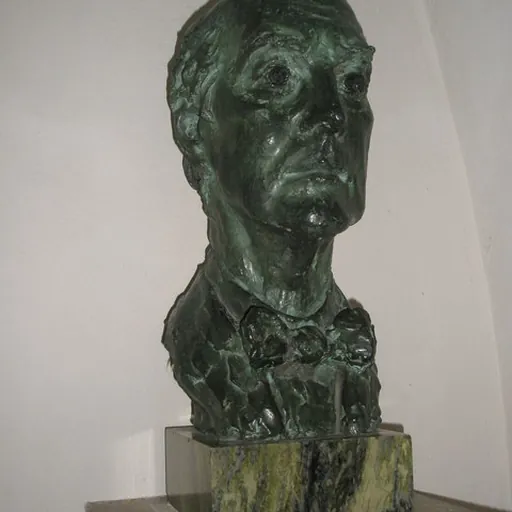
About Edward Maufe
Lived 1883 – 1974 (aged 91). Edward Maufe was a British designer and architect.
Sir Edward Brantwood Maufe, RA, FRIBA (12 December 1882 – 12 December 1974) was an English architect and designer. He built private homes as well as commercial and institutional buildings, and is remembered chiefly for his work on places of worship and memorials. Perhaps his best known buildings are Guildford Cathedral and the Air Forces Memorial. He was a recipient of the Royal Gold Medal for architecture in 1944 and, in 1954, received a knighthood for services to the Imperial War Graves Commission, with which he was associated from 1943 until his death.
Biography
Early life and career Maufe was born Edward Muff in Sunny Bank, Ilkley, Yorkshire, on 12 December 1882. He was the second of three children and the youngest son of Henry Muff and Maude Alice Muff Smithies. His older brother was Herbert Maufe, a geologist.
Henry Muff was a linen draper who was part owner of Brown Muff & Co a department store in Bradford, “the Harrods of the North”. Maude was the niece of Titus Salt, the founder of Saltaire. Maufe started his education at Wharfedale School in Ilkley, and later attended Bradford School.
During his adolescent years, Maufe became interested in architecture. In 1899 he was sent to London to serve a five-year apprenticeship under the direction of the architect William A. Pite, brother of Arthur Beresford Pite. Soon after, the Muff family moved from Yorkshire to Red House in Bexleyheath. The house was designed by Philip Webb for William Morris; Maufe later acknowledged the design as an early architectural influence. After completing his apprenticeship in 1904, Maufe attended St John's College, Oxford, where, in 1908, he received a B.A.; he also studied design at the Architectural Association School of Architecture. The following year Maufe, then aged 28, moved to 139 Old Church Street, Chelsea, London. On 1 October 1910, he married Prudence Stutchbury (1882–1976), the daughter of Edward Stutchbury of the Geological Survey of India. She was an interior designer and later a director of Heal's. They had a son who died in 1968. Maufe enlisted in the Royal Garrison Artillery on 9 January 1917, was commissioned as a staff lieutenant that April, and saw action in Salonika. He was discharged on 26 February 1919.
Architecture Maufe's first important commission after establishing his own practice was in 1912, the design of Kelling Hall, Norfolk, for Sir Henry Deterding. The building shows Maufe's early links with the arts and crafts movement due to its butterfly plan, knapped flint walls, and a grey tiled and gabled roof. Maufe's other pre-war work included the decoration of St Martin-in-the-Fields, the chapels and alterations at All Saints' Church, Southampton (destroyed in the Southampton Blitz in 1940), and restoration at St John's, Hackney, which first brought him into notice in church circles. In 1944, he was awarded the Royal Gold Medal for architecture.
From 1943, Maufe was principal architect UK to the Imperial War Graves Commission, eventually becoming chief architect and artistic adviser until 1969. Among his war memorial designs are those at Tower Hill which was an expansion to the already established memorial by Sir Edward Lutyens and the Air Forces Memorial at Cooper's Hill overlooking Runnymede (1950–53).
Retirement and death Maufe retired in 1964 to Shepherd's Hill, Buxted, East Sussex, which he had restored as his second home in the late 1920s. He died aged 92 on his birthday, 12 December 1974, in nearby Uckfield Hospital. His architectural drawings and correspondence were deposited at the RIBA upon his death. Chatham Naval Memorial, Chatham, Kent (1945) (extension only) Plymouth Naval Memorial, Plymouth, Devon (1945) (extension only) The RAF Shelter, Brookwood Cemetery, Surrey (1947) Dolphin Quad, St John's College, Oxford (1947) Dulwich Picture Gallery post-war restoration (1947–53) Commonwealth War Graves Commission cremation memorial, Golders Green Crematorium, London (1949) St Mary's Church, Hampden Park, Eastbourne (1952–54) Air Forces Memorial, Runnymede, Surrey (1953) The Tower Hill Memorial, London (1955) (extension only) The Master's House, Temple Church (c1955) (rebuilding following war-time bomb damage, work shared with Sir Hubert Worthington) St Columba's Church, London, Pont Street, London SW1 (1955) Crown Row Building, Inner Temple (1955) (rebuilding following wartime bomb damage) St Mary in the Park, Willingdon near Eastbourne (1956) Magna Carta Memorial, Runnymede, Surrey (1957) Francis Taylor Building, Inner Temple (1957) St Alphege's, Lower Edmonton, London (1958) The Chapel at Lewes Priory School Mountfield Road, Lewes (1960) Cathedral Church of St Peter, Bradford (1963) (extension) St Nicholas' Church, Saltdean (1964)
Don’t just read it —
keep it.
Full-length biographies made to live with: read them, listen on the way to work, watch them tonight.
- E-book
- Audio
- Video
Instant download · yours to keep · every purchase keeps this site free
Important facts
more
Sir Edward Brantwood Maufe, Sir Edward MaufePeople in Edward Maufe's life
Named in this biography and alive at the same time






Related people
Same field, nearest in time


Contemporaries
People whose lives overlapped Edward Maufe's



Frequently asked questions
Who was Edward Maufe?
English architect and designer (1883-1974)
When was Edward Maufe born?
Edward Maufe was born on 12 December 1883 in Ilkley.
When did Edward Maufe die?
Edward Maufe died on 12 December 1974 in Shepherd's Hill.
What was Edward Maufe's occupation?
Edward Maufe was a designer and architect.
What nationality was Edward Maufe?
Edward Maufe was British.
Sources & further reading
Cite this page
APA: Biography.guide. (2026). Edward Maufe. https://biography.guide/edward-maufe/
MLA: "Edward Maufe." Biography.guide, https://biography.guide/edward-maufe/.
Chicago: "Edward Maufe." Biography.guide. https://biography.guide/edward-maufe/.
Data last updated: 2026-09-22 · Spot an error? Report a correction.
Portrait: Wikimedia Commons · author & licence
Page generated 2026-09-27 05:03 UTC