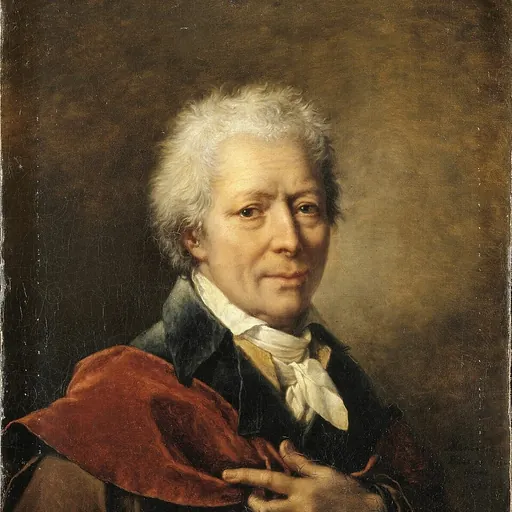
About Nicolas-André Monsiau
Lived 1754 – 1837 (aged 82–83). Nicolas-André Monsiau was a French painter and illustrator.
Nicolas-André Monsiau (1754 – 31 May 1837) was a French history painter and a refined draughtsman who turned to book illustration to supplement his income when the French Revolution disrupted patronage. His Poussiniste drawing style and coloring marked his conservative art in the age of Neoclassicism.
Background His training at the school of the Académie royale de peinture et de sculpture, Paris, was under the direction of Jean-François Pierre Peyron. An early patron, the marquis de Corberon, paid for a sojourn at Rome, where he studied at the French Academy in Rome from 1776. On his return to Paris, he was unable to exhibit in the annual Paris Salon, which were closed to all but those who had been received ("agréé") by the Académie or were members, under the Ancien Régime. Instead he found an outlet in the smaller Salon de la corréspondance, where in 1782 he showed a tenebrist Piquant effect of the light of a lamp.
Two years later he was received at the Académie with a historical subject, Alexander taming Bucephalus and was made a member 3 October 1787, his second attempt, on the strength of The Death of Agis. The influence of Jacques-Louis David, an acquaintance from Monsiau's days in Rome, is most vividly represented by Monsiau's Ulysses, after returning to his palace and slaying Penelope's suitors, orders the women to remove the corpses (1791 Salon), where the action is played out in a shallow frieze-like space defined by a colonnade parallel to the picture plane.
In his best-known painting, Zeuxis choosing among the most beautiful girls of Crotona, shown at the Salon of 1791, Monsiau illustrates an anecdote of the painter Zeuxis, recorded in Pliny's Natural History, that exemplifies an essential aspect of the Classical approach to artistic creation, in the artist's refining an ideal Art by selecting from among the lesser beauties of Nature.
Monsiau's great public commission was a commemoration of the occasion on 26 January 1802, at which Napoleon delivered an authoritarian constitution to the Cisalpine Republic at a convocation of notables (the consulta) at Lyon. François Gérard had turned down the commission, preferring to continue his series of individual portraits of the Bonapartes. Monsiau received the commission in 1806; the finished painting was exhibited at the Salon of 1808 and was installed at the Tuileries the following year.
Monsiau was among the first history painters to depict scenes from modern history that were not commemorations of battles. He showed Molière reading Tartuffe at the house of Ninon de Lenclos at the Salon of 1802. It was engraved by Jean-Louis Anselin. His painting of Louis XVI giving instructions to the sea captain-explorer La Pérouse before his attempted circumnavigation was exhibited at the Salon of 1817 and was purchased for the recently restored Louis XVIII.
His portrayal of a sensational episode in which an escaped lion from the Grand Ducal menagerie in Florence had dropped a child it had picked up, without harming it, was exhibited at the Salon of 1801 and is conserved in the Louvre.
Among his pupils was the portrait draughtsman Louis Letronne (1790–1842), whose pencil portrait of Ludwig van Beethoven is iconic.
Gallery
Don’t just read it —
keep it.
Full-length biographies made to live with: read them, listen on the way to work, watch them tonight.
- E-book
- Audio
- Video
Instant download · yours to keep · every purchase keeps this site free
Important facts
more
Nicolas-Andre Monsiau, Nicolas-Andre Monsiaux, Nicolas Andre Monsiaux, Monchault, Nicolas Monsiare, M. Monsiau, M^Tr^R. Monsiau, M. Moncicau, Monssiau, Monsiau, M. MousiauxPeople in Nicolas-André Monsiau's life
Named in this biography and alive at the same time



Related people
Same field, nearest in time



Contemporaries
People whose lives overlapped Nicolas-André Monsiau's




Frequently asked questions
Who was Nicolas-André Monsiau?
French artist and draughtsman (1754–1837)
When was Nicolas-André Monsiau born?
Nicolas-André Monsiau was born in 1754 in Paris.
When did Nicolas-André Monsiau die?
Nicolas-André Monsiau died on 31 May 1837 in Paris.
What was Nicolas-André Monsiau's occupation?
Nicolas-André Monsiau was a painter and illustrator.
What nationality was Nicolas-André Monsiau?
Nicolas-André Monsiau was French.
Sources & further reading
· Wikipedia: Nicolas-André Monsiau
· DBpedia: Nicolas-André Monsiau
Cite this page
APA: Biography.guide. (2026). Nicolas-André Monsiau. https://biography.guide/nicolas-andre-monsiau/
MLA: "Nicolas-André Monsiau." Biography.guide, https://biography.guide/nicolas-andre-monsiau/.
Chicago: "Nicolas-André Monsiau." Biography.guide. https://biography.guide/nicolas-andre-monsiau/.
Data last updated: 2026-09-22 · Spot an error? Report a correction.
Portrait: Wikimedia Commons · author & licence
Page generated 2026-09-27 05:01 UTC