
Jean-François Pierre Peyron
French painter (1744-1814) from Aix-en-Provence
About Jean-François Pierre Peyron
Lived 1744 – 1814 (aged 69). Jean-François Pierre Peyron was a French painter and printmaker.
Jean-François Pierre Peyron (15 December 1744 – 20 January 1814) was a French Neoclassical painter, printmaker, and art collector.
Biography Peyron was born on 15 December 1744 in Aix-en-Provence in Southern France to a wealthy family. He studied law until the death of his father in 1765, at which point Peyron enrolled in the (Drawing School) in Aix. There he learned from the history painter and etcher Michel-François Dandré-Bardon. In 1767, Peyron moved to Paris at the age of twenty-three where he entered the atelier of Rococo painter Louis Jean François Lagrenée.
He was one of the first to re-apply the Classic principles of composition, in the manner of Poussin, while the prevailing fashion was in favour of Rococo.
In 1773, the Académie royale de peinture announced that the theme for the next Grand Prix de Rome would be the death of Seneca as described by Tacitus, a favorite topic for French painters. Of the six artists approved to compete, first prize was awarded to Peyron for a now lost painting, but for which an engraving survives.
He spent the years between 1775 and 1782 in Rome, with the Academy of France in Rome. Relegation On his return to Paris, Peyron found that the career of his rival, Jacques-Louis David, had taken its rise and had completely eclipsed his own, relegating it to a minor role in the history of art – which became evident in the exhibitions at the Salon of Paris between 1785 and 1787. Following his fall from grace, Peyron was appointed inspector general of the Gobelins tapestry factory from 1786 to 1792.
David would later pay homage to Peyron at the time of his funeral, stating: "He had opened my eyes". Death Peyron died in Paris in 1814, aged 69.
List of works (partial)
The Death of Seneca (1773) – a now-lost painting that earned Peyron the Prix de Rome Athéniennes or Young Athenians Drawing Lots to be Sacrificed to the Minotaur (1778) – Wellington Museum, London Belisarius Receiving Hospitality from a Peasant Who Had Served under Him (1779) – Musée de Augustins, Toulouse Hagar and the Angel (1779) – private collection, Paris Cornelia, Mother of the Gracchi (1781) – National Gallery, London The Funeral of Miltiades (1782) – The Louvre, Paris The Resurrection of Christ (1784) – Church of Saint-Louis-en-l'Île, Paris Socrate arrachant Alcibiade des bras de la Volupté (1785) – , Guéret The Death of Alcestis (1785) – The Louvre, Paris The Death of Socrates (1786 or 1787) – National Gallery of Denmark, Copenhagen Manius Curius Dentatus Refusing the Samnite Ambassadors (1787) – Musée des Beaux-Arts, Marseille The Death of Socrates (1788) – Joslyn Art Museum, Omaha Ulysse et Nausicaa (1791) – Staatliches Museum Schwerin, Schwerin Time and Minerva (1799) – Ministère des Armées, Paris King Perseus of Macedon in front of Aemilius Paulus (1802) – Museum of Fine Arts, Budapest Paul-Émile, conqueror of Perseus, last king of the Macedonians (1804) – Exhibited at the Salon of 1804, then later deposited at the Museum of Fine Arts in Caen before being destroyed during World War II. A painted sketch from 1802 can still be found in Budapest. The Death of General Valhubert (1808) – Musée de l'Histoire de France, Palace of Versailles The School of Pythagoras (1812) – Exhibited at the Salon of 1812, now lost L'Entretien de Démocrite avec Hippocrate (1812) – Exhibited at the Salon of 1812, now lost Sainte Madeleine méditant – Musée Granet, Aix-en-Provence Gallery
Don’t just read it —
keep it.
Full-length biographies made to live with: read them, listen on the way to work, watch them tonight.
- E-book
- Audio
- Video
Instant download · yours to keep · every purchase keeps this site free
Important facts
People in Jean-François Pierre Peyron's life
Named in this biography and alive at the same time
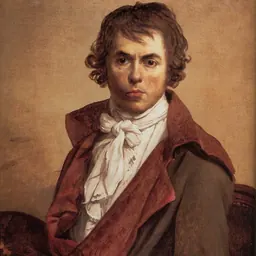

Related people
Same field, nearest in time



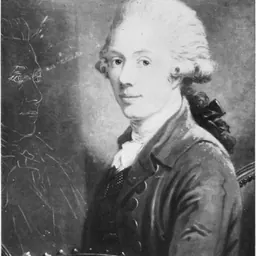

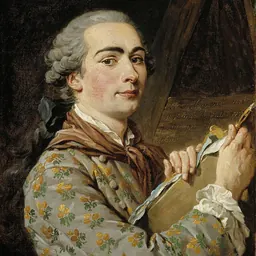
Contemporaries
People whose lives overlapped Jean-François Pierre Peyron's
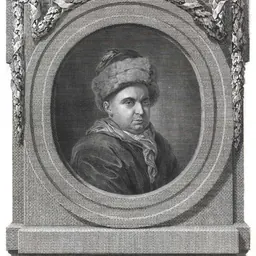




Frequently asked questions
Who was Jean-François Pierre Peyron?
French painter (1744-1814) from Aix-en-Provence (1744–1814)
When was Jean-François Pierre Peyron born?
Jean-François Pierre Peyron was born on 15 December 1744 in Aix-en-Provence.
When did Jean-François Pierre Peyron die?
Jean-François Pierre Peyron died on 20 January 1814 in Paris.
What was Jean-François Pierre Peyron's occupation?
Jean-François Pierre Peyron was a painter and printmaker.
What nationality was Jean-François Pierre Peyron?
Jean-François Pierre Peyron was French.
Sources & further reading
· Wikipedia: Jean-François Pierre Peyron
· DBpedia: Jean-François Pierre Peyron
Cite this page
APA: Biography.guide. (2026). Jean-François Pierre Peyron. https://biography.guide/jean-francois-pierre-peyron/
MLA: "Jean-François Pierre Peyron." Biography.guide, https://biography.guide/jean-francois-pierre-peyron/.
Chicago: "Jean-François Pierre Peyron." Biography.guide. https://biography.guide/jean-francois-pierre-peyron/.
Data last updated: 2026-09-20 · Spot an error? Report a correction.
Page generated 2026-09-27 05:18 UTC