
About François Gérard
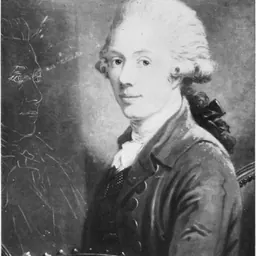
Lived 1770 – 1837 (aged 66). François Gérard was a French painter, politician, teacher, portraitist, illustrator and visual artist.
François Pascal Simon Gérard (, 4 May 1770 – 11 January 1837), titled as Baron Gérard in 1809, was a French painter. He was born in Rome, where his father occupied a post in the house of the French ambassador, and his mother was Italian.
A student of Jacques-Louis David, Gérard became one of the leading painters of the First French Empire (1804–1815) and the Bourbon Restoration (1815–1830). Court painter to Emperor Napoleon and later First Painter to Kings Louis XVIII and Charles X, Gérard enjoyed great renown across Europe. Nicknamed “the painter of kings, the king of painters”, he was the portraitist of choice for many European royal families. His salon was one of the most celebrated of its time and welcomed the some of the era’s most eminent figures.
After he was made a baron of the Empire in 1809 by Emperor Napoleon, he was known formally as Baron Gérard.
Life and career
François Gérard was born in Rome to J. S. Gérard and Cleria Matteï. At the age of twelve, Gérard obtained admission into the Pension du Roi in Paris. From the Pension, he passed to the studio of the sculptor Augustin Pajou, which he left at the end of two years for the studio of the history painter Nicolas-Guy Brenet, whom he quit almost immediately to place himself under Jacques-Louis David.
In 1789, he competed for the Prix de Rome, which was carried off by his comrade Girodet. The following year (1790), he once more showed up, but the passing of his father prevented him from finishing his work and forced him to travel to Rome with his mother. He eventually made it back to Paris in 1791, but due to his extreme poverty, he was forced to abandon his studies in favor of a job that would pay him money right away. David at once availed himself of his help, and one of that master's most celebrated portraits, of Louis-Michel Le Pelletier de Saint-Fargeau, may owe much to the hand of Gérard. This painting was executed early in 1793, the year in which Gérard, at the request of David, was named a member of the revolutionary tribunal, from the fatal decisions of which he, however, invariably absented himself.
In 1794, he obtained the first prize in a competition, the subject of which was The Tenth of August, that is, the storming of the Tuileries Palace on that date in 1792. Further stimulated by the successes of his rival and friend Girodet in the Salons of 1793 and 1794, Gérard (aided by Jean-Baptiste Isabey, the miniaturist) produced in 1795 his famous Bélisaire. In 1796, a portrait of his generous friend (conserved today in the Louvre) obtained undisputed success, and the money received from Isabey for these two works enabled Gérard to execute in 1797 his Psyche et l'Amour (illustration). At last, in 1799, his portrait of Madame Mère established his position as one of the foremost portrait-painters of the day.
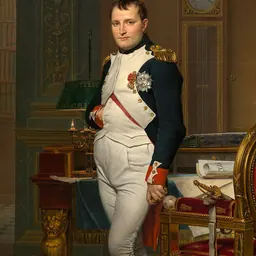
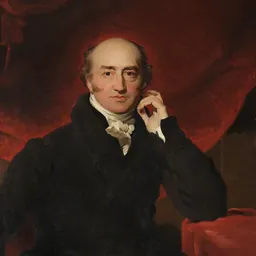
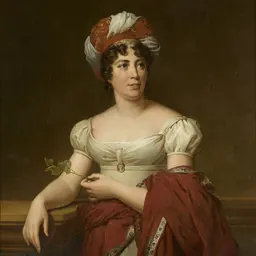
At the Salon of 1808, eight (and at the Salon of 1810, fourteen) portraits by him were exhibited, indicating the numbers he executed yearly. Figures of the Empire and of the Bourbon Restoration, as well as men and women of Europe, sat for Gérard. This was due in part to his manner and conversation, as his salon was frequented alongside his studio. Madame Germaine de Staël, George Canning, Charles de Talleyrand, and the Duke of Wellington have written about his society.
Rich and famous, Gérard was stung by remorse for earlier ambitions abandoned; at intervals, he had indeed striven with Girodet and other rivals to prove his strength at history painting, still a more prestigious genre than portraiture. His Bataille d'Austerlitz (1810) showed a breadth of invention and style which was even more conspicuous in L'Entrée d'Henri IV à Paris (at Versailles), the work with which in 1817 he paid homage to the returned Louis XVIII. After this date, Gérard declined, watching with impotent grief the progress of the Romantic school.
Loaded with honors – baron of the Empire in 1809, member of the Institut on 7 March 1812, officer of the Légion d'honneur, first painter to the king – he worked on, sad and discouraged. He painted several works to celebrate the Coronation of Charles X in 1825. In 1830 he was commissioned by Charles to produce a large history painting of his son Duke of Angoulême bidding farewell to the French Army expedition departing Toulon for the Conquest of Algeria. This was never executed as it was rapidly overtaken by the events of the July Revolution that brought down Charles and the Bourbon Dynasty.
The revolution of 1830 added to his disquiet, and on 11 January 1837, after three days of fever, he died. gérard is best remembered for his portraits. The color of his paintings has suffered, but his drawings show in uninjured delicacy the purity of his line, and those of women are specially remarkable for a virginal simplicity and frankness of expression. His students included Heinrich Christoph Kolbe.
Selected works
Don’t just read it —
keep it.
Full-length biographies made to live with: read them, listen on the way to work, watch them tonight.
- E-book
- Audio
- Video
Instant download · yours to keep · every purchase keeps this site free
Important facts
more
Francois, Baron Francis Gerard, Francis, Baron Francois Pascal Simon Gerard, Francois Pascal Simon Gerard, Baron François Gérard, François, François-Pascal-Simon, Baron Francois-Pascal-Simon Gerard, François-Pascal-Simon Gérard Baron, François Pascal Simon Gérard Baron, Gerard, f.pPeople in François Gérard's life
Named in this biography and alive at the same time





Related people
Same field, nearest in time



Contemporaries
People whose lives overlapped François Gérard's





Frequently asked questions
Who was François Gérard?
French painter (1770–1837)
When was François Gérard born?
François Gérard was born on 4 May 1770 in Rome.
When did François Gérard die?
François Gérard died on 11 January 1837 in Paris.
What was François Gérard's occupation?
François Gérard was a painter, politician, teacher, portraitist, illustrator and visual artist.
What nationality was François Gérard?
François Gérard was French.
Sources & further reading
Cite this page
APA: Biography.guide. (2026). François Gérard. https://biography.guide/francois-gerard/
MLA: "François Gérard." Biography.guide, https://biography.guide/francois-gerard/.
Chicago: "François Gérard." Biography.guide. https://biography.guide/francois-gerard/.
Data last updated: 2026-09-20 · Spot an error? Report a correction.
Page generated 2026-09-27 05:29 UTC