
About Li Qi
Lived 871 – 930 (aged 58–59). Li Qi was a poet and politician.
Li Qi (; 871 – October 26, 930? ), courtesy name Taixiu (台秀), was an official of the Chinese Tang dynasty and its successor states Later Liang and Later Tang of the Five Dynasties and Ten Kingdoms period, serving as a chancellor during Later Liang.
Background and service during the Tang dynasty Li Qi was born in 871, during the reign of Emperor Yizong of Tang. His ancestors had been Tang dynasty officials for generations, and his fifth-generation ancestor Li Cheng (李憕) was particularly well known for his faithfulness to Tang during the An-Shi Rebellion, during the early stage of which he served as the defender of the eastern capital Luoyang and was killed by An Lushan for refusing to surrender, after An captured the city. Li Qi's father Li Hu (李縠) served as a secretary to Wang Duo, who was the overall commander of Tang forces against the great rebellion led by Huang Chao during the reign of Emperor Yizong's son Emperor Xizong. However, due to Li's talent, Zhu listened to him more than did Xiao. It was said that Emperor Zhuangzong had heard of Li Qi's fame before and wanted to give him important offices. Emperor Zhuangzong much approved of Li's suggestions, but the suggestions were not actually implemented.
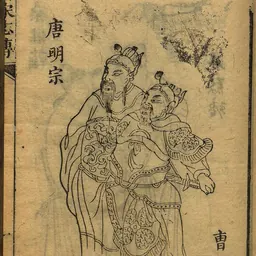
During Emperor Mingzong's reign Emperor Zhuangzong's adoptive brother Li Siyuan, the leader of another major mutiny, soon arrived at Luoyang and took over control of the city, initially with the title of regent. He was preparing to take the throne himself, when a question arose as to what he would be claiming to be the emperor of. His associates Li Shaozhen and Kong Xun, believing that Tang's Mandate of Heaven had ended, advocated that he change the name of the state. Li Siyuan himself, however, felt that his life and career were so connected to Emperor Zhuangzong, his grandfather Li Guochang, and father Li Keyong, such that he could not just become disconnected with them. Li Qi pointed out, if the name of the state was changed, then Li Siyuan would effectively be turning his back on three generation of lords that he served after, and that given his status as an adoptive son, he could take the throne under the Tang name and use the ceremony of an enthroned heir. Li Siyuan agreed, and subsequently took the throne as Emperor Mingzong. )
By spring 927, after Doulu Ge and Wei Yue were removed from chancellor positions, there were discussions at court as to who would replace them. By this point, An had come to trust Kong greatly, and at Kong's suggestion, An first recommended Zheng Jue, who was made chancellor, and then recommended Cui Xie. Ren, however, favored Li, but because Zheng disliked Li, Kong became against Li, stating to An, "Li Qi is well-versed in literature, but is corrupt. A chancellor should be upright and tolerant, so that he could be a leader to the officials." At a subsequent discussion before Emperor Mingzong, An and Ren got into a heated argument over the merits of Cui and Li. Eventually, Emperor Mingzong commissioned Cui and Feng Dao as chancellors, bypassing Li. Li Qi, as the highest-ranked official then at Luoyang, led a group of officials to welcome him. Apparently to praise Emperor Mingzong and the general Wang Yanqiu, who had just defeated the rebellious Wang Du and Wang Du's allied Khitan troops, the military governor (Jiedushi) of Yiwu Circuit (義武, headquartered at Ding Prefecture (定州), in modern Baoding, Hebei), Li, in his submission to Emperor Mingzong, wrote the sentence, "the violent gang of Khitan has been defeated, and the rebellious city of Zhending [(真定)] has fallen," and in doing so confused Zhending — the capital of Yiwu's neighboring circuit Chengde (成德, headquartered in modern Shijiazhuang, Hebei) — with Ding Prefecture. When this was pointed out, Li was punished with having one month of salary withheld from him. Also, when the general Huo Yanwei (i.e., Li Shaozhen, who changed his name from the Emperor Zhuangzong-bestowed imperial clan name back to his birth name) died, Li was put in charge of drafting the tomb monument text. As both Li and Huo served Later Liang, Li described Huo's career during Later Liang as if it were under Later Tang, despite that Later Tang officially viewed Later Liang as an illegitimate regime. The chancellors rebuked him and had Emperor Mingzong issue an order for revision.
It was said that Li Qi, while learned and talented, did not have restraint over his behavior and was overly aggressive in the government despite his actually knowing that doing so was risky, because he lacked an ability to calm himself. He was eventually ordered into retirement with the title of Taizi Taifu (太子太傅) — senior advisor to the Crown Prince, but an entirely honorary position since there was no crown prince at the time. He died in 930, at his mansion at Fushan Block (福善里) in Luoyang. Before his death, he compiled a 10-volume collection of edicts that he had written, and published it with the title of Collection of the Golden Door (金門集), and it was said that the work was popular among the people.
Don’t just read it —
keep it.
Full-length biographies made to live with: read them, listen on the way to work, watch them tonight.
- E-book
- Audio
- Video
Instant download · yours to keep · every purchase keeps this site free
Important facts
People in Li Qi's life
Named in this biography and alive at the same time





Related people
Same field, nearest in time




Contemporaries
People whose lives overlapped Li Qi's


Frequently asked questions
Who was Li Qi?
Chinese writer and politician
When was Li Qi born?
Li Qi was born in 871.
When did Li Qi die?
Li Qi died in 930.
What was Li Qi's occupation?
Li Qi was a poet and politician.
What nationality was Li Qi?
Li Qi's recorded nationality: Later Tang.
Sources & further reading
· DBpedia: Li Qi (Five Dynasties)
Cite this page
APA: Biography.guide. (2026). Li Qi. https://biography.guide/li-qi-poet/
MLA: "Li Qi." Biography.guide, https://biography.guide/li-qi-poet/.
Chicago: "Li Qi." Biography.guide. https://biography.guide/li-qi-poet/.
Data last updated: 2026-09-20 · Spot an error? Report a correction.
Page generated 2026-09-27 05:06 UTC