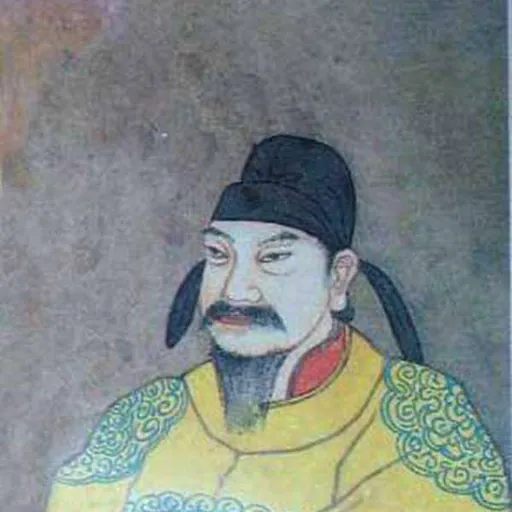
About Emperor Yizong of Tang
Lived 833 – 873 (aged 39). Emperor Yizong of Tang was a Chinese poet.
Emperor Yizong of Tang (December 28, 833 – August 15, 873), né Li Wen, later changed to Li Cui , was an emperor of the Tang dynasty of China. He reigned from 859 to 873. Emperor Yizong was the eldest son of Emperor Xuanzong. After Emperor Xuanzong's death in 859, Emperor Yizong was placed on the throne by the eunuch Wang Zongshi , who killed other eunuchs supporting another son of Emperor Xuanzong, Li Zi the Prince of Kui.
According to traditional historians, Emperor Yizong did not pay much attention to governmental affairs but instead chose to live in opulence, became an alcoholic and surrounded himself with women while his government levied heavy taxes on its citizens. A deeply devout Buddhist, even more so than his father, he would hold grand Buddhist ceremonies throughout the year as well as ordering frequent musical performances in the palace. If the entertainment was to his liking, Yizong would not only reward the entertainers greatly but also bestow governmental ranks. Emperor Yizong eventually exhausted the empire's treasury that had accumulated during his father's administration. Extreme hardships, including famines that forced people to resort to cannibalism, led to widespread agrarian rebellions late in his reign. Those rebellions would plague the reign of his son Emperor Xizong.
Background Li Wen was born around the new year 834, during the reign of his cousin Emperor Wenzong. His father Li Yi was then the Prince of Guang, and Li Wen was born at Li Yi's mansion. He was Li Yi's first son. His mother was Li Yi's concubine Lady Chao. Li Wen's mother Lady Chao was created the imperial consort rank of Meiren , which was only the 15th highest rank for imperial consorts (and there could be as many as nine Meiren at any single point). She died sometime in the middle of Emperor Xuanzong's Dazhong era (847–860), and was posthumously created the higher rank of Zhaorong ,
Late in Emperor Xuanzong's reign, he came to favor certain alchemists who promised immortality, and he took pills that they made. It was said that as a result, he became paranoid and easily angered. By 859, as a side effect of those pills, he had a large ulcerous boil on his back, such that he was bedridden and could not meet with the chancellors or other officials. He entrusted Li Zi to three high-level eunuchs that he favored—the directors of palace communications (Shumishi) Wang Guizhang and Ma Gongru and the director of the southern court affairs (宣徽南院使, Xuanhui Nanyuanshi) Wang Jufang . After Emperor Xuanzong died, Wang Guizhang, Ma, and Wang Jufang did not initially announce his death, and were set to send one of the eunuch commanders of the Shence Armies , Wang Zongshi , who was not on good terms with them, out of Chang'an to Huai'nan Circuit (淮南, headquartered in modern Yangzhou, Jiangsu) to serve as the eunuch monitor for Huai'nan. Wang Zongshi, however, reacted by intruding into the palace; finding that Emperor Xuanzong had already died, he arrested Wang Guizhang, Ma, and Wang Jufang for falsely issuing edicts, and then put them to death. He welcomed Li Wen to the palace, and then issued an edict in Emperor Xuanzong's name creating Li Wen crown prince and changing his name to Li Cui. The next day, Emperor Xuanzong's death was announced, and Li Cui became emperor (as Emperor Yizong).
Yet more disastrous, though, was a mutiny by soldiers for Xusi Circuit (徐泗, headquartered in modern Xuzhou, Jiangsu), who had been posted to Gui Prefecture (桂州, in modern Guilin, Guangxi) to defend against a potential Dali attack, with a promise that they would be allowed to return home after three years. When the term was up in 868, however, the governor of Xusi Circuit, Cui Yanzeng , ordered that the term be extended one year, causing the Xusi soldiers to mutiny under the leadership of Pang Xun. They headed northeast home, and when they reached Xusi's capital Xu Prefecture , they attacked and captured it. After Pang's initial attempts to obtain an imperial commission was rebuffed, the mutineer army attacked the nearby regions, with the imperial forces unable to stop them. Not until Kang Chengxun, with major assistance from the Shatuo chieftain Zhuye Chixin (who was bestowed the imperial surname of Li, as well as a new name of Guochang because of his contributions), was able to defeat Pang in 869 was the rebellion suppressed. (Subsequently, though, Kang, due to the false accusations of the chancellor Lu Yan and the imperial scholar Wei Baoheng (the husband of Emperor Yizong's favorite daughter Princess Tongchang), was exiled.)
Late reign A gold and silver staff gifted to Famen Temple in 873. The rod is 196.5 cm long, and weighs 2390 grams.
Meanwhile, late in 869, Li Shiwang provoked Dali by killing its emissary Yang Qiuqing . Dali's emperor Qiulong thus launched a major attack on Dingbian, and neither Li nor his successor Dou Pang was able to repel it. The Dali forces quickly arrived at Chengdu's vicinity and put Chengdu under siege. Emperor Yizong commissioned Gao Pian as Xichuan's military governor, and Dali forces thereafter withdrew, but both Dingbian (which was then merged back into Xichuan) and Xichuan had been deeply wounded.
Princess Tongchang died in 870, and this caused a major display of Emperor Yizong's caprice at the capital Chang'an, as Emperor Yizong, in anger that the imperial physicians were not able to cure her, executed some 20 imperial physicians and had some 300 of their relatives imprisoned. When the chancellor Liu Zhan and the mayor of Jingzhao Municipality (京兆, i.e., the Chang'an region) Wen Zhang tried to intercede, both were exiled; in response, Wen committed suicide. Princess Tongchang was buried in a grand ceremony that demonstrated Emperor Yizong's wastefulness. As described in the Zizhi Tongjian:
Despite Princess Tongchang's death, Emperor Yizong continued to remain close to Wei Baoheng, who became extremely powerful and corrupt late in Emperor Yizong's reign. Emperor Yizong also reacted in anger whenever Consort Guo's family was accused of misconduct.
In 873, in a grand ceremony, Emperor Yizong welcomed what was claimed to be a relic (a finger bone) of Gautama Buddha to the palace, despite warnings by some that his grandfather Emperor Xianzong died shortly after also welcoming the same relic to the palace. (Emperor Yizong responded to the warnings by stating, "As long as I can see it once while living, I do not have regrets about dying.") The ceremony was said to bring out great offerings by the households of Chang'an. Emperor Yizong himself walked toward the relic and bowed on the ground in tears.
Later in the year, Emperor Yizong became critically ill. With his not having designated an heir, the eunuchs Liu Xingshen and Han Wenyue supported his 11-year-old son Li Yan the Prince of Pu as his heir. Liu and Han had an edict issued in Emperor Yizong's name creating Li Yan crown prince. Emperor Yizong died the next day, and Li Yan took the throne (as Emperor Xizong).
Chancellors during reign
Family Empress Hui'an, of the Wang clan (; d. 866) Li Xuan, Xizong (; 862–888), 5th son Empress Gongxian, of the Wang clan (/恭宪皇后; d. 867) Li Ye, Zhaozong (; 867–904), 7th son Li Yi, Crown Prince Gong'ai (恭哀皇太子 李倚; d. 897), 8th son Noble Consort, of the Yang clan of Hongnong (貴妃 弘農楊氏/贵妃 弘弄杨氏, 833 – 17 May 865) Pure Consort, of the Guo clan Princess Weiwenyi (/卫文懿公主; 849–870), 1st daughter Married Wei Baoheng of Jingzhao (; d. 873) in 869 Virtuous Consort, of the Wang clan (; 844–870) Princess Changning (/昌宁公主), 5th daughter Two sons: Qilang (七郎), Balang (八郎) Jieyu, of the Cui clan (婕妤 崔氏) Jieyu, of the Wang clan (婕妤 王氏) Lady, of the Lei clan Li Ting, Prince of Liang (; d. 878), 2nd son Unknown Li Yi, Prince of Wei (; d. 879), 1st son Li Ji, Prince of Shu (; killed 873), 3rd son Li Kan, Prince of Wei (; 861-893), 4th son Li Bao, Prince of Ji (; executed 897?), 6th son Princess Anhua , 2nd daughter Princess Pukang (; 861–866), 3rd daughter Princess Changyuan Princess Jinhua (/金华公主) Princess Renshou (/仁寿公主) Princess Yongshou (/永寿公主) Princess Suining (/遂宁公主), 11th daughter
Don’t just read it —
keep it.
Full-length biographies made to live with: read them, listen on the way to work, watch them tonight.
- E-book
- Audio
- Video
Instant download · yours to keep · every purchase keeps this site free
Important facts
more
Li Cui(Yizonghuangdi), Yi ZongFamily & relationships
People in Emperor Yizong of Tang's life
Named in this biography and alive at the same time





Related people
Same field, nearest in time

Contemporaries
People whose lives overlapped Emperor Yizong of Tang's

Frequently asked questions
Who was Emperor Yizong of Tang?
emperor of the Tang Dynasty
When was Emperor Yizong of Tang born?
Emperor Yizong of Tang was born on 28 December 833 in Chang'an.
When did Emperor Yizong of Tang die?
Emperor Yizong of Tang died on 15 August 873 in Chang'an.
What was Emperor Yizong of Tang's occupation?
Emperor Yizong of Tang was a poet.
What nationality was Emperor Yizong of Tang?
Emperor Yizong of Tang was Chinese.
Sources & further reading
· Wikipedia: Emperor Yizong of Tang
· DBpedia: Emperor Yizong of Tang
Cite this page
APA: Biography.guide. (2026). Emperor Yizong of Tang. https://biography.guide/emperor-yizong-of-tang/
MLA: "Emperor Yizong of Tang." Biography.guide, https://biography.guide/emperor-yizong-of-tang/.
Chicago: "Emperor Yizong of Tang." Biography.guide. https://biography.guide/emperor-yizong-of-tang/.
Data last updated: 2026-10-02 · Spot an error? Report a correction.
Portrait: Wikimedia Commons · author & licence
Page generated 2026-10-04 14:17 UTC