
About Ono no Komachi
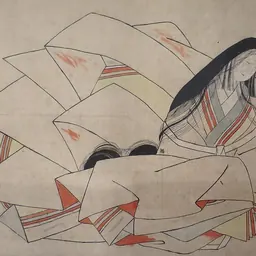
Lived 825 – 900. Ono no Komachi was a Japanese poet and writer.
was a Japanese waka poet, one of the Rokkasen—the six best waka poets of the early Heian period. She was renowned for her unusual beauty, and Komachi is today a synonym for feminine beauty in Japan. She also counts among the Thirty-six Poetry Immortals.
Life Almost nothing of Komachi's life is known for certain, save for the names of various men with whom she engaged in romantic affairs and whose poetry exchanges with her are preserved in the Kokin Wakashū. She was probably born between 820 and 830, and she was most active in composing poetry around the middle of the ninth century. It has been conjectured that she was a in the service of Emperor Ninmyō, and when the latter died in 850 she started relationships with other men.
According to one tradition, she was born in what is now Akita Prefecture, daughter of Yoshisada, Lord of Dewa. The Noh play Sotoba Komachi by Kan'ami describes her as "the daughter of Ono no Yoshizane, the governor of Dewa". Her social status is also uncertain. She may have been a low-ranking consort or a lady-in-waiting of an emperor.
The headnote to poem #938 in the Kokinshū implies she had some sort of connection to Fun'ya no Yasuhide.
Legends had developed as early as the eleventh century. They were later used extensively by the writers of Noh plays.
Stories abound of Komachi in love. One of the legends about her is that she was a lover of Ariwara no Narihira, her contemporary poet and also a member of the Rokkasen. It has been speculated that this legend may derive from the perhaps-accidental placement of one her poems next to one of Narihira's. She gives five groupings:
Poetry Almost all of Komachi's extant poems are melancholic.
The poem was originally included in the Kokinshū as #133, in the section dedicated to seasonal (spring ) poetry. The poem is filled with many layers of significance, with almost every word carrying more than one meaning. It was the subject of a short essay appended to Peter McMillan's translation of the Ogura Hyakunin Isshu.
In his Seeds in the Heart, translator, critic and literary historian Donald Keene said that " he intensity of emotion expressed in poetry not only was without precedent but would rarely be encountered in later years. Komachi's poetry, however extravagant in expression, always seems sincere."
Legacy The many legends about her have made her the best-known of the Rokkasen in modern times. Until relatively recently, when the title "Miss XYZ" became common in Japan, the woman considered most beautiful in such-and-such town or region would be dubbed "XYZ Komachi". She and her contemporary Ariwara no Narihira are considered archetypes of female and male beauty, respectively, and both feature heavily in later literary works, particularly Noh plays.
Komachi features frequently in later-period literature, including five Noh plays: Sotoba Komachi, Sekidera Komachi, Ōmu Komachi, Sōshi Arai Komachi and Kayoi Komachi. These works tend to focus on her talent for waka and her love affairs and the vanity of a life spent indulging in romantic liaisons. Komachi's old age is also frequently portrayed: when she has lost her beauty, has been abandoned by her former lovers, and now regrets her life, wandering around as a lonely beggar woman — albeit still appreciated by young admirers of her poetry.
Mishima Yukio reworked Sotoba Komachi for the modern theater, publishing his version in January 1952. It was first performed the following month. The basic plot (the age-worn former beauty encounters a young poet and relates some of her life's story, which causes him to fall in love with her, with fatal results) is retained, but the action takes place in a public park, with flashbacks to the salons and ballrooms of Meiji-era Japan. An English translation by Donald Keene was published in 1967.
The play Three Poets by playwright Romulus Linney includes a one act story about Komachi the poet.
In her honor, the Akita Shinkansen is named Komachi. A variety of rice, Akita Komachi, also bears her name.
Gallery
Don’t just read it —
keep it.
Full-length biographies made to live with: read them, listen on the way to work, watch them tonight.
- E-book
- Audio
- Video
Instant download · yours to keep · every purchase keeps this site free
Important facts
People in Ono no Komachi's life
Named in this biography and alive at the same time

Related people
Same field, nearest in time





Contemporaries
People whose lives overlapped Ono no Komachi's


Frequently asked questions
Who was Ono no Komachi?
Japanese poet
When was Ono no Komachi born?
Ono no Komachi was born in 825.
When did Ono no Komachi die?
Ono no Komachi died in 900.
What was Ono no Komachi's occupation?
Ono no Komachi was a poet and writer.
What nationality was Ono no Komachi?
Ono no Komachi was Japanese.
Sources & further reading
Cite this page
APA: Biography.guide. (2026). Ono no Komachi. https://biography.guide/ono-no-komachi/
MLA: "Ono no Komachi." Biography.guide, https://biography.guide/ono-no-komachi/.
Chicago: "Ono no Komachi." Biography.guide. https://biography.guide/ono-no-komachi/.
Data last updated: 2026-09-25 · Spot an error? Report a correction.
Page generated 2026-09-27 05:12 UTC