
George R. Stark
American biochemist and molecular biologist
About George R. Stark
Born 1933. George R. Stark is an American biochemist, molecular biologist and university teacher.
George Stark (born 1933) is an American chemist and biochemist. His research interests include protein and enzyme function and modification, interferons and cytokines, signal transduction, and gene expression.
Personal life George Stark was born in New York City in 1933. His father, Jack Stark, was a restaurant owner, and his mother, Florence Stark, was a bookkeeper. He was the youngest of three children, with two older sisters, Edna and Bernyce.
Stark and his family moved to semi-rural Maryland (around the Washington, D.C. area) at the start of World War II. His father opened a restaurant named “Stark's Beef and Beans,” which Stark would often help at. The family remained there until Stark was through his third year of high school, after which they relocated back to New York City, NY in 1950.
During his fellowship at Rockefeller, he worked with Nobel Laureates Stanford Moore and William Howard Stein. He did significant work with cyanate, which can be produced from urea. His experiments set out to explain why enzymatic activity, namely of ribonuclease, decreased when in solution with urea. Using chromatography, Stark was able to detect a change in the amino acid sequence of ribonuclease, specifically the loss of lysine residues, in the presence of cyanate, and so he postulated that the cyanate facilitated the carbamylation of amino groups in the urea solution. He then conducted several experiments to evaluate his hypothesis using various proteins and urea. Upon further chromatography analysis and acid hydrolysis of the modified proteins, Stark came to the conclusion that cyanate indeed reacts with amino and sulfhydryl groups, with the latter being a more rapid reaction. Stark and his colleague Derek Smyth then used these findings to develop a new method of determining the N-terminal residues to assist with sequencing peptide chains. Essentially, cyanate reacts with the amino groups and exposes them in order for them to react with acid and form hydantoins, which can be broken down into their corresponding amino acids. This process is similar to the dinitrofluorobenzene method for sequencing proteins.
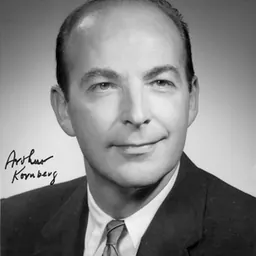
Following his Rockefeller fellowship, Stark was recruited by Arthur Kornberg, another Nobel Laureate, to conduct research at Stanford. His research was now focused on aspartate transcarbamylase, which catalyzes the transfer of a carbamyl group from phosphate to aspartate, and he and his colleague Kim Collins investigated a certain intermediate of this reaction, namely N-phosphonacetyl-l-aspartate, better known as PALA. They postulated that this particular intermediate could be a feasible inhibitor, and after synthesizing it, found that it indeed inhibited ATCase. This is where Stark's research on mammalian cells began. Aspartate transcarbamylase is one of the first three enzymes necessary for de novo synthesis of pyrimidine nucleotides, and after Stark was able to isolate this protein complex in hamster cells, he then treated them with PALA and found this pathway inhibited. Furthermore, with another colleague Randall Johnson, Stark began testing the use of PALA as a treatment for tumors in mice cells, with significant rudimentary results. PALA was able to successfully inhibit growth of transplantable tumors, but was less successful with solid tumors. It was later found that this ability did not translate well to human cells and has minimal therapeutic uses on its own.
Another major advancement made by Stark and his colleagues at Stanford was the development of the Northern blot and Western blot techniques, which allow researchers to more efficiently detect isolated mRNA. To do this, they first developed a method to couple DNA with diazotized cellulose, which was reactive with both DNA and RNA. They were then able to use gel electrophoresis and cellulose chromatography paper to isolate mRNA molecules, and then probe them with complementary DNA strands. In contrast with the previously used Southern blot, this method allowed for the analysis of RNA instead of DNA. A similar method was used for identification of proteins, leading to the method referred to as the Western blot., variations of which were also reported by two other groups, working independently at about the same time: Harry Towbin and coworkers in Basel, Switzerland, and W. Neil Burnett in Robert Nowinski's lab at Fred Hutchinson Cancer Research Center in Seattle, who also coined the name "Western" blotting. The Towbin group used secondary antibodies for detection, which is now the predominant method in Western blotting.
Some of Stark's most important advancements have been within the realm of interferon-dependent signalling. These studies began at Stanford and continued during his time in London, where his lab focused on these pathways, along with mechanisms of gene amplification, and this research has continued throughout the rest of his career. Stark's lab group, in collaboration with Ian M. Kerr’s group at the Imperial Cancer Research Fund, was attempting to identify the key components of IFN-dependent signaling. Interferons induce antiviral activities, inhibit cell growth, control apoptosis, and are implicated in promoting immune responses. Concurrently with James E. Darnell’s lab group, Stark's group was able to uncover a new direct signal transduction pathway through their study of interferon alpha and interferon gamma. This particular pathway, better known as the JAK-STAT signaling pathway, is characterized by the interaction of interferon receptors at the cell's surface with Janus kinases (JAKs), which are then able to phosphorylate substrate proteins called signal transducers and activators of transcription (STATs). These STAT proteins then migrate to the nucleus and then initiate transcription. These proteins are also involved in the resistance of cancer cells to DNA damaging therapies, and this is just one of the many topics that Stark has focused on during his research career at the Case Comprehensive Cancer Center.
Awards and legacy
Awards
American Society of Biological Chemists 1986 H. A. Sober Memorial Lectureship 1997 Milstein Award Winner for Excellence in Interferon and Cytokine Research University of Connecticut, Department of Molecular and Cell Biology 1998 Hugh Clark Distinguished Lectureship Distinguished Scientist of the Lerner Research Institute Cancer Research Institute 1999 William B. Coley Award for Distinguished Research in Basic and Tumor Immunology 2019 Steven C. Beering Award, 37th annual recipient
Memberships
Member of the US National Academy of Sciences Member of the National Academy of Medicine Member of the European Molecular Biology Organisation Fellow of the American Association for the Advancement of Science Fellow of the Royal Society of London, elected in 1990 Representative for the American Society for Biochemistry and Molecular Biology in the U.S. National Committee for Biochemistry and Molecular Biology from 1995 to 2000
Legacy In 2015, Stark and his wife endowed a graduate scholarship at the Center for Gene Regulation in Health and Disease at Cleveland State University.
Don’t just read it —
keep it.
Full-length biographies made to live with: read them, listen on the way to work, watch them tonight.
- E-book
- Audio
- Video
Instant download · yours to keep · every purchase keeps this site free
Important facts
People in George R. Stark's life
Named in this biography and alive at the same time






Related people
Same field, nearest in time

Contemporaries
People whose lives overlapped George R. Stark's




Frequently asked questions
Who is George R. Stark?
American biochemist and molecular biologist
When was George R. Stark born?
George R. Stark was born on 4 July 1933 in New York City.
What is George R. Stark's occupation?
George R. Stark is a biochemist, molecular biologist and university teacher.
What nationality is George R. Stark?
George R. Stark is American.
Sources & further reading
Cite this page
APA: Biography.guide. (2026). George R. Stark. https://biography.guide/george-r-stark/
MLA: "George R. Stark." Biography.guide, https://biography.guide/george-r-stark/.
Chicago: "George R. Stark." Biography.guide. https://biography.guide/george-r-stark/.
Data last updated: 2026-09-27 · Spot an error? Report a correction.
Page generated 2026-09-27 05:17 UTC