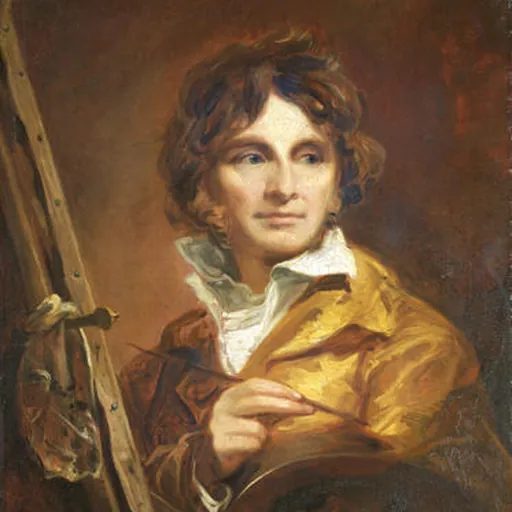
About Thomas Barker
Lived 1769 – 1847 (aged 77–78). Thomas Barker was a Welsh and British painter and artist.
Thomas Barker or Barker of Bath (1769 – 11 December 1847), was a British painter of landscape and rural life.
Early life
Barker was born in 1769, at Trosnant near the village of Pontypool, in Monmouthshire. His father, Benjamin Barker, was the son of a barrister, and practiced as an artist, but never attempted more than the portraits of horses. He eventually took up employment as a Japanware decorator.
From an early age Barker showed a remarkable talent for drawing figures and designing landscapes, although he never took a lesson in either drawing or painting and was entirely self-taught. When he was sixteen his family moved to Bath where the patronage of an opulent coach-builder named Charles Spackman allowed him to follow his talent as an artist. During the first four years he employed himself in copying the works of the old Dutch and Flemish masters. At the age of twenty-one he was sent to Rome with ample funds to maintain his position there as a gentleman. While there he painted very little, contenting himself with society life.
Life as an artist Hampton Rocks, Morning, now at the Victoria Art Gallery, Bath. Macbeth and the Witches, now at the Folger Shakespeare Library, Washington, D.C. Barker was an occasional exhibitor at the Royal Academy and the British Institution for almost fifty years, during which period he exhibited nearly one hundred pictures. He was a prolific artist, and painted a wide range of subjects. Few pictures of the English school are more generally known and appreciated than The Woodman, of which it appears two were painted, both of them from nature, and of life size: the first was sold to Mr. Macklin for 500 guineas; the second, for the same amount, became the property of Lord W. Paulett. In 1821 he painted the Trial of Queen Caroline, which included portraits of many celebrated men; but perhaps the best effort of Barker's pencil skill was the fresco, 30 feet in length, and 12 feet in height, representing The Inroad of the Turks upon Scio, in April, 1822, painted on the wall of his residence, Sion Hill, Bath.
When Barker's talents were in full vigour, no artist of his time had a greater hold on popular favour; his pictures of The Woodman, Old Tom (painted before he was seventeen years of age), and gipsy groups and rustic figures, were copied onto almost every possible material: Staffordshire pottery, Worcester china, Manchester cottons, and Glasgow linens. At one time he amassed considerable property by the sale of his works, and spent a large sum in building a mansion for his residence, enriching it with sculpture and other works of art. He died at Bath in 1847.
Barker was one of the first British artists, along with Benjamin West and Richard Westhall, to use Lithography as a print medium and contributed two prints Young Boy Seated, and Tilemakers to Specimens of Polyautography, the first British publication of a collection of Lithographic plates, originally published by Philipp André in 1803, and then reissued in an enlarged edition by Von Weiler in 1806-07. Barker's series of Rustic figures after nature published in Bath in 1813 in a small edition, is the first series of lithographs by a British single artist. Some of Barker's stones survive.
Works There are six paintings by Barker in the Tate Gallery, and several landscapes.
The British Museum holds a number of Barker's drawings and prints.
Three of Barker's paintings, Italian Landscape 1808, Landscape with a Waterfall and Landscape with Cattle are in Wolverhampton Art Gallery.
A painting of Wooded landscape with gipsies round a camp fire turned out to be probably the work of Barker painted over an earlier work by Michael Dahl, was featured on the BBC television series Fake or Fortune? in 2019. Barker's work on this subject was heavily inspired by Gainsborough's, and he painted several copies of The Gipsies, as well as many gypsy works of his own. He used the grouping from Gainsborough's The Gipsies as the background to one of his 1789 self-portraits.
In an episode of BBC's Britain's Lost Masterpieces broadcast in November 2019, a forest scene thought to be a copy of a famous painting by Gainsborough, was located at Birmingham Art Gallery. Following a full restoration by Simon Gillespie, the work was attributed to Barker.
In 1825, Thomas Barker painted a fresco depicting the Chios Massacre on the walls of Doric House, Bath, Somerset.
Two T. Barker of Bath landscape pictures appeared in the Walker's Galleries, 118 New Bond Street, Exhibition of Sketches & Water-colour Drawings by the Early English Water-Colour Artists and a few Foreign Artists, June 22 - September 30, 1920, both priced at fifteen guineas .
Family As well as Thomas Barker, the Barker family produced several artists of note. As well as his father's ability, Thomas' younger brother Benjamin Barker II (1776–1838) was also a talented artist known for his landscape work. Benjamin II exhibited at the Royal Academy and many of his works were engraved by Thales Fielding in aquatint. Barker's son, Thomas Jones Barker (1815–1882), followed his father and uncle into painting, studying at the studio of Horace Vernet in Paris. Many of Jones Barker's works were of a military nature, including Lord Clive's relief of Lucknow and The Allied generals before Sebastopol.
Don’t just read it —
keep it.
Full-length biographies made to live with: read them, listen on the way to work, watch them tonight.
- E-book
- Audio
- Video
Instant download · yours to keep · every purchase keeps this site free
Important facts
more
thos barker, Barker, Thos. Barrke, Bath, Thos. Barker, T. BarkerPeople in Thomas Barker's life
Named in this biography and alive at the same time




Related people
Same field, nearest in time




Contemporaries
People whose lives overlapped Thomas Barker's





Frequently asked questions
Who was Thomas Barker?
Welsh painter (1769-1847)
When was Thomas Barker born?
Thomas Barker was born in 1769 in Pontypool.
When did Thomas Barker die?
Thomas Barker died on 11 December 1847 in Bath.
What was Thomas Barker's occupation?
Thomas Barker was a painter and artist.
What nationality was Thomas Barker?
Thomas Barker was Welsh and British.
Sources & further reading
· DBpedia: Thomas Barker (painter)
Cite this page
APA: Biography.guide. (2026). Thomas Barker. https://biography.guide/thomas-barker-painter/
MLA: "Thomas Barker." Biography.guide, https://biography.guide/thomas-barker-painter/.
Chicago: "Thomas Barker." Biography.guide. https://biography.guide/thomas-barker-painter/.
Data last updated: 2026-09-20 · Spot an error? Report a correction.
Page generated 2026-09-27 05:09 UTC