
About Horace Vernet
Lived 1789 – 1863 (aged 73). Horace Vernet was a French painter, photographer, military personnel, graphic artist, draftsperson and lithographer.
Émile Jean-Horace Vernet (; 30 June 178917 January 1863), better known as Horace Vernet, was a French painter of battles, portraits, and Orientalist subjects.
Biography
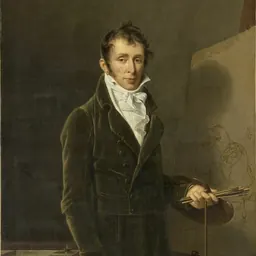
Early career Vernet was born to painter Carle Vernet, who was himself a son of Claude-Joseph Vernet, also a painter. He was born in the Paris Louvre, while his parents were staying there during the French Revolution. Vernet quickly developed a disdain for the high-minded seriousness of academic French art work which was distinguished by art influenced by Classicism, and decided to paint subjects taken mostly from contemporary life. During his early career, when Napoleon Bonaparte was in power, he began depicting the French soldier in a more familiar, vernacular manner rather than in an idealized, Davidian fashion; he was just twenty when he exhibited the Taking of an Entrenched Camp Some other of his paintings that represent French soldiers in a more direct, less idealizing style, include Dog of the Regiment, Trumpeter's Horse, and Death of Poniatowski.
Restoration France
He gained recognition during the Bourbon Restoration for a series of battle paintings commissioned by the duc d'Orleans, the future King Louis Philippe I. Critics marvelled at the incredible speed with which he painted. Many of his paintings made during this early phase of his career were "noted for their historical accuracy as well as their charged landscapes". Examples of paintings in this style include his Four Battles series: The Battle of Jemappes (1821), The Battle of Montmirail (1822), The Battle of Hanau (1824), and The Battle of Valmy (1826). Enjoying equal favour with the court and with the opposition, he was appointed director of the French Academy in Rome, from 1829 to 1835.
Later career His depictions of Algerian battles, such as the Capture of the Smahla and the Capture of Constantine, were well received by other French people, as they were vivid depictions of their army in the heat of battle. After the fall of the July Monarchy during the Revolution of 1848, Vernet discovered a new patron in Napoléon III of France. He continued to paint representations of the heroic French army during the Second Empire and maintained his commitment to and realistic way. He accompanied the French Army during the Crimean War, producing several paintings, truthfully including one of the Battle of the Alma, which was not as well received as his earlier paintings. One well known and possibly apocryphal anecdote maintains that when Vernet was asked to remove a certain obnoxious general from one of his paintings, he replied, "I am a painter of history, sire, and I will not violate the truth", hence demonstrating his fidelity to representing war.
Vernet also developed an interest in daguerreotype photography. He took photographs in Egypt as reference material for his paintings, and during a stop at Malta in March 1840 while en route to Egypt, he took the earliest known photographs of the island at Fort Manoel. Today these early photographs are believed to be lost.
His nephew Frédéric Goupil-Fesquet, also a painter and his pupil, wrote Voyage d'Horace Vernet en Orient (2 volumes, 1844).
Vernet died in his hometown of Paris in 1863.
Literary references In Arthur Conan Doyle's Sherlock Holmes story "The Adventure of the Greek Interpreter", Holmes claims to be related to Vernet, stating, "My ancestors were country squires... my grandmother... was the sister of Vernet, the French artist"; it is generally assumed that this individual is Émile Jean-Horace Vernet, because Horace was only 65 years older than Sherlock Holmes while the other Vernets lived much before. The Holmes-Vernet connection is also central to the plot of Laurie R. King's 2024 novel, The Lantern's Dance.
Gallery
Don’t just read it —
keep it.
Full-length biographies made to live with: read them, listen on the way to work, watch them tonight.
- E-book
- Audio
- Video
Instant download · yours to keep · every purchase keeps this site free
Important facts
more
vernet horace, Vernet, emil jean horace vernet, E. J. H. Vernet, M. VernePeople in Horace Vernet's life
Named in this biography and alive at the same time


Related people
Same field, nearest in time



Contemporaries
People whose lives overlapped Horace Vernet's


Frequently asked questions
Who was Horace Vernet?
French painter (1789–1863)
When was Horace Vernet born?
Horace Vernet was born on 30 June 1789 in Paris.
When did Horace Vernet die?
Horace Vernet died on 17 January 1863 in Paris.
What was Horace Vernet's occupation?
Horace Vernet was a painter, photographer, military personnel, graphic artist, draftsperson and lithographer.
What nationality was Horace Vernet?
Horace Vernet was French.
Sources & further reading
Cite this page
APA: Biography.guide. (2026). Horace Vernet. https://biography.guide/horace-vernet/
MLA: "Horace Vernet." Biography.guide, https://biography.guide/horace-vernet/.
Chicago: "Horace Vernet." Biography.guide. https://biography.guide/horace-vernet/.
Data last updated: 2026-09-20 · Spot an error? Report a correction.
Page generated 2026-09-27 05:23 UTC