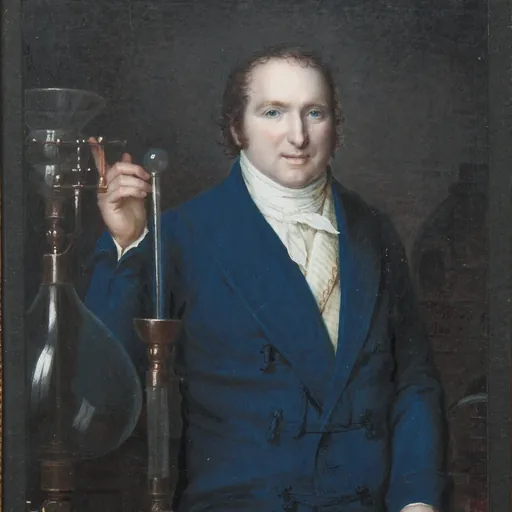
About Antoine François, comte de Fourcroy
Lived 1755 – 1809 (aged 54). Antoine François, comte de Fourcroy was a French chemist, politician, entomologist, encyclopédistes, university teacher and physician, known for Iridium.
Antoine François Fourcroy (; 15 June 175516 December 1809) Fourcroy's attention was turned specifically to chemistry by J. B. M. Bucquet (1746–1780), the professor of chemistry at the Medical School of Paris. In 1784 Fourcroy was chosen to succeed P. J. Macquer (1718–1784) as lecturer in chemistry at the college of the Jardin du Roi, where his lectures attained great popularity.
Works Last work published by Foucroy before his death, the "Système des connaissances chimiques et de leurs applications aux phénomènes de la nature et de l'art", 1801.
Chemical Work Fourcroy was one of the earliest converts to the views of Lavoisier, which he helped to make widely known by his own voluminous writings.
Biological and Neurochemical Work Fourcroy's views and studies grew from Bucquet. Fourcroy was a critic of earlier use of chemistry in medicine and saw great importance in studying the chemical materials of plants and animals, particularly for medicinal use. alt= A marble bust of Fourcroy designed by Antoine-Denis Chaudet and completed by Pierre Cartellier in 1811.
Fourcroy also had a prominent role in developing law that would affect medical education in France. Fourcroy collaborated with physician Francois Chaussier to create a report that would be the basis of the Law of 1794, which integrated medicine and surgery and established health schools that taught both of these fields to all students. Prior to this law, medical education was heterogeneous throughout France, with several different colleges and universities operating under varying standards. The law pushed by Fourcroy unified the French medical education system under centralized authority, and led to the issuing of national licensing years later.
Work in Laboratory and Medical Clinic Procedure While observing the 18th century clinics of Fourcroy’s time, he observed several problems. Fourcroy noticed that physicians got accustomed to seeing the diseases of an individual patient but failed in considering a large number of cases comparatively. There was also practical problems with this idea, as physician’s individual practices were insufficient in accommodating for large numbers of people with large varieties of issues. To deal with this Fourcroy proposed a program in 1791 to establish more effective clinical laboratories. It was Fourcroy who had initially noted the division that chemistry had undergone from natural history, concluding that the two studies no longer shared objectives nor methods. While natural historians of his era merely described and preserved that which they studied, as Fourcroy believed, it was chemists who now sought to uncover the most fundamental structures of the natural world by experimental analysis. In his publications, Fourcroy referred to many other contemporary chemists as well as those from other nations, proposing that the extensive chemical reform being done was a collaborative effort.
Awards and honors In 1801, Fourcroy was elected a foreign member of the Royal Swedish Academy of Sciences.
On 16 December 1809, the very day on which he died in Paris, Fourcroy was created a count of the French empire. was honored by a Citation for Chemical Breakthrough Award from the Division of History of Chemistry of the American Chemical Society, presented at the Académie des Sciences (Paris) in 2015. Title page of a 1787 copy of "Méthode de Nomenclature Chimique" It is believed that Cape Fourcroy, at the western tip of Bathurst Island, Northern Territory, Australia, is named after Fourcroy. The cape was named during Baudin's expedition to Australia, and it is known that Baudin had a copy of one of Fourcroy's texts with him on the Géographe.
Controversy By his conduct as a member of the Convention, Fourcroy has been accused of contributing to Lavoisier's death. Baron Cuvier, in his Eloge historique of Fourcroy, repelled such charges. According to the Encyclopædia Britannica Eleventh Edition: although active, though secret, participation cannot be proved against Fourcroy, "he can scarcely be acquitted of time-serving indifference."
Don’t just read it —
keep it.
Full-length biographies made to live with: read them, listen on the way to work, watch them tonight.
- E-book
- Audio
- Video
Instant download · yours to keep · every purchase keeps this site free
Important facts
People in Antoine François, comte de Fourcroy's life
Named in this biography and alive at the same time
Related people
Same field, nearest in time



Contemporaries
People whose lives overlapped Antoine François, comte de Fourcroy's






Frequently asked questions
Who was Antoine François, comte de Fourcroy?
French chemist (1755-1809)
When was Antoine François, comte de Fourcroy born?
Antoine François, comte de Fourcroy was born on 15 June 1755 in Paris.
When did Antoine François, comte de Fourcroy die?
Antoine François, comte de Fourcroy died on 16 December 1809 in Paris.
What was Antoine François, comte de Fourcroy's occupation?
Antoine François, comte de Fourcroy was a chemist, politician, entomologist, encyclopédistes, university teacher and physician.
What was Antoine François, comte de Fourcroy known for?
Antoine François, comte de Fourcroy was known for Iridium.
What nationality was Antoine François, comte de Fourcroy?
Antoine François, comte de Fourcroy was French.
Sources & further reading
· Wikipedia: Antoine François, comte de Fourcroy
· DBpedia: Antoine-François de Fourcroy
Cite this page
APA: Biography.guide. (2026). Antoine François, comte de Fourcroy. https://biography.guide/antoine-francois-comte-de-fourcroy/
MLA: "Antoine François, comte de Fourcroy." Biography.guide, https://biography.guide/antoine-francois-comte-de-fourcroy/.
Chicago: "Antoine François, comte de Fourcroy." Biography.guide. https://biography.guide/antoine-francois-comte-de-fourcroy/.
Data last updated: 2026-09-20 · Spot an error? Report a correction.
Portrait: Wikimedia Commons · author & licence
Page generated 2026-09-27 04:57 UTC