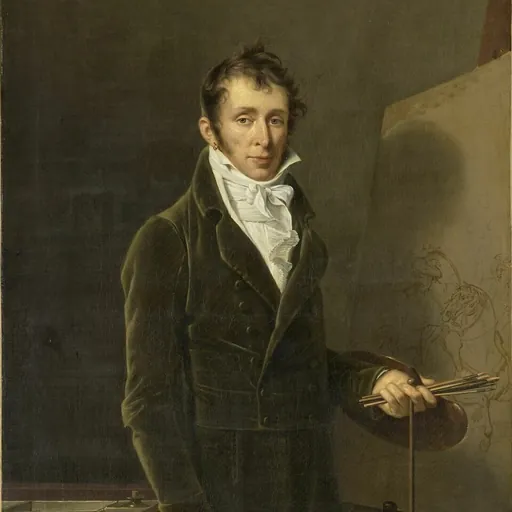
About Carle Vernet
Lived 1758 – 1836 (aged 78). Carle Vernet was a French lithographer, painter, graphic artist and visual artist.
Antoine Charles Horace Vernet (; 14 August 175827 November 1836), better known as Carle Vernet, was a French painter, the youngest child of painter Claude-Joseph Vernet and the father of painter Horace Vernet.
Biography
Vernet was born in Bordeaux. At the age of five, he showed an extraordinary passion for drawing horses, but went through the regular academic course as a pupil of his father and of Nicolas-Bernard Lépicié. Strangely, after winning the Prix de Rome (1782), he seemed to lose interest in the occupation, and his father had to recall him from Rome to prevent his entering a monastery.
In his "Triumph of Aemilius Paulus", Vernet broke with tradition and drew the horse with the forms he had learnt from nature in stables and riding schools. His hunting pieces, races, landscapes, and work as a lithographer were also very popular.
Carle's sister was executed by the guillotine during the Revolution. After this, he gave up art.
When he again began to produce under the French Directory (1795–1799), his style had changed radically. He started drawing in minute detail battles and campaigns to glorify Napoleon. His drawings of Napoleon's Italian campaign won acclaim as did the Battle of Marengo, and for his Morning of Austerlitz Napoleon awarded him the Legion of Honour, and Louis XVIII awarded him the Order of Saint Michael. Afterwards he excelled in hunting scenes and depictions of horses.
He produced a painting Capture of Pamplona celebrating the 1823 Siege of Pamplona which he exhibited at the Paris Salon of 1824.
In addition to being a painter and lithographer, Carle Vernet was an avid horseman. Just days before his death at the age of seventy-eight, he was seen racing as if he were a sprightly young man.
He died in Paris.
Literary references In Maria Wirtemberska's novel Malvina, or the Heart's Intuition (1816; English translation 2001, by Ursula Phillips), it is said that a view that is being described merits the talent of Vernet, who as the writer explains in her own footnote was a sea painter.
Selected works
Don’t just read it —
keep it.
Full-length biographies made to live with: read them, listen on the way to work, watch them tonight.
- E-book
- Audio
- Video
Instant download · yours to keep · every purchase keeps this site free
Important facts
more
Vernet, horace vernet, Vernet the Younger, charles vernet, Vernet's Son, Ch. Vernet, carlo vernet, Vernet fils, C. WernetFamily & relationships
People in Carle Vernet's life
Named in this biography and alive at the same time
Related people
Same field, nearest in time


Contemporaries
People whose lives overlapped Carle Vernet's





Frequently asked questions
Who was Carle Vernet?
French painter (1758-1836)
When was Carle Vernet born?
Carle Vernet was born on 14 August 1758 in Bordeaux.
When did Carle Vernet die?
Carle Vernet died on 27 November 1836 in Paris.
What was Carle Vernet's occupation?
Carle Vernet was a lithographer, painter, graphic artist and visual artist.
What nationality was Carle Vernet?
Carle Vernet was French.
Sources & further reading
Cite this page
APA: Biography.guide. (2026). Carle Vernet. https://biography.guide/carle-vernet/
MLA: "Carle Vernet." Biography.guide, https://biography.guide/carle-vernet/.
Chicago: "Carle Vernet." Biography.guide. https://biography.guide/carle-vernet/.
Data last updated: 2026-09-21 · Spot an error? Report a correction.
Portrait: Wikimedia Commons · author & licence
Page generated 2026-09-27 04:59 UTC