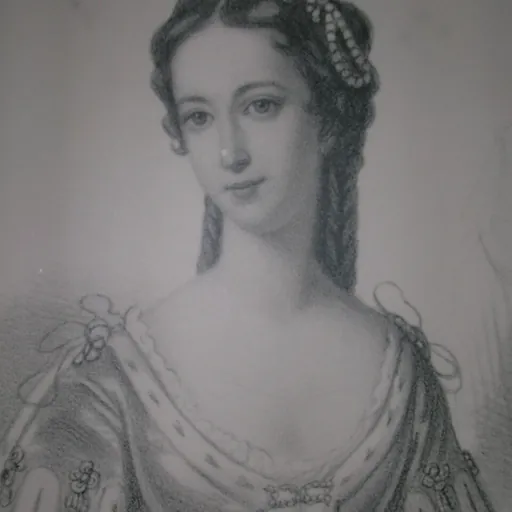
Susanna Montgomery, Countess of Eglinton
Scottish literary patron and society hostess
About Susanna Montgomery, Countess of Eglinton
Lived 1690 – 1780 (aged 90). Susanna Montgomery, Countess of Eglinton was a writer.
Susanna Montgomerie, Countess of Eglinton (1690 – 18 March 1780) was the third wife of Alexander Montgomerie, 9th Earl of Eglinton. She lived as a widow for nearly 51 years before dying at Auchans, Scotland in 1780, aged 90. She signed herself as S. Eglintoune.
Background Born at Culzean Castle in 1690, Lady Eglinton was the daughter of Sir Archibald Kennedy, 1st Baronet of Culzean, and the Hon. Elizabeth Leslie, daughter of David Leslie, 1st Lord Newark.
Personal qualities, marriage and anecdotes
Lady Eglinton was celebrated for her beauty and height (6 feet), and for her patronage of the Scottish poets and writers of her day. She was exceptional in her knowledge of art, music, literature, science, philosophy and history; additionally she spoke Italian, French and German. Her interest in literature was seen by her contemporaries to be distinctly odd for one of her station. Sir William Fraser, the Scottish historian, said that "to her loveliness were added the more valuable attractions of genius and great accomplishment." Fullarton suggests that Susanna's personality owed much to her maternal grandfather, General David Leslie, later Lord Newark; he was second in command at the Battle of Marston moor and in command at the Battle of Philiphaugh, on the winning side at both encounters.
She was beautiful and at 6-foot, unusually tall for those times. It is stated that, on her arrival with her father in Edinburgh around the time of the Union (1702), she was surrounded by wooers. One of these, Sir John Clerk, baronet, of Pennycuik, was deemed likeliest to succeed, but was unsuccessful. She instead married the 9th Earl in June 1709. When Susanna's father consulted him as to the propriety of the match, the earl, whose second countess was then alive but in a long-continued state of ill health, purportedly replied, "Bide awee, Sir Archie, my wife’s very sickly." Soon afterwards his second wife died of natural causes and he married again, this being to his third countess. Susanna did not immediately accept, but the earl eventually won through in spite of numerous rivals. One story relates that she had long been destined to marry the 9th Earl, for one day whilst out walking at Culzean, a hawk belonging to the Earl landed on her shoulder when she called to it and those observing saw it as a clear omen once the silver bells around its neck were seen to carry the name of the earl.
She was married for 20 years and a widow at the age of 40, living for another 51 years. She brought to the family a way of walking in a stately fashion which became known as 'the Eglinton air'.
The Gentle Shepherd, first published in 1725, was dedicated to her by Allan Ramsay and Hamilton of Bangour wrote flattering verse to Susanna, Lady Eglinton and her daughters.
The Gentle Shepherd
Paraphrased by Hamilton of Bangour.
Oh Eglintoun! thy happy breast, Calm and serene enjoys the heavenly guest; From the tumultuous rule of passions freed, Pure in thy thought, and spotless in thy deed; In virtues rich, in goodness unconfin'd, Thou shin'st a fair example to thy kind.
She briefly attended the court of King George II in 1730 and had caught the eye of the Queen, Caroline of Ansbach. King George II described her as the most beautiful woman in my dominions. Susanna's special entertainments were magnificent and it was said that they were seldom if ever equalled in any private mansion. She refused to attend the procession at the coronation of King George III in 1760 because of her Jacobite sympathies.
Susanna retained her figure and complexion until her death, supposedly because she never used paint or cosmetics and daily washed her face with sow's milk and drank it, recommending this treatment to others. She once said to her daughter, Lady Bettie, "What would you give to be as pretty as I am?" to which Lady Bettie replied, "Not half as much as you would give to be as young as I am." Her daughter Helen once commented, "Who can surpass Mama? She has not aged a day in years." It was believed that Susanna had discovered the secret of eternal youth, showing no signs of her beauty lessening even at the age of sixty. Her blue eyes grew lighter in colour as she advanced in years." Her portrait still hangs in Culzean Castle. Her husband had been a covert Jacobite. This painting now hangs in Culzean Castle.
Robert Campbell (Cummell) records that Quintin Crawfurd was Lady Susanna's factor.
Involvement in industry
The Montgomerie family owned a number of coal mines or pits and Susanna was involved in the general supervision of miners on the estate as shown by her correspondence and the fact that she intervened in the 1749–50 labour unrest. The miners at this time claimed that they were forced to work a 14-hour day, six days a week in order to earn a living wage.
Susanna summoned the miners to Eglinton Castle to try and sort things out, as a result of which several of the miners signed a 'disclamation' which they later tried to repudiate. The lawyer who dealt with the case stated that it is probable a Lady of great Beauty of Address might prevail with some of the old Coalziers to sign any paper.
She was very industrious and even established a distillery, later a brewery at the family's Burgh and Regality of Montgomeryston inside the walls of Cromwell's old Citadel fort at Ayr to increase her income. It seems to have been only moderately successful.
Offspring and stepchildren
She had three sons: James, Lord Montgomerie, who died young; Alexander, 10th Earl of Eglinton. Archibald, 11th Earl of Eglinton.
And eight daughters, who were all married but one. Lady Elizabeth married Sir John Cunningham of Caprington; Lady Helen married Francis Stuart of Pittendriech in 1745; Lady Susan married John Renton of Lamberton; Lady Margaret married Sir Alexander MacDonald in 1739; Lady Christian married James Moray of Abercairny; Lady Grace married Cornet Byrne, a debaucher and gambler, Lady Charlotte, who died suddenly of fever after having previously lost the use of her limbs. Lady Eleanor, who was frequently unwell and a special trip to the 'waters' at Bath did not cure her. Lady Susanna, who died of scurvy.
To them their handsome mother transmitted a nobleness of mien, distinguished at the period as the "Eglinton air."
Death of her son Alexander, 10th Earl of Eglinton
A panel from the coach in which the 10th Earl travelled during the Mungo Campbell incident. the outside facing side of the panel from the coach in which the 10th Earl travelled during the Mungo Campbell incident. On 24 October 1769, near Ardrossan, travelling in his carriage and four servants following him, Alexander met two men, one of whom was Mungo Campbell, an officer of excise at Saltcoats, and son of a Provost of Ayr, one of twenty-four children. Alexander, as Mungo had previously been caught shooting game on his estates, asked Mungo to hand over the gun he was carrying, which he refused, saying that he would rather die. The earl then ordered his fowling-piece, which was not loaded, to be brought from the carriage and in the scuffle that ensued, Mungo fired at Lord Eglinton, who was mortally wounded in the bowels, and died ten hours later at about one o’clock the following morning, at Eglinton Castle, where he had been taken in his carriage. The preserved door pannel (sic) contradicts the stated course of events by stating that the Earl was instantly shot upon leaving his carriage.
A contemporary newspaper report first recorded the incident as actually being a duel over a woman in which the Earl had been worsted. Indeed, when in London (from 1760 to 1763 at the least) he stayed in Queen Street, Mayfair and according to Boswell, he kept a mistress, a Ms. or Mrs. Brown, who, in 1763, "had lived with him seven or eight years".
Mungo Campbell hanged himself and thereby cheated the hangman. He left the following note -
"Farewell, vain world, I've had enough of thee, And now am careless what thou say'st of me, Thy smiles I court not, nor thy frowns I fear, My cares are past, my heart lies easy here, What faults they find in me take care to shun, And look at home, enough is to be done".
Susanna never quite recovered from the sight of her dying son being carried into Eglinton Castle and wrote I shall endeavour to bear my suffering with as little trouble to my fellow creatures as possible. Millar records that after the murder, she retired from the position which she held in society. She had insisted that the Earl was always referred to as Lord Eglinton as a youth and he had formally led her down to dinner every night. Mungo himself was also well liked in all the places that he had resided as an Excise officer, namely Stewarton, Saltcoats and Irvine.
Wilson records that "This sad affair , which took place on the grounds between Saltcoats and Ardrossan, was long the topic of discourse in town and country.."
Dying unmarried, the earl was succeeded by his brother, Archibald. The incident was written into a novel by John Galt, the well known story of fictitious Ayrshire village life, Annals of the Parish.
Correspondence Susanna was a prolific letter writer if the 64 letters that have survived are any indication. She wrote in particular to her daughters, stepchildren, Lord Milton (the family Guardian appointed by her deceased husband), Andrew Fletcher of Salton and the Lord Justice Clerk.
Dower houses
It was traditional and practical for a dowager to move out of the family seat and dwell within a dower house. Susanna as dowager countess seems to have first moved to Kilmaurs Place in Kilmaurs, East Ayrshire and later moved to Auchans near Dundonald. Letters from 1751 to 1762 are recorded as being written at Kilmars (sic) and from 1765 they are recorded as being written at Auchans. In 1762 she writes in a letter to her son-in-law James Moray of Abercairney that her son (the tenth Earl) has given her Auchans House and that she was about to repair it. When her second son, Archibald (the 11th Earl) was married in 1772, she took up her residence permanently at Auchans, She knew that Johnson wished to live a long life and became sulky if death was mentioned. She tactfully embraced Johnson upon his departure and commented that as she was old enough to be his mother, she would adopt him as her son; Johnson was delighted. Auchans is now Old Auchans and stands as a substantial ruin in 2009.
Lady Susanna is also remembered for taming a number of rats at Auchans to come for food at her table when she tapped on the oak wall panel and opened a small door. These ten or twelve rats would leave when instructed to; she commented that she valued the gratitude they showed, something she had rarely received from humans.
Archibald William Alexander Montgomerie, 17th Earl of Eglinton and Winton named his first child for Susanna; Lady Susanna Montgomerie was born 19 October 1941 and became Lady Susanna Crawfurd, having married Mr David Dundas Crawford.
Microhistory
Around 1708 the elderly Sir John Eldon laid siege to Culzean Castle in a passionate and fruitless act known to locals as Susanna and the Elder.
Don’t just read it —
keep it.
Full-length biographies made to live with: read them, listen on the way to work, watch them tonight.
- E-book
- Audio
- Video
Instant download · yours to keep · every purchase keeps this site free
Important facts
Family & relationships
People in Susanna Montgomery, Countess of Eglinton's life
Named in this biography and alive at the same time




Related people
Same field, nearest in time


Contemporaries
People whose lives overlapped Susanna Montgomery, Countess of Eglinton's



Frequently asked questions
Who was Susanna Montgomery, Countess of Eglinton?
Scottish literary patron and society hostess
When was Susanna Montgomery, Countess of Eglinton born?
Susanna Montgomery, Countess of Eglinton was born on 1 January 1690 in Culzean Castle.
When did Susanna Montgomery, Countess of Eglinton die?
Susanna Montgomery, Countess of Eglinton died on 18 March 1780 in Auchans Castle.
What was Susanna Montgomery, Countess of Eglinton's occupation?
Susanna Montgomery, Countess of Eglinton was a writer.
Sources & further reading
· Wikipedia: Susanna Montgomery, Countess of Eglinton
· DBpedia: Susanna Montgomerie, Countess of Eglinton
Cite this page
APA: Biography.guide. (2026). Susanna Montgomery, Countess of Eglinton. https://biography.guide/susanna-montgomery-countess-of-eglinton/
MLA: "Susanna Montgomery, Countess of Eglinton." Biography.guide, https://biography.guide/susanna-montgomery-countess-of-eglinton/.
Chicago: "Susanna Montgomery, Countess of Eglinton." Biography.guide. https://biography.guide/susanna-montgomery-countess-of-eglinton/.
Data last updated: 2026-09-21 · Spot an error? Report a correction.
Portrait: Wikimedia Commons · author & licence
Page generated 2026-09-27 05:00 UTC