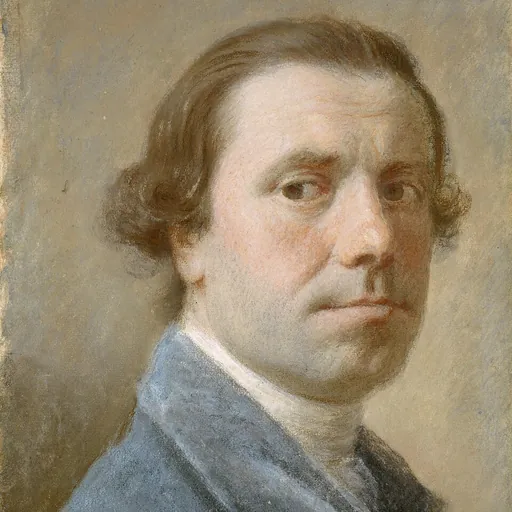
About Allan Ramsay
Lived 1713 – 1784 (aged 70). Allan Ramsay was a British painter and draftsperson.
Allan Ramsay (13 October 171310 August 1784) was a Scottish painter who specialised in portrait painting.
Life and career
Ramsay was born on 13 October 1712, in Edinburgh, Scotland, the eldest son of Allan Ramsay, poet and author of The Gentle Shepherd. From the age of 20, he studied in London under the Swedish painter Hans Hysing, and at the St. Martin's Lane Academy; leaving in 1736 for Rome and Naples. In Rome, he enrolled as a day student at the French Academy and worked for three years under Francesco Solimena and Imperiali (Francesco Fernandi).
On his return in 1738 to the British Isles, he first settled in Edinburgh, attracting attention by his head of Duncan Forbes of Culloden and his full-length portrait of Archibald Campbell, 3rd Duke of Argyll, later used on Royal Bank of Scotland banknotes. He later moved to London, where he was employed by Francis Egerton, 3rd Duke of Bridgewater.
He gained recognition in London for both his artistic work and his social connections. Three children survived from their long marriage, Amelia (1755–1813), Charlotte (1758–1818?), and John (1768–1845).
Ramsay and his new wife spent 1754 to 1757 together in Italy, going to Rome, Florence, Naples and Tivoli, researching, painting and drawing old masters, antiquities and archaeological sites. He used the material of blue paper as a support. He earned income painting Grand Tourists' portraits. During these trips to Italy, Ramsay also pursued literary and antiquarian research in addition to his artistic work. After their return, Ramsay in 1761 was appointed to succeed John Shackleton as Principal Painter in Ordinary to George III, beating Hudson to the post. The King commissioned so many royal portraits to be given to ambassadors and colonial governors, that Ramsay used the services of numerous assistants—of whom David Martin and Philip Reinagle are the best known.
Art
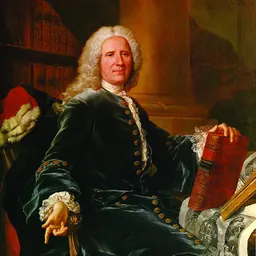
Among his most satisfactory productions are some of his earlier ones, such as the full-length of the Duke of Argyll, and the numerous bust-portraits of Scottish gentlemen and their ladies which he executed before settling in London. They are full of both grace and individuality. Art historians have noted the precise draughtsmanship and the technical qualities of his flesh-painting. His full-length of Lady Mary Coke has been noted for the treatment of its white satin drapery; while the portrait of his brown-eyed second wife Margaret, in the National Gallery of Scotland, is described as having a sweetness and tenderness. The portrait of his wife also shows the influence of French art, which Ramsay incorporated into his work. The large collection of his sketches in the possession of the Royal Scottish Academy and the Board of Trustees, Edinburgh also reflect stylistic influences associated with French art of the period.
Paintings
Ramsay has paintings in the collection of a few British institutions including the National Gallery in London, Sheffield, Derby Museum and Art Gallery (attributed), Glasgow Museum and Newstead Abbey.
In 2016, a portrait of Richard Mead (King George II's physician) by Ramsay was discovered by Bendor Grosvenor (using the Art UK website) as part of the British BBC Four television programme Britain's Lost Masterpieces; conservation treatment was carried out by Simon Rollo Gillespie to repair the torn canvas and remove layers of discoloured varnishes.
One of the most famous paintings attributed to Ramsay was titled Portrait of an African and has attracted extensive attention across recent decades, both as a representation of a Black man in 18th century Britain, but also for the difficulty of identifying the sitter. A documentary that features this painting, exploring the many meanings of its enigmatic image, has been produced by Royal Albert Memorial Museum & Art Gallery in Exeter. The portrait was renamed Portrait of a Man in a Red Suit in 2023, and it has been noted that the painting's true artist is unknown.
Theory In 1755, Ramsay made a considerable contribution to the Greco-Roman controversy, which was mainly discussed in Paris and Rome, when he anonymously published his Dialogue on Taste, in which he named Greece as the superior source of artistic excellence.
Abolitionism and paintings of Queen Charlotte
According to Mario de Valdes y Cocom in 2009, on an edition of PBS Frontline, in several paintings of Queen Charlotte, Ramsay deliberately emphasised "mulatto features" which the Queen supposedly inherited via descent from a 13th-century Moorish ancestor. Valdes suggests that copies of these paintings were sent to the colonies to be used by abolitionists as a de facto support for their cause.
Gallery
Writings A Dialogue on Taste, 1762 (Kessinger Publishing, 2009) Letters on the Present Disturbances in Great Britain and her American Provinces 1777 (Gale ECCO, 2010) Observations on the Riot Act, 1781 (Gale ECCO, 2010)
Don’t just read it —
keep it.
Full-length biographies made to live with: read them, listen on the way to work, watch them tonight.
- E-book
- Audio
- Video
Instant download · yours to keep · every purchase keeps this site free
Important facts
more
ramsay a., Ramsey, Alan Ramsay, A. Ramsay, allen ramsay, Ramsay, Allan, II Ramsay, Alexander Ramsay, of Kinkell Ramsay, II Allan Ramsay, Allan Ramsay II, Allan Ramsay of KinkellPeople in Allan Ramsay's life
Named in this biography and alive at the same time



Related people
Same field, nearest in time

Contemporaries
People whose lives overlapped Allan Ramsay's


Frequently asked questions
Who was Allan Ramsay?
Scottish portrait painter (1713-1784)
When was Allan Ramsay born?
Allan Ramsay was born on 2 October 1713 in Edinburgh.
When did Allan Ramsay die?
Allan Ramsay died on 10 August 1784 in Dover.
What was Allan Ramsay's occupation?
Allan Ramsay was a painter and draftsperson.
What nationality was Allan Ramsay?
Allan Ramsay was British.
Sources & further reading
· DBpedia: Allan Ramsay (artist)
Cite this page
APA: Biography.guide. (2026). Allan Ramsay. https://biography.guide/allan-ramsay/
MLA: "Allan Ramsay." Biography.guide, https://biography.guide/allan-ramsay/.
Chicago: "Allan Ramsay." Biography.guide. https://biography.guide/allan-ramsay/.
Data last updated: 2026-09-22 · Spot an error? Report a correction.
Portrait: Wikimedia Commons · author & licence
Page generated 2026-09-27 05:02 UTC