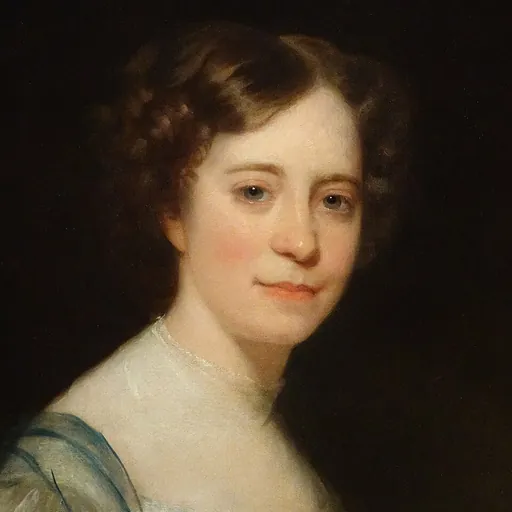
About Sophia Hawthorne
Lived 1809 – 1871 (aged 61). Sophia Hawthorne was an American painter, diarist, writer and artist.
Sophia Amelia Hawthorne ( Peabody; September 21, 1809 – February 26, 1871) was an American painter and illustrator and one of the first professional women artists in America. Her work was notably exhibited at the Boston Athenæum. Additionally, she published her journals and various articles. She was married to writer Nathaniel Hawthorne.
Life
Early life Sophia Amelia Peabody was born September 21, 1809, in Salem, Massachusetts, and named after two of her aunts. Peabody's father was the dentist Nathaniel Peabody, while her mother was the strong Unitarian Elizabeth Palmer. She had three brothers; her sisters were Elizabeth Palmer Peabody and Mary Tyler Peabody Mann, later Horace Mann's wife. Her sister Elizabeth educated Sophia, focusing on geography, science, literature and both American and European history; eventually, she learned to read in Latin, French, Greek and Hebrew; she knew some German, as well.
Sophia's health had been questionable since infancy, and she was an occasional invalid. One possible cause was a fashionable treatment her dentist father prescribed for her teething pains that included mercury. When doctors pronounced Sophia had no discernible illness, she sought the "rest therapy". She left for Cuba on December 4, 1833, with her sister Mary.
Courtship Sophia first met Nathaniel Hawthorne through her sister, Elizabeth. When the author came to visit once, Elizabeth is said to have reported, "He is handsomer than Lord Byron!" When she urged Sophia to come downstairs to meet him, she laughed and said, "If he has come once he will come again". After meeting her, Nathaniel wrote the tale "Edward Randolph’s Portrait", which included an artist character inspired by Sophia Peabody named Alice Vane.
Sophia had originally objected to marriage, partly because of her health. They became secretly engaged by New Year's Day, 1839.
Sophia gave two of her paintings to Hawthorne in 1840 on the first anniversary of their engagement. "Hawthorne valued the paintings so much that he hid them behind curtains to enjoy when he was alone".
Marriage and family A wedding was scheduled for June 27, 1842, but was postponed when Sophia fell ill. On July 9, 1842, five years after first meeting, she and Nathaniel were married at 13 West Street in Boston, the Peabody bookstore where Margaret Fuller held some of her "conversations". The day before, Nathaniel wrote to James Freeman Clarke asking him to oversee the ceremony. "I am to be married to Miss Sophia Peabody tomorrow; and it is our mutual desire that you should perform the ceremony", he wrote. Both were considered relatively old for marriage (she was 32 and he was five days past his 38th birthday), but the coupling proved happy for both of them. Immediately after their wedding, they rented and moved into The Old Manse in Concord, Massachusetts. The next day, Hawthorne wrote to his sister, Louisa: "We are as happy as people can be, without making themselves ridiculous, and might be even happier; but, as a matter of taste, we choose to stop short at this point." Together the couple etched their impressions of their new married life in the glass of a window in the study using Sophia's diamond ring: Man's accidents are God's purposes. Sophia A. Hawthorne 1843 Nath Hawthorne This is his study The smallest twig leans clear against the sky Composed by my wife and written with her diamond Inscribed by my husband at sunset, April 3, 1843. In the Gold light. SAH
On their first wedding anniversary, Nathaniel wrote to Sophia: "We were never so happy as now—never such wide capacity for happiness, yet overflowing with all that the day and every moment brings to us. Methinks this birth-day of our married life is like a cape, which we have now doubled and find a more infinite ocean of love stretching out before us."
The Hawthornes' first child was born March 3, 1844, after a difficult 10-hour delivery. They named her Una, a reference to The Faerie Queene by Edmund Spenser, to the disapproval of many family members. Sophia wrote in her journal, "It was a great happiness to be able to put her to my breast immediately and I thanked Heaven I was able to have the privilege of nursing her." John L. O'Sullivan served as her godfather and gave her a Newfoundland dog named Leo when she was two months old. Nathaniel wrote that fatherhood brought "a very sober and serious kind of happiness", and the family began to worry about money. Sophia also had a recurrence of her migraines after Una's birth.
The family was soon kicked out of the Old Manse, left with only 10 dollars. They moved in with family on Herbert Street in Salem while Nathaniel awaited a government job appointment. In March, 1846, Sophia moved to 77 Carver Street in Boston to be closer to family and Dr. William Wesselhœft while pregnant with her second child. The couple's son Julian was born in Boston on May 22, 1846. His father wrote of the news to a sister, "A small troglodyte made his appearance here at ten minutes to six o'clock this morning, who claims to be your nephew".
The family moved to Lenox, Massachusetts, and it was there, in a red farmhouse they rented, that Sophia gave birth to her third child, Rose. Two months prior to giving birth, Sophia claimed she instinctively knew it would be a girl and chose the name Rose. She was born on May 20, 1851, about a month after the publication of The House of the Seven Gables. Sophia went into labor early, before the midwife could arrive; Rose was delivered with the help of Sophia's father.
The Hawthornes raised their children in a positive environment and did not believe in harsh discipline or physical punishment. Hawthorne in 1862 praised his wife: "She is the most sensible woman I ever knew in my life, much superior to me in general talent, and of fine cultivation." Sophia had a close friendship with Annie Adams Fields, wife of the publisher James T. Fields. In 1863, Sophia wrote to her, "You embellish my life."
Nathaniel Hawthorne died in May 1864, and Sophia was given the news by her sister, Elizabeth Peabody, who had been informed by Franklin Pierce. Pierce, a close friend of Hawthorne, had been at the author's side when he died in his sleep. Sophia wrote about her husband's death to Annie Fields: "My darling has gone over that Sapphire sea, and these grand soft waves are messages from his Eternal Rest." She moved to England four years later in 1868 with her three children.
Later life, death, burial, and reburial
After her husband's death, Sophia threatened to sue publisher James T. Fields for not paying enough in royalties from book sales. Fields blamed his recently deceased business partner William Ticknor for promising "to pay the highest rate of copyright it ever paid" but that no written contract existed. The two agreed to a compromise as, Sophia said, she preferred "peace to pence".
Sophia became ill in February 1871, diagnosed with "typhoid pneumonia". She had difficulty breathing and was cared for by her daughters before dying on February 26. She was buried in Kensal Green Cemetery in London on March 4. Una wrote to Julian that their mother's grave was "on a sunny hillside looking towards the east... We had a head and footstone of white marble, with a place for flowers between, and Rose and I planted some ivy there that I had brought from America, and a periwinkle from papa's grave. The inscription is—Sophia, wife of Nathaniel Hawthorne."
Una died in September 1877 at the age of 33 and was buried alongside her mother in Kensal Green.
Artwork
Sophia Hawthorne was a writer and a painter. Sophia was one of America’s first professional women artists; her paintings were exhibited at the Boston Athenæum and she earned an income from her oil canvases, illustrations, decorative art, sculptures, and copies of the masters’ works. By 1832, Hawthorne was painting regularly—at first reproducing copies of existing artworks, and later executing landscapes of her own volition. In a letter to her sister Elizabeth in 1832, she wrote:
Sophia Hawthorne's artistic endeavors were hampered not only by the restrictive expectations placed upon women of the Victorian era, but also due to the objections of her husband who attempted to "colonize Sophia's talents, allowing her to hold the brush in order to paint his inner life rather than her own."
Sophia briefly studied sculpture with Shobal Vail Clevenger and produced a bas-relief medallion portrait of her dying brother George Peabody and, shortly thereafter, a similar work of Ralph Waldo Emerson's dead brother Charles. Later, she tutored her daughter Rose in art.
During their courtship, Sophia created an illustration for Nathaniel's tale "The Gentle Boy". After completing it, Sophia asked him if it looked like the main character, Ilbrahim. He answered, "He will never look otherwise to me". The story was republished with Sophia's illustration as The Gentle Boy: A Thrice Told Tale in December 1838, subsidized by a Salem hostess named Susan Burley. The book was dedicated to Sophia, inscribed: "To Miss Sophia A. Peabody, this little tale, to which her kindred art has given value, is respectfully inscribed by the author". When Nathaniel moved to Boston, Sophia painted two landscapes to decorate his apartment. On January 2, 1840, he wrote to her, "You cannot think how much delight those pictures are going to give me... I never owned a picture in my life." He later asked her to illustrate a reissue of his children's book Grandfather's Chair.
Don’t just read it —
keep it.
Full-length biographies made to live with: read them, listen on the way to work, watch them tonight.
- E-book
- Audio
- Video
Instant download · yours to keep · every purchase keeps this site free
Important facts
Family & relationships
People in Sophia Hawthorne's life
Named in this biography and alive at the same time


Related people
Same field, nearest in time

Contemporaries
People whose lives overlapped Sophia Hawthorne's





Frequently asked questions
Who was Sophia Hawthorne?
American artist (1809-1871)
When was Sophia Hawthorne born?
Sophia Hawthorne was born on 21 September 1809 in Salem.
When did Sophia Hawthorne die?
Sophia Hawthorne died on 26 February 1871 in London.
What was Sophia Hawthorne's occupation?
Sophia Hawthorne was a painter, diarist, writer and artist.
What nationality was Sophia Hawthorne?
Sophia Hawthorne was American.
Sources & further reading
Cite this page
APA: Biography.guide. (2026). Sophia Hawthorne. https://biography.guide/sophia-hawthorne/
MLA: "Sophia Hawthorne." Biography.guide, https://biography.guide/sophia-hawthorne/.
Chicago: "Sophia Hawthorne." Biography.guide. https://biography.guide/sophia-hawthorne/.
Data last updated: 2026-09-22 · Spot an error? Report a correction.
Portrait: Wikimedia Commons · author & licence
Page generated 2026-09-27 04:59 UTC