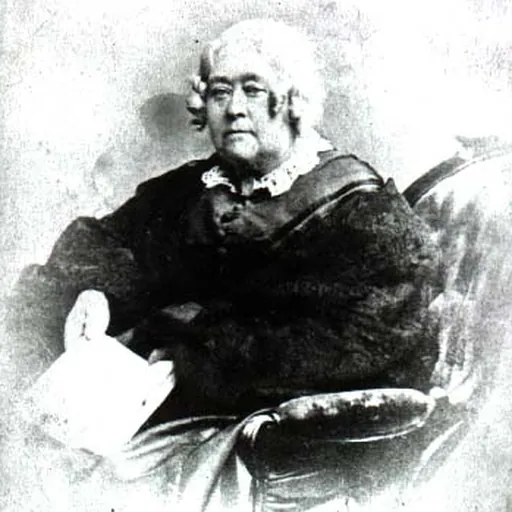
About Elizabeth Peabody
Lived 1804 – 1894 (aged 89). Elizabeth Peabody was an American writer.
Elizabeth Palmer Peabody (May 16, 1804 – January 3, 1894) was an American educator who opened the first English-language kindergarten in the United States. Long before most educators, Peabody embraced the premise that children's play has intrinsic developmental and educational value.
With a grounding in history and literature and a reading knowledge of ten languages, in 1840, she also opened a bookstore that held Margaret Fuller's "Conversations". She published books from Nathaniel Hawthorne and others in addition to the periodicals The Dial and Æsthetic Papers. She was an advocate of antislavery and of Transcendentalism.
Peabody also led efforts for the rights of the Paiute Indians. She was the first translator into English of the Buddhist scripture the Lotus Sutra, translating a chapter from its French translation in 1844. It was the first English version of any Buddhist scripture.
Personal life Early years Peabody was born in Billerica, Massachusetts, on May 16, 1804. She was the eldest daughter of Nathaniel Peabody, a physician, and Elizabeth Peabody, the granddaughter of Joseph Palmer, a general during the American Revolutionary War. The Peabodys were a two-income family. Elizabeth advocated for preschool child education and taught school. Nathaniel was an apothecary, doctor, and dentist. Her sisters were Mary, reformer, educator, and pioneer in establishing kindergarten schools and Sophia, painter and the wife of Nathaniel Hawthorne. Peabody developed an interest in philosophy, theology, literature, and history over the years and she spoke ten languages.
Legacy The Elizabeth Peabody House in Somerville, MA continues to educate children, after evolving from an early 20th century settlement house and moving out of the West End of Boston.
Career Educator Peabody operated a private school for girls in Boston from 1822 to 1823. She also became a writer and a prominent figure in the Transcendental movement. Peabody and her sister Mary operated a school in Brookline, Massachusetts, from 1825 to 1832, when there was a scandal about finances. Through her kindergarten and as editor of the Kindergarten Messenger (1873–1877), Peabody helped establish kindergarten as an accepted institution in American education.
Bookstore owner In 1840, Peabody established the West Street Bookshop near Beacon Hill and Boston Common in Boston and had a home above the bookstore where her sisters and parents lived with her. Sophia and Mary lived there until they were married. Peabody purchased foreign journals and books for her business, which was part bookstore, a lending library, and a place for scholars, liberal thinkers, and transcendentalists to meet.
It was there that Margaret Fuller held "Conversations" for women beginning on November 6, 1839. Topics for these discussions and debates included fine arts, history, mythology, literature, and nature. Fuller served as the "nucleus of conversation" and hoped to answer the "great questions" facing women: "What were we born to do? How shall we do it? which so few ever propose to themselves 'till their best years are gone by", Many figures in the woman's rights movement took part, including Sophia Dana Ripley, Caroline Sturgis, and Maria White Lowell. when the bookstore and library closed down. Members of the Transcendentalist movement had begun to disperse since the mid-1840s, and income from the bookstore gradually declined. In 2011, the Boston Landmarks Commission designated the building a Boston Landmark.
The Dial
For a time, Peabody was the business manager of The Dial, the main publication of the Transcendentalists. In 1843, she noted that the journal's income was not covering the cost of printing and that subscriptions totaled just over two hundred. In 1844 the magazine published Peabody's translation of a chapter of the Lotus Sutra from French, which was the first English version of a Buddhist scripture.
Author and publisher Peabody published antislavery literature and books, like Civil Disobedience by Henry David Thoreau and children's stories written by Nathaniel Hawthorne. She was one of the country's first female publisher. In the 1860s and 1870s, Peabody wrote about social and educational reform, producing 50 articles and 10 books.
Selected works Peabody published and authored a number of works, including this selection: About Bronson Alcott's Temple School, Boston.
About William Ellery Channing
About Washington Allston. Also published in Putnam's monthly.
Don’t just read it —
keep it.
Full-length biographies made to live with: read them, listen on the way to work, watch them tonight.
- E-book
- Audio
- Video
Instant download · yours to keep · every purchase keeps this site free
Important facts
Family & relationships
People in Elizabeth Peabody's life
Named in this biography and alive at the same time



Related people
Same field, nearest in time



Contemporaries
People whose lives overlapped Elizabeth Peabody's





Frequently asked questions
Who was Elizabeth Peabody?
American educator 1804-1894
When was Elizabeth Peabody born?
Elizabeth Peabody was born on 16 May 1804 in Middlesex County.
When did Elizabeth Peabody die?
Elizabeth Peabody died on 3 January 1894 in Jamaica Plain.
What was Elizabeth Peabody's occupation?
Elizabeth Peabody was a writer.
What nationality was Elizabeth Peabody?
Elizabeth Peabody was American.
Sources & further reading
· Wikipedia: Elizabeth Peabody
Cite this page
APA: Biography.guide. (2026). Elizabeth Peabody. https://biography.guide/elizabeth-peabody/
MLA: "Elizabeth Peabody." Biography.guide, https://biography.guide/elizabeth-peabody/.
Chicago: "Elizabeth Peabody." Biography.guide. https://biography.guide/elizabeth-peabody/.
Data last updated: 2026-09-23 · Spot an error? Report a correction.
Portrait: Wikimedia Commons · author & licence
Page generated 2026-09-27 05:05 UTC