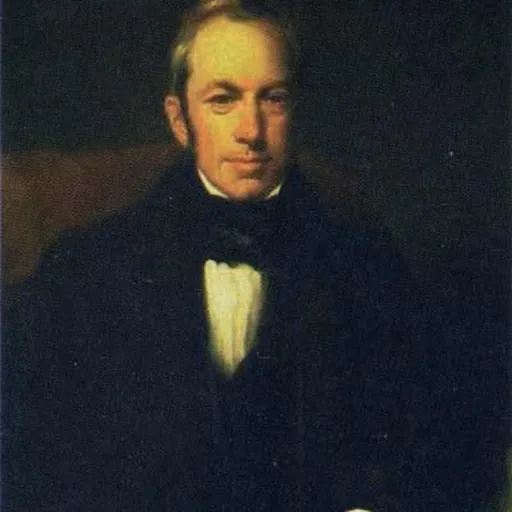
Robert Brown
British botanist (1773-1858), discoverer of the cell nucleus and of Brownian Motion
About Robert Brown
Lived 1773 – 1858 (aged 84). Robert Brown was a British botanist, pteridologist, bryologist, surgeon, mycologist and naturalist, known for Brownian motion.
Australia Investigator arrived in King George Sound in what is now Western Australia in December 1801. For three and a half years Brown did intensive botanic research in Australia, collecting about 3400 species, of which about 2000 were previously unknown. A large part of this collection was lost when was wrecked en route to England.
Brown remained in Australia until May 1805. He then returned to Britain where he spent the next five years working on the material he had gathered. He published numerous species descriptions; in Western Australia alone he is the author of nearly 1200 species. The list of major Australian genera that he named includes: Livistona, Triodia, Eriachne, Caladenia, Isolepis, Prasophyllum, Pterostylis, Patersonia, Conostylis, Thysanotus, Pityrodia, Hemigenia, Lechenaultia, Eremophila, Logania, Dryandra, Isopogon, Grevillea, Petrophile, Telopea, Leptomeria, Jacksonia, Leucopogon, Stenopetalum, Ptilotus, Sclerolaena and Rhagodia.
Subsequent career
In early 1809 he read his paper called On the natural order of plants called Proteaceae to the Linnean Society of London. This was subsequently published in March 1810 as On the Proteaceae of Jussieu. It is significant for its contribution to the systematics of Proteaceae, and to the floristics of Australia, and also for its application of palynology to systematics. This work was extensively plagiarised by Richard Anthony Salisbury, who had memorised much of the Linnean reading and then inserted it in Joseph Knight's 1809 publication On the cultivation of the plants belonging to the natural order of Proteeae.
In 1810, he published the results of his collecting in his famous Prodromus Florae Novae Hollandiae et Insulae Van Diemen, the first systematic account of the Australian flora. Over half of New Zealand's orchid genera were first described in the work. That year, he succeeded Jonas C. Dryander as Joseph Banks' librarian, and on Banks' death in 1820 Brown inherited his library and herbarium. This was transferred to the British Museum in 1827, and Brown was appointed Keeper of the Banksian Botanical Collection.
In 1818 he published Observations, systematical and geographical, on the herbarium collected by Professor Christian Smith, in the vicinity of the Congo. In 1822, he was elected a Fellow of the Linnean Society and a foreign member of the Royal Swedish Academy of Sciences. In 1827 he became correspondent of the Royal Institute of the Netherlands, three years later he became associated member. When the institute became the Royal Netherlands Academy of Arts and Sciences in 1851 Brown joined as foreign member. He was elected a Foreign Honorary Member of the American Academy of Arts and Sciences in 1849.
Brown was one of the seven founding members of the Royal Geographical Society which formed on 16 July 1830.
In a paper read to the Linnean society in 1831 and published in 1833, Brown named the cell nucleus. The nucleus had been observed before, perhaps as early as 1682 by the Dutch microscopist Leeuwenhoek, and Franz Bauer had noted and drawn it as a regular feature of plant cells in 1802, but it was Brown who gave it the name it bears to this day (while giving credit to Bauer's drawings). Neither Bauer nor Brown thought the nucleus to be universal, and Brown thought it to be primarily confined to Monocotyledons.
After the division of the Natural History Department of the British Museum into three sections in 1837, Robert Brown became the first Keeper of the Botanical Department, remaining so until his death. He was succeeded by John Joseph Bennett.
He served as president of the Linnean Society from 1849 to 1853.
Brown died at 17 Dean Street, Soho Square in London, on 10 June 1858. He was buried in Kensal Green Cemetery in London.
Legacy Brown's name is commemorated in the Australian herb genus Brunonia as well as numerous Australian species such as Eucalyptus brownii, Banksia brownii and the moss Brown's Tetrodontium Moss (Tetrodontium brownianum), a species which he discovered growing at Roslin near Edinburgh whilst still a student. The plant can still be found at the site of its discovery. Brown's River, south of Hobart, upon the banks of which he collected botanical samples, was named in his honour. In South Australia, Mount Brown and Point Brown (near Smoky Bay) were named for him by Flinders during the Investigator expedition. Mount Brown in British Columbia, Canada was named for him by David Douglas.
In 1938 the London County Council commemorated Brown, as well as botanists Joseph Banks and David Don, and meetings of the Linnean Society, with a rectangular stone plaque at 32 Soho Square.
A small New Zealand tree Pisonia brunoniana was named in recognition of him, Specimens collected by Brown are cared for at the National Herbarium of Victoria (MEL), Royal Botanic Gardens Victoria.
Brownian motion In 1827, while examining grains of pollen of the plant Clarkia pulchella suspended in water under a microscope, Brown observed minute particles, now known to be amyloplasts (starch organelles) and spherosomes (lipid organelles), ejected from the pollen grains, executing a continuous jittery motion. He then observed the same motion in particles of inorganic matter, enabling him to rule out the hypothesis that the effect was life-related. Although Brown did not provide a theory to explain the motion, the phenomenon is now known as Brownian motion.
In recent years controversy arose over whether Brown's microscopes were sufficient to reveal phenomena of this order. Brown's discoveries were denied in a brief paper in 1991. Shortly thereafter, in an illustrated presentation, British microscopist Brian J. Ford presented to Inter Micro 1991 in Chicago a reprise of the demonstration using Brown's original microscope. His video sequences substantiated Brown's observations, suggesting Brown's microscope was sufficient to allow him to see motion. Physicist Phil Pearle and colleagues presented a detailed discussion of Brown's original observations of particles from pollen of Clarkia pulchella undergoing Brownian motion, including the relevant history, botany, microscopy, and physics.
Don’t just read it —
keep it.
Full-length biographies made to live with: read them, listen on the way to work, watch them tonight.
- E-book
- Audio
- Video
Instant download · yours to keep · every purchase keeps this site free
Important facts
People in Robert Brown's life
Named in this biography and alive at the same time






Related people
Same field, nearest in time



Contemporaries
People whose lives overlapped Robert Brown's



Frequently asked questions
Who was Robert Brown?
British botanist (1773-1858), discoverer of the cell nucleus and of Brownian Motion (1773–1858)
When was Robert Brown born?
Robert Brown was born on 21 December 1773 in Montrose.
When did Robert Brown die?
Robert Brown died on 10 June 1858 in London.
What was Robert Brown's occupation?
Robert Brown was a botanist, pteridologist, bryologist, surgeon, mycologist and naturalist.
What was Robert Brown known for?
Robert Brown was known for Brownian motion.
What nationality was Robert Brown?
Robert Brown was British.
Sources & further reading
· DBpedia: Robert Brown (botanist, born 1773)
Cite this page
APA: Biography.guide. (2026). Robert Brown. https://biography.guide/robert-brown-botanist/
MLA: "Robert Brown." Biography.guide, https://biography.guide/robert-brown-botanist/.
Chicago: "Robert Brown." Biography.guide. https://biography.guide/robert-brown-botanist/.
Data last updated: 2026-09-20 · Spot an error? Report a correction.
Portrait: Wikimedia Commons · author & licence
Page generated 2026-09-27 04:58 UTC