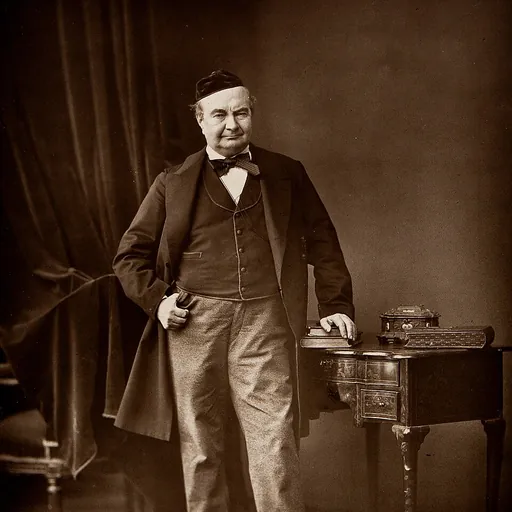
About Charles-Augustin Sainte-Beuve
Lived 1804 – 1869 (aged 64). Charles-Augustin Sainte-Beuve was a French writer, aphorist, poet, politician, professor and literary critic.
Charles Augustin Sainte-Beuve (; 23 December 1804 – 13 October 1869) was a French literary critic. into close association with Hugo and the Cénacle, the literary circle that strove to define the ideas of the rising Romanticism and struggle against classical formalism. Sainte-Beuve became friendly with Hugo after publishing a favourable review of the author's work but later had an affair with Hugo's wife, Adèle Foucher, which resulted in their estrangement. Curiously, when Sainte-Beuve was made a member of the French Academy in 1845, the ceremonial duty of giving the reception speech fell upon Hugo.
Career Sainte-Beuve published collections of poems and the partly autobiographical novel Volupté in 1834. His articles and essays were collected the volumes Port-Royal and Portraits littéraires.
During the rebellions of 1848 in Europe, he lectured at Liège on Chateaubriand and his literary circle. He returned to Paris in 1849 and began his series of topical columns, Causeries du lundi ('Monday Chats') in the newspaper, Le Constitutionnel. When Louis Napoleon became Emperor, he made Sainte-Beuve professor of Latin poetry at the Collège de France, but anti-Imperialist students hissed him, and he resigned.
Reception In 1880 Friedrich Nietzsche, though an avowed opponent of Sainte-Beuve, prompted the wife of his friend Franz Overbeck, Ida Overbeck, to translate the Causeries du lundi into German. Until then, Sainte-Beuve was never published in German despite his great importance in France, since it was considered representative of a French way of thinking detested in Germany. Ida Overbeck's translation appeared in 1880 under the title Die Menschen des XVIII. Jahrhunderts (Men of the 18th Century). Nietzsche wrote to Ida Overbeck on August 18, 1880: "An hour ago I received the Die Menschen des XVIII. Jahrhunderts, [...] It is just a marvellous book. I think I've cried." Ida Overbeck's translation is an important document of the cultural transfer between Germany and France in a period of strong tension, but it was largely ignored. It was not until 2014 that a critical and annotated edition of this translation appeared in print.
Sainte-Beuve died in Paris, aged 64.
Publications
Non-fiction Tableau Historique et Critique de la Poésie Française et du Théâtre Français au XVIe Siècle (2 vols., 1828). Port-Royal (5 vols., 1840–1859). Portraits Littéraires (3 vols., 1844; 1876–78). Portraits Contemporains (5 vols., 1846; 1869–71). Portraits de Femmes (1844; 1870). Causeries du Lundi (16 vols., 1851–1881). Nouveaux Lundis (13 vols., 1863–1870). Premiers Lundis (3 vols., 1874–75). Étude sur Virgile (1857). Chateaubriand et son Groupe Littéraire (2 vols., 1860). Le Général Jomini (1869). Madame Desbordes-Valmore (1870). M. de Talleyrand (1870). P.-J. Proudhon (1872). Chroniques Parisiennes (1843–1845 & 1876). Les Cahiers de Sainte-Beuve (1876). Mes Poisons (1926).
Novels Volupté (1834). Madame de Pontivy (1839). Christel (1839). La Pendule (1880).
Short stories Le Clou d’or dedicated to Sophie de Bazancourt, woman of letters and wife of général François Aimé Frédéric Loyré d'Arbouville. De la littérature industrielle, Paris, Allia, 2013, 48p. Portrait de Leopardi (Paris, Allia, 2019, 2nd edition, 80p)
Poetry Vie, Poésies et Pensées de Joseph Delorme (1829). Les Consolations (1830). Pensées d'août (1837). Livre d'Amour (1843). Poésies Complètes (1863). Poésies françaises d'une Italienne (1854) by Agathe-Sophie Sasserno, preface by Sainte-Beuve
In English translation Portraits of Celebrated Women (1868, trans. Harriet W. Preston). Memoirs of Madame Desbordes-Valmore (1873, trans. Harriet W. Preston). English Portraits (1875, a selection from Causeries du Lundi). Monday-chats (1877, trans. William Matthews) Essays on Men and Women (1890, trans. William Matthews and Harriet W. Preston). Essays (1890, trans. Elizabeth Lee). Portraits of Men (1891, trans. Forsyth Edeveain). Portraits of Women (1891, trans. Helen Stott). Select Essays of Sainte-Beuve (1895, trans. Arthur John Butler). The Prince de Ligne (1899, trans. Katharine Prescott Wormeley). The Correspondence of Madame, Princess Palatine (1899, trans. Katharine Prescott Wormeley). The Essays of Sainte-Beuve (1901, ed. William Sharp). Memoirs and Letters of Cardinal de Bernis (1902, trans. Katharine Prescott Wormeley). Causeries du lundi (1909–11, 8 vols., trans. E.J. Trechmann). Selected Essays (1963, trans. & ed. Francis Steegmuller and Norbert Guterman). Volupté: The Sensual Man (1995, trans. Marilyn Gaddis Rose).
Don’t just read it —
keep it.
Full-length biographies made to live with: read them, listen on the way to work, watch them tonight.
- E-book
- Audio
- Video
Instant download · yours to keep · every purchase keeps this site free
Important facts
more
M. Sainte Beuve, M. Ste BeuvePeople in Charles-Augustin Sainte-Beuve's life
Named in this biography and alive at the same time



Related people
Same field, nearest in time



Contemporaries
People whose lives overlapped Charles-Augustin Sainte-Beuve's





Frequently asked questions
Who was Charles-Augustin Sainte-Beuve?
French literary critic (1804–1869)
When was Charles-Augustin Sainte-Beuve born?
Charles-Augustin Sainte-Beuve was born on 23 December 1804 in Boulogne-sur-Mer.
When did Charles-Augustin Sainte-Beuve die?
Charles-Augustin Sainte-Beuve died on 13 October 1869 in Paris.
What was Charles-Augustin Sainte-Beuve's occupation?
Charles-Augustin Sainte-Beuve was a writer, aphorist, poet, politician, professor and literary critic.
What nationality was Charles-Augustin Sainte-Beuve?
Charles-Augustin Sainte-Beuve was French.
Sources & further reading
· Wikipedia: Charles-Augustin Sainte-Beuve
· DBpedia: Charles Augustin Sainte-Beuve
Cite this page
APA: Biography.guide. (2026). Charles-Augustin Sainte-Beuve. https://biography.guide/charles-augustin-sainte-beuve/
MLA: "Charles-Augustin Sainte-Beuve." Biography.guide, https://biography.guide/charles-augustin-sainte-beuve/.
Chicago: "Charles-Augustin Sainte-Beuve." Biography.guide. https://biography.guide/charles-augustin-sainte-beuve/.
Data last updated: 2026-09-21 · Spot an error? Report a correction.
Portrait: Wikimedia Commons · author & licence
Page generated 2026-09-27 05:00 UTC