
About Charles Soubre
Lived 1821 – 1895 (aged 73). Charles Soubre was a Belgian painter and draftsperson.
Charles Joseph Soubre (4 February 1821 – 29 January 1895) was a Belgian history painter and drawing professor at the Royal Academy of Fine Arts of Liège.
Soubre trained from 1834 in the studio of the landscape painter Jules Van Marcke, then at the Liège academy under and Gilles-François Closson, and finally at the Royal Academy of Fine Arts, Brussels. He supported his studies by giving lessons. In 1853 he was appointed professor of drawing at the Liège academy, beginning a teaching career that lasted 35 years. He retired with the title of honorary professor.
Soubre worked primarily as a history painter, drawing subjects from local history and legend, but also produced genre scenes, portraits, landscapes, and female nudes. His major historical canvases include Death of Henry IV, German Emperor (1850), A Noble Family Before the Council of Troubles (1873), La Måle Saint-Martin (1876), and The Departure of the Liège Volunteers for Brussels Led by Charles Rogier (1878). By the end of his life his kind of large-scale historical composition had fallen out of fashion, though his plein air landscapes, marked by balanced composition and decorative synthesis, continued to be valued.
Soubre exhibited extensively: sixteen times at the Brussels Salon between 1839 and 1884, nine times at the Antwerp Salon, ten times at the Ghent Salon, and at international events including the Paris Salon (1861, 1863), the London International Exhibitions (1872–1874), the Vienna World's Fair (1873), the Philadelphia Centennial Exposition (1876), and the Sydney International Exhibition (1879–1880). He received a gold medal at the 1866 Brussels Salon for Victor Pisani and a bronze medal at Sydney.
Biography
Early life and training
Charles Joseph Soubre was born on 4 February 1821 in Liège. His father, Jean Joseph Soubre (1788–1864), was a music dealer; his mother was Marie Françoise Hubertine Thiriard (1791–1861). His brother Étienne Soubre became a composer.
In 1834 Soubre began studying in the studio of the landscape painter Jules Van Marcke. From 1837 to 1843 he attended the Liège Academy of Fine Arts, where his teachers included , Gilles-François Closson, Lambert Herman, and Auguste Chauvin. He won first prizes for painting and historical composition there, View of the Banks of the Aîne in the Ardennes at the 1840 Antwerp Salon, The painting was later used—under the title A Violent Attack —as the cover illustration for Georgette Heyer's short-story collection Pistols for Two (Arrow Books, 2005).
At the 1848 Brussels Salon Soubre showed Henri de Dinant, Liège Tribune Departing for Exile. A review noted that while the colouring was "somewhat commonplace", the composition and drawing were strong, and the costumes historically faithful.
alt=A child lies in a canopy bed with crimson curtains, flanked on the left by two standing women and on the right by a man in profile and a man playing the lute.
In 1850 he presented Death of Henry IV, German Emperor at the Liège salon. The painting illustrates an anecdote from Michel de Montaigne's childhood: his father had him wakened each morning by music rather than abruptly, so as not to disturb his young mind. At the 1854 Brussels Salon he showed The Last Boatload of Hay. and Eugénie (born January 1857).
Professorship and mature work (1854–1889)
Teaching
Soubre was appointed professor of drawing at the Liège academy in August 1853 and taught there for over 35 years. He began in the elementary section, teaching linear drawing, replacing Henri Ponchon.
In 1859 he moved to intermediate teaching, taking over drawing "after the antique" and expression from Auguste Chauvin. When Chauvin retired in 1880, Soubre taught drawing "after the live model" and painting (advanced level) jointly with Jean-Mathieu Nisen for five years, and then exclusively after Nisen's death in 1885. succeeded him in the intermediate courses.
Exhibitions and sales
Alongside teaching, Soubre maintained an active exhibition schedule. He continued to produce historical scenes but also painted landscapes and genre works. In 1855 he showed Angelica and the Enchanted Horse, drawn from Orlando Furioso, at the Antwerp Salon.
From 1861 onward his exhibition pace quickened, becoming nearly annual for over twenty years. He appeared at the Brussels Salon (1863, 1866, 1869, 1872, 1875, 1878, 1881, 1884), the Antwerp Salon (1864, 1867, 1873, 1876, 1879), the Ghent Salon (1865, 1868, 1871, 1874, 1877, 1880, 1883, 1889), and internationally at the Paris Salon (1861, 1863), the London International Exhibitions (1872, 1873, 1874), the Vienna World's Fair (1873), the Philadelphia Centennial Exposition (1876), the Sydney International Exhibition (1879–1880), and the Historical Exhibition of Belgian Art (1880). He received a gold medal at the 1866 Brussels Salon and La Måle Saint-Martin was acquired by the Belgian royal family. (photographic reproduction of The Banquet of the Beggars), (photogravures for the Franklin Society of Liège album, 1877), Jean-Baptiste-Alfred Cornilliet,
Family
Soubre's first wife, Eugénie Cajot, died in December 1861. On 11 August 1863 he married Marie Christine Wurth (1828–1908), his first wife's niece. They had two daughters: Madilène Jeanne (known as Madeleine), and Marguerite Caroline, born in June 1869, who died at just over a year old.
Soubre's eldest daughter, Françoise, married the engineer Albert Battaille on 28 December 1878. Battaille was the son of Jean Battaille, an engineer in the Russian Empire, and Marie Straatman, daughter of the Brussels shipowner Lambert Straatman. They had three children. They had two children. and at the 1884 Brussels Salon,
Final years (1889–1895)
Soubre resigned his teaching post on 11 February 1889 and was named honorary professor in recognition of his service. He was replaced in drawing "after the live model" by Adrien de Witte and in painting by his son-in-law, Émile Delperée.
Soubre died unexpectedly on 29 January 1895 and was buried in Robermont Cemetery in Liège.
Work
Style
Charles Soubre was primarily a painter of historical subjects, genre scenes, portraits, landscapes, and female nudes. He is associated with the Romantic movement.
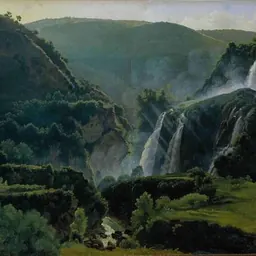
As a landscape painter, Soubre worked en plein air and had a taste for large formats unusual for the period, according to the art critic and museum curator Jules Bosmant. He ranged widely in search of subjects, from Grand-Halleux to the Grand Duchy of Luxembourg. Bosmant considered that Soubre "tended to see broadly, and rather as a decorator concerned with overall effect and balance, than with the truth of atmosphere and milieu". The art historian André Marchal concurred, noting Soubre's "pursuit of balanced masses, an organisation of planes and decorative synthesis".
The few nudes Soubre produced late in his career were, in Bosmant's words, "most chaste and quite inoffensive". They were unusual in being set in open-air décors with streams and trees surrounding female figures. When Soubre exhibited these works—considered audacious in provincial Liège at the end of the 19th century—a local newspaper rebuked him for neglecting "the moral duties of a professor at the Academy".
As a history painter, Bosmant wrote, Soubre brought "a serious spirit and gifts as a colourist which, at that time at least, were not negligible", and he drew more from local history and legend than any of his contemporaries. The art historian David Bronze observed that Soubre and his son-in-law Émile Delperée "perpetuate as best they can the tradition of history painting in Liège".
Soubre also produced decorative works. Around 1860 he painted a series of eight murals in the Edmond Hustinx room of the Vrijthof Theatre in Maastricht, personifying the four seasons and the four elements.
Principal works
Death of Henry IV, German Emperor (1850)
Commissioned by the city of Liège, The review noted that a canvas on the same subject, titled Provenzano Salvani Begging for his Friend's Ransom, appeared at the 1863 Brussels Salon. before it was acquired by the city of Liège in 1875. and photogravure.
The scene is set before the Council of Troubles, the tribunal established by the Duke of Alba to suppress unrest in the Netherlands from 1566. Also known as the Council of Blood, it was responsible for numerous executions; a study published by the Royal Academy of Belgium in 1961 lists 12,302 victims banished or executed between 1567 and 1573.
Jules Bosmant considered the painting to be "of a sufficiently broad historical scope to be situated solely in time", representing "a moment of our Western civilisation". He noted that the "very sober composition, in which gestures are rare and measured, in which there is no theatrical effect, does not lack grandeur".
La Måle Saint-Martin (1876)
This painting, which entered the Belgian Royal Collection, was sent to the Philadelphia Centennial Exposition of 1876 the Museum of Walloon Life, the Royal Museum of the Armed Forces and Military History, the Herbert Art Gallery and Museum in Coventry, the Belgian Royal Collection,
Critical reception
During his lifetime Soubre's work was generally well received by critics and the public. (1867–1947) (1856–1911) (1869–1950) Edgar D'Hont (1861–1941) (1862–1921) (1850–1889) (1846–1887) Émile Ubaghs (1844–1879) (1852–1937) 1842: Brussels Salon, 22 August – 6 November, former apartments of the Palace of Charles of Lorraine, Brussels (Landscape; Souvenir of the Ardennes). 1844: 19th triennial salon – Ghent Salon, 30 June – 12 August, Palace of Justice, Ghent (The Return from Palestine). 1845: Brussels Salon, 15 August – 6 October, former apartments of the Palace of Charles of Lorraine, Brussels (The Return from Palestine). 1846: Antwerp Salon, 1 August – 15 September, rue Vénus, Antwerp (View Taken in the Valley of Lauterbrunnen, Canton of Bern). 1848: Brussels Salon, 15 August – 2 October (Henri de Dinant, Liège Tribune Departing for Exile). 1850: Liège Salon, May–June, Société d'Émulation, Liège (Death of Henry IV, German Emperor). 1852: Antwerp Salon, 8 August – 19 September, rue Vénus, Antwerp (The Awakening of Montaigne). 1854: Brussels Salon, 6 August – 1 November (The Last Boatload of Hay). 1855: Antwerp Salon, 12 August – 30 September, rue Vénus, Antwerp (Angelica and the Enchanted Horse). 1857: Brussels Salon, 1 September – 15 November (Dream of an Arab Chief). 1858: Liège Salon. 1860: Liège Salon, May–June; Brussels Salon, 18 August – 1 November (The Madness of Ophelia). 1861: Paris Salon (Dream of an Arab Chief). 1862: Liège Salon, May–June, Société d'Émulation (second version of The Awakening of Montaigne). 1863: Paris Salon (Saint Vincent de Paul Attending the Dying Louis XIII and Saint Vincent de Paul Among the Daughters of Charity); Brussels Salon, 3 August – 15 October (Provenzano Salvani Begging for his Friend's Ransom). 1864: Liège Salon, April–May (Ardenne Poachers in the St Jean Forest); Antwerp Salon, 7 August – 2 October (Ardenne Poachers in the St Jean Forest). 1865: 26th national and triennial exhibition – Ghent Salon, 15 August – September (The Horror of Cold Water). 1866: Brussels Salon, 9 August – 21 October (Victor Pisani). 1867: Antwerp Salon, 11 August – 6 October (Execution of Pierre de Bex, Former Mayor of Liège and Ardenne Shepherd; Autumn Squall). 1868: Exhibition of the Union of Artists, July, Liège (two genre scenes and Victor Pisani); 27th national and triennial exhibition – Ghent Salon, 13 September – October (Good Friday and Poachers Lying in Wait). 1869: Liège Salon, April–May (First Prayer and Notched Sword); Brussels Salon, 29 July – 27 October, greenhouses of the former botanical garden, Brussels (The Banquet of the Beggars). 1871: 28th national and triennial exhibition – Ghent Salon, 10 September – 14 November (Proud Humility and Premonition). 1872: Brussels Salon, 15 August – 3 November (Mary Stuart); London International Exhibition, Royal Albert Hall (Proud Humility). 1873: Vienna World's Fair, 1 May – 1 November (A Noble Family Before the Council of Troubles); Antwerp Salon, 10 August – 5 October (Jeanne the Sulker, Bohemian Woman and Ardenne Shepherd Struck by Lightning); London International Exhibition, Royal Albert Hall (Mary Stuart and The Last Days of Queen Elizabeth I). 1874: 29th triennial exhibition – Ghent Salon, 30 August – 18 October (Cromwell and his Daughter Lady Claypole); London International Exhibition, Royal Albert Hall (Catherine of Aragon and Cardinal Wolsey and A Noble Family Before the Council of Troubles). 1875: Liège Salon, April–May (A Noble Family Before the Council of Troubles); Brussels Salon, 23 August – 15 November (A Burial in the Ardennes). 1876: Philadelphia Centennial Exposition, 10 May – 10 November (La Måle Saint-Martin); Antwerp Salon, 13 August – 1 October (The Banquet of the Beggars and Cromwell and his Daughter Lady Claypole). 1877: 30th triennial exhibition – Ghent Salon, 26 August – 2 November (La Måle Saint-Martin, Lady Macbeth and The Snub). 1878: Brussels Salon, 5 September – 3 November (The 4th of September 1830, also known as The Departure of the Liège Volunteers for Brussels Led by Charles Rogier). 1879: Liège Salon, 25 April – 28 May (The 4th of September 1830); Antwerp Salon, 10 August – 1 October (A Burial in the Ardennes and Resentment); Exhibition of the Artistic Circle, December, casino hall of the Passage Lemonnier, Liège. 1879–1880: Sydney International Exhibition, 18 September 1879 – June 1880 (The Notched Sword); Exhibition of drawings, watercolours and sketches, Artistic and Literary Circle of Liège, 25 December 1879 – 2 January 1880. 1880: 31st triennial exhibition – Ghent Salon, 15 August – 2 November (Happiness); Circle Artistic Festival, August, Artistic and Literary Circle of Brussels; Historical Exhibition of Belgian Art 1830–1880, 1 August – 31 October, Royal Museums of Fine Arts of Belgium, Brussels (The 4th of September 1830 and A Noble Family Before the Council of Troubles). 1881: Brussels Salon, 14 August – 16 September (Jealousy). 1883: 32nd triennial exhibition – Ghent Salon, 26 August – 4 November (Weariness and Study of a Head). 1884: Brussels Salon, 1 September – 1 November (The Widow). 1889: 34th triennial exhibition – Ghent Salon, 11 August – 6 October (Sunday Morning in the Ardennes and Javanese Woman Teasing a Cat). 1892: Liège Salon, 8 May – 4 June, festival hall and foyer of the Royal Conservatory of Liège (pastel portrait). 1893–1895: various exhibitions at the Royal Circle of Fine Arts of Liège.
Posthumous exhibitions
1895: Charles Soubre Retrospective, March–April, Emulation Hall, Liège; 36th triennial exhibition – Ghent Salon, 1 September – 28 October (posthumous showing of the pastel Young Girl at the Fountain). 1955: Romanticism in the Country of Liège, 10 September – 31 October, Museum of Fine Arts, Liège. 1964: 125th Anniversary of the Royal Academy of Fine Arts, 11 April – 10 May, Museum of Fine Arts, Liège. 1992: The Royal Circle of Fine Arts of Liège 1892–1992, 18 September – 6 October, Royal Circle of Fine Arts, Liège (catalogue no. 21, Ardennes Landscape). 2001–2002: Towards Modernity: the 19th Century in the Country of Liège, 5 October 2001 – 20 January 2002, Museum of Walloon Art and Saint-Georges Hall, Liège (The Departure of the Liège Volunteers for Brussels Led by Charles Rogier, The Arrival of Charles Rogier and the Liège Volunteers in Brussels, and The Indonesian Woman with the Parasol). 2012: Spirituality, 9 June – 1 July, Rue des Prémontrés 38, Liège. 2018: Liège School of Landscape (1880–1950), 1 August – 2 September, Fléron; Liège School of Landscape, 27 October – 18 November, Saint-Hubert. 2019: Paintings of Fishing and Rivers, 6–28 July, Chapel of the Sépulcrines, Visé. 2021: June 2021 at the Office… Still More Heintz, 5 June – 4 July, Rue Henri Vieuxtemps 13, Liège (The Beggar Girl). 2024: Quaestus: Art Acquisitions at the Treasury of Liège, 4 July – 6 October, Treasury of Liège Cathedral (The Holy Family, 1862).
Awards
1866: gold medal at the Brussels Salon for Victor Pisani. 1879: Knight of the Order of Leopold (7 February). 1880: bronze medal at the Sydney International Exhibition.
Don’t just read it —
keep it.
Full-length biographies made to live with: read them, listen on the way to work, watch them tonight.
- E-book
- Audio
- Video
Instant download · yours to keep · every purchase keeps this site free
Important facts
People in Charles Soubre's life
Named in this biography and alive at the same time



Related people
Same field, nearest in time


Contemporaries
People whose lives overlapped Charles Soubre's



Frequently asked questions
Who was Charles Soubre?
Belgian painter (1821-1895)
When was Charles Soubre born?
Charles Soubre was born on 4 February 1821 in Liège.
When did Charles Soubre die?
Charles Soubre died on 29 January 1895 in Liège.
What was Charles Soubre's occupation?
Charles Soubre was a painter and draftsperson.
What nationality was Charles Soubre?
Charles Soubre was Belgian.
Sources & further reading
Cite this page
APA: Biography.guide. (2026). Charles Soubre. https://biography.guide/charles-soubre/
MLA: "Charles Soubre." Biography.guide, https://biography.guide/charles-soubre/.
Chicago: "Charles Soubre." Biography.guide. https://biography.guide/charles-soubre/.
Data last updated: 2026-09-27 · Spot an error? Report a correction.
Page generated 2026-09-27 05:17 UTC