
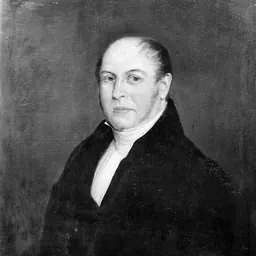
Samuel Stanhope Smith
American clergyman and educator (1751–1819); president of Princeton university
About Samuel Stanhope Smith
Lived 1751 – 1819 (aged 68). Samuel Stanhope Smith was an American writer and politician.
Samuel Stanhope Smith (March 15, 1751 – August 21, 1819) was a Presbyterian minister, founding president of Hampden–Sydney College and the seventh president of the College of New Jersey (now Princeton University) from 1795 to 1812. His stormy career ended in his forced resignation. His words – "If reason and charity cannot promote the cause of truth and piety, I cannot see how it should ever flourish under the withering fires of wrath and strife" – epitomize his career.
Early life Smith was born in Pequea, Pennsylvania, on March 15, 1751. He was the son of Robert Smith (1723–1793) and Elizabeth (née Blair) Smith (1725–1777). In 1769, he graduated as a salutatorian from the College of New Jersey (name later changed to Princeton University), and went on to study theology and philosophy under John Witherspoon. The school, not then named, was always intended to be a college-level institution; later in the same advertisement, Smith explicitly likens its curriculum to that of the College of New Jersey. "Academy" was a technical term used for college-level schools not run by the established church. Stanhope Smith held honorary doctorates from Yale and Harvard and in 1785, was elected a member of the American Philosophical Society.
President of Princeton Smith studied under president Witherspoon and returned to Princeton as a professor in 1779, and succeeded Witherspoon as president in 1795. The situation during the winter semester of 1806–07 under Smith's presidency was characterized by little or no faculty-student rapport or communication, crowded conditions, and strict school rules — a combination that led to a student riot on 31 March–1 April 1807. College authorities denounced it as a sign of moral decay. Smith was active in the affairs of the Presbyterian Church and served as moderator of the 11th General Assembly in 1799. Smith was an urbane and cultivated man who sought, in the tradition of Witherspoon, to maintain orthodoxy while opposing tendencies toward rigidity and obscurantism. His efforts were unsuccessful, and he was forced to resign from his office in 1812 as a result of criticism from within the church. In his efforts to reconcile reason and revelation Smith left himself vulnerable to charges of rationalism and Arminianism.
Theories Smith was the first systematic expositor of Scottish Common Sense Realism in America. An empiricist in his anthropology and a Lamarckian before Lamarck, he sought to mediate between science and religious orthodoxy. He opposed the racial classifications of naturalists such as Johann Friedrich Blumenbach, Georges-Louis Leclerc, Comte de Buffon, and Carl Linnaeus. In this text, his attempt to explain the variety of physical appearances among humans involved a strongly environmental outlook. An example he provides involves "the blacks in the southern states." Smith noted that field slaves had darker skin pigmentation and other "African" features than did domestic slaves, and claimed that exposure to white, European culture through their "civilized" masters had changed their anatomy as well.
In Smith's essay titled Essay on the Causes of Variety of Complexion and Figure in the Human Species, Smith claimed that Negro pigmentation was nothing more than a huge freckle that covered the whole body as a result of an oversupply of bile, which was caused by tropical climates. In this essay Smith described the basic concept of sexual selection, this was before Charles Darwin later popularized the theory.
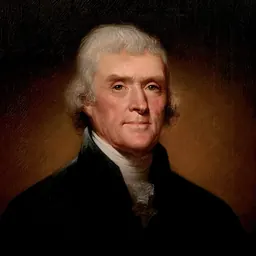
Smith is also known for his attempt to refute Thomas Jefferson's claim in Notes on the State of Virginia that there were no great black writers or artists. In it, he attacked Jefferson's disregard of poetic abilities of Phillis Wheatley.
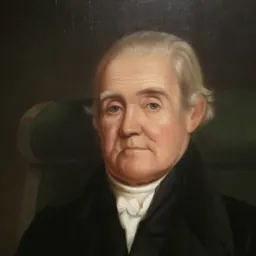
Noah Webster cited Stanhope Smith in Webster's 1828 Dictionary in the definition of philosophy. The citation was from Stanhope Smith's second edition of his Essay on the Causes of Variety of Complexion and Figure in the Human Species (1810). The quote as given, "True religion, and true philosophy must ultimately arrive at the same principle."
Personal life On June 28, 1775, Smith was married to Ann Witherspoon (1749–1817), the daughter of his mentor and predecessor President. Together, they were the parents of:
Elizabeth Smith, who married John Marsden Pristard.
Works Essay on the Causes of Variety of Complexion and Figure in the Human Species. (1787, 2nd ed. 1810) Sermons. Newark, New Jersey: Jacob Halsey and Co., 1799. Lectures on the Evidences of the Christian Religion. (1809) Lectures on Moral and Political Philosophy. (1812) A Comprehensive View of the Leading and Most Important Principles of Natural and Revealed Religion: Digested in Such Order as to Present to the Pious and Reflecting Mind, a Basis for the Superstructure of the Entire System of the Doctrines of the Gospel, Samuel Stanhope Smith, New Brunswick, N.J., Deare & Myer, 1815
Don’t just read it —
keep it.
Full-length biographies made to live with: read them, listen on the way to work, watch them tonight.
- E-book
- Audio
- Video
Instant download · yours to keep · every purchase keeps this site free
Important facts
People in Samuel Stanhope Smith's life
Named in this biography and alive at the same time





Related people
Same field, nearest in time


Contemporaries
People whose lives overlapped Samuel Stanhope Smith's



Frequently asked questions
Who was Samuel Stanhope Smith?
American clergyman and educator (1751–1819); president of Princeton university
When was Samuel Stanhope Smith born?
Samuel Stanhope Smith was born on 15 March 1751 in Pequea.
When did Samuel Stanhope Smith die?
Samuel Stanhope Smith died on 21 August 1819 in Princeton.
What was Samuel Stanhope Smith's occupation?
Samuel Stanhope Smith was a writer and politician.
What nationality was Samuel Stanhope Smith?
Samuel Stanhope Smith was American.
Sources & further reading
· Wikipedia: Samuel Stanhope Smith
· DBpedia: Samuel Stanhope Smith
Cite this page
APA: Biography.guide. (2026). Samuel Stanhope Smith. https://biography.guide/samuel-stanhope-smith/
MLA: "Samuel Stanhope Smith." Biography.guide, https://biography.guide/samuel-stanhope-smith/.
Chicago: "Samuel Stanhope Smith." Biography.guide. https://biography.guide/samuel-stanhope-smith/.
Data last updated: 2026-09-26 · Spot an error? Report a correction.
Page generated 2026-09-27 05:14 UTC