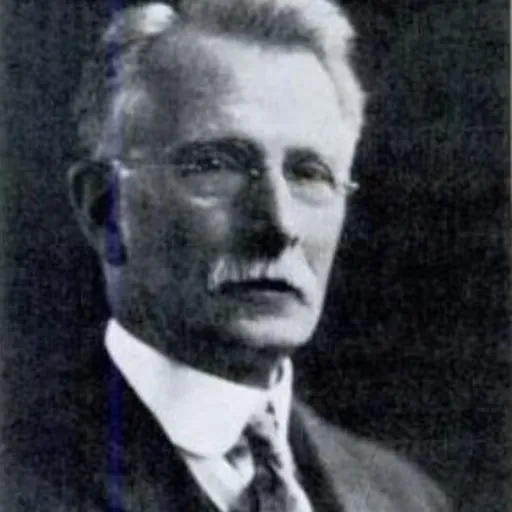
About Philip Green Wright
Lived 1861 – 1934 (aged 72). Philip Green Wright was an American econometrician, publisher, economist and poet.
Philip Green Wright (October 3, 1861 – September 4, 1934) was an American economist who in 1928 first proposed the use of instrumental variables estimation as the earliest known solution to the identification problem in econometrics. In a book review published in 1915 he wrote one of the first explanations of the identification problem. His primary topic of applied research was tariff policy, and he wrote several books on the topic. He also wrote poetry, was a mentor to the poet and author Carl Sandburg, and published some of Sandburg's earliest works. Wright was the father of geneticist Sewall Wright.
Early life Wright was born in Boston, Massachusetts, in 1861 to John Seward Wright and Mary Clark Green Wright. His grandfather was Elizur Wright, an abolitionist and pioneer of life insurance regulation. Philip Wright grew up in Medford, Massachusetts, and in 1884 graduated from Tufts College with a bachelor of mechanic arts (AMB) degree. From 1884 to 1886 he taught mathematics at Buchtel College in Akron, Ohio, after which he attended Harvard University and graduated with a Master of Arts (AM) degree in economics in 1887.
After graduating from Harvard, Wright worked as a civil engineer and a life insurance actuary. In 1889 he married Elizabeth Quincy Sewall of Saint Paul, Minnesota, who was Wright's first cousin. The couple had three sons, geneticist Sewall Wright, political scientist Quincy Wright, and aeronautical engineer Theodore Paul Wright. Wright's teaching load was heavy and covered a wide variety of subjects. In addition to teaching mathematics (through calculus), astronomy, and economics, he also taught classes in fiscal history, surveying, English composition, and literature and was director of the gymnasium. He owned a hand printing press, which he used to print college notices and bulletins from the basement of his home. He also wrote two books of poetry, A Baker's Dozen for a Few Score Friends (1903) and The Dreamer (1906), that he published from his own basement press, which he named "Asgard Press." The Dreamer was favorably reviewed by William Marion Reedy, editor of The Mirror, who described it as "poetry of this very time, a poetry of intense concern of practicality, full of 'the hate of hater, the scorn of scorn, the love of love.'".
From 1898 to 1902, Sandburg, recently discharged from military service in the Spanish–American War, enrolled as a student at Lombard College. Wright taught a class called "Daily Themes" in which students were required to write one or two-page essays each day and then critique their work. He also invited about a dozen students to his home each Sunday evening for a literary discussion group. During Sandburg's final year at Lombard, Wright organized a "Poor Writers' Club" consisting of Sandburg, two other students who were interested in creative writing, and himself, in which they discussed each other's work and endeavored to improve it. Sandburg was influenced not only by Wright's interests in poetry and literature, but also by his political theory and emphasis on social consciousness. Sandburg wrote, "I had four years of almost daily contact with [Wright] and visited with him in later years as often as possible. And there was never a time that he didn't deepen whatever reverence I had for the human mind and the workings of a vast mysterious Universe."
In 1904 Wright's Asgard Press published Sandburg's first book, In Reckless Ecstasy, a 39-page book containing 17 poems and six prose vignettes. Wright wrote the foreword, writing that the contents have "the delightful bloom and freshness and spontaneous enthusiasm of expression of one who is witnessing the sunrise for the first time." The edition of 100 copies sold out at a price of $1.00 each.
Economics and instrumental variables Return to Massachusetts In 1912, with his two oldest sons having graduated from Lombard College, Wright decided to return to Massachusetts. He first took a position as an assistant professor at Williams College, substituting for a professor on leave. In 1913 he obtained employment at Harvard University, first as the assistant to Frank W. Taussig, his former advisor, then as an instructor in economics. Finally having the time and opportunity to write on economics, Wright was prolific, writing several articles and reviews for the Quarterly Journal of Economics, which Taussig edited.
Move to Washington In 1917, Wright accepted a position in Washington with the newly formed U.S. Tariff Commission where Taussig had been appointed as the first chairman. Wright remained at the Tariff Commission until 1922, when he accepted a position at the Institute of Economics, which would later become the Brookings Institution. He worked at Brookings until his retirement in 1929, writing several monographs and scholarly articles on international trade and tariffs.
Instrumental variables In an appendix of his 1928 book, The Tariff on Animal and Vegetable Oils, Wright proposed instrumental variables regression as a solution to the identification problem for a supply-and-demand model. Wright needed to estimate the slope of a demand curve in order to measure the impact of a tariff. But, as he had noted in his 1915 review of Moore's book, the observed data were determined simultaneously by supply and demand, so the demand curve could not be determined directly from data on price and quantity alone. The appendix begins with a thorough explanation of the identification problem in the context of a supply-and-demand model. Wright noted that statistical methods "must be based on the introduction of additional factors. Such additional factors may be factors which (A) affect demand conditions without affecting cost conditions or which (B) affect cost conditions without affecting demand conditions."
For more than four decades Wright's 1928 publication on instrumental variables was overlooked and largely forgotten. In the 1940s Olav Reiersøl and Roy C. Geary independently discovered the idea of using instrumental variables to solve the identification problem in an errors-in-variables model, and a 1945 paper by Reiersøl introduced the name "instrumental variables." In a 1972 article that largely focused on Sewall Wright's method of path analysis, Arthur Goldberger rediscovered Philip Wright's 1928 appendix.
Goldberger said that Wright prepared the 1928 appendix on instrumental variables in collaboration with his son, Sewall.
Retirement and death After Wright's retirement from the Brookings Institution, he did research on tariffs for the Institute of Pacific Relations and on the effects of inflation for the Duke Foundation. With his wife, Elizabeth, he coauthored a biography of their grandfather, Elizur Wright, which was published after Philip's death. A newspaper reported that at Lombard College's final commencement ceremonies on June 2, 1930, the exercises "were closed by the singing of 'The Lombard Hymn,' written by Dr. Philip G. Wright, Lombard... former professor, of Washington, DC."
In honor of Wright and other teachers from Lombard College, Knox College annually presents the Philip Green Wright – Lombard College Prizes for Distinguished Teaching to two Knox faculty members.
On October 3, 2011, Tufts University organized a seminar honoring Wright on the 150th anniversary of his birth.
Don’t just read it —
keep it.
Full-length biographies made to live with: read them, listen on the way to work, watch them tonight.
- E-book
- Audio
- Video
Instant download · yours to keep · every purchase keeps this site free
Important facts
People in Philip Green Wright's life
Named in this biography and alive at the same time






Related people
Same field, nearest in time



Contemporaries
People whose lives overlapped Philip Green Wright's

Frequently asked questions
Who was Philip Green Wright?
American economist
When was Philip Green Wright born?
Philip Green Wright was born on 3 October 1861 in Boston.
When did Philip Green Wright die?
Philip Green Wright died on 4 September 1934 in Washington, D.C..
What was Philip Green Wright's occupation?
Philip Green Wright was an econometrician, publisher, economist and poet.
What nationality was Philip Green Wright?
Philip Green Wright was American.
Sources & further reading
· Wikipedia: Philip Green Wright
· DBpedia: Philip Green Wright
Cite this page
APA: Biography.guide. (2026). Philip Green Wright. https://biography.guide/philip-green-wright/
MLA: "Philip Green Wright." Biography.guide, https://biography.guide/philip-green-wright/.
Chicago: "Philip Green Wright." Biography.guide. https://biography.guide/philip-green-wright/.
Data last updated: 2026-09-23 · Spot an error? Report a correction.
Portrait: Wikimedia Commons · author & licence
Page generated 2026-09-27 05:07 UTC