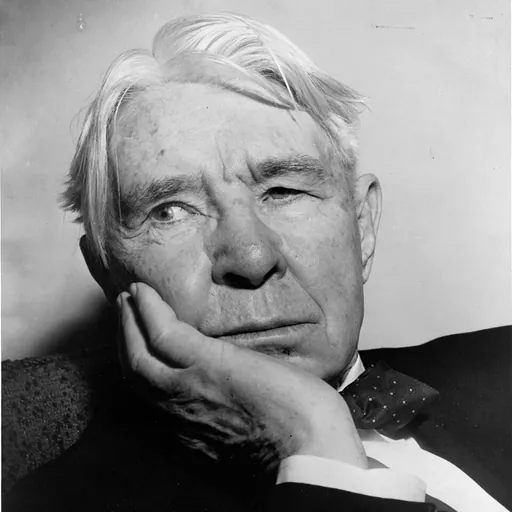
About Carl Sandburg
Lived 1878 – 1967 (aged 89). Carl Sandburg was an American poet, musicologist, historian, novelist, writer and screenwriter.
Life
Carl Sandburg was born in a three-room cottage at 313 East Third Street in Galesburg, Illinois, to Clara Mathilda (née Anderson) and August Sandberg, both of Swedish ancestry. He adopted the nickname "Charles" or “Charlie” in elementary school and, along with his two oldest siblings, changed the spelling of the family name to "Sandburg".
At the age of thirteen, Sandburg left school and began driving a milk wagon. Between approximately ages fourteen and seventeen or eighteen, he worked as a porter at the Union Hotel barbershop in Galesburg. He later returned to the milk route for eighteen months before working as a bricklayer and a farm laborer on the wheat plains of Kansas.
After a period at Lombard College in Galesburg, Sandburg worked in various jobs, including as a hotel servant in Denver and a coal-heaver in Omaha, Nebraska. He began his writing career as a journalist for the Chicago Daily News and went on to write poetry, history, biographies, novels, children's literature, and film reviews. He also collected and edited books of ballads and folklore. Sandburg lived primarily in Illinois, Wisconsin, and Michigan before moving to North Carolina.
During the Spanish–American War, Sandburg volunteered for military service and was stationed in Puerto Rico with the 6th Illinois Infantry, landing at Guánica on July 25, 1898, though he did not see combat. He attended the United States Military Academy in West Point, New York for two weeks but left after failing mathematics and grammar examinations. He returned to Galesburg and entered Lombard College, leaving without a degree in 1903.
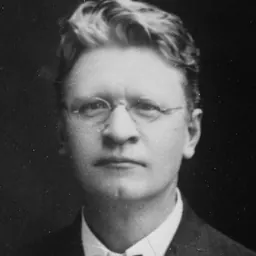
Sandburg subsequently moved to Milwaukee, Wisconsin, where he worked for a newspaper and joined the Wisconsin Social Democratic Party, affiliated with the Socialist Party of America. Sandburg served as secretary to Emil Seidel, Milwaukee's socialist mayor from 1910 to 1912. Sandburg later stated that his experiences in Milwaukee were formative for his life and work.
Sandburg's home in Ravenswood, Chicago, where he wrote "Chicago", designated a Chicago Landmark in 2005.
In 1907, Sandburg met Lilian Steichen (1883–1977), sister of photographer Edward Steichen, at the Milwaukee Social Democratic Party office. They married the following year and had three daughters. Their first daughter, Margaret, was born in 1911. The family later lived in Harbert, Michigan; the Ravenswood neighborhood of Chicago; and then in Maywood, Illinois. In 1945, he settled at Connemara, a estate in Flat Rock, Henderson County, North Carolina, where he lived with his wife, daughters, and grandchildren and produced a substantial portion of his later writings.
Remembrance Rock gravesiteOn February 12, 1959, during the 150th anniversary of Abraham Lincoln’s birth, Sandburg delivered an address before a joint session of Congress following actor Fredric March’s reading of the Gettysburg Address. Sandburg supported the civil rights movement and received the NAACP Silver Plaque Award in recognition of his contributions to civil rights.
Sandburg died of natural causes in 1967 and his body was cremated. The ashes were interred under "Remembrance Rock", a granite boulder located behind his birth house in Galesburg.
Career
Poetry and prose
Much of Carl Sandburg's poetry, such as "Chicago", focused on Chicago, Illinois, where he spent time as a reporter for the Chicago Daily News and The Day Book. His most famous description of the city is as "Hog Butcher for the World/Tool Maker, Stacker of Wheat/Player with Railroads and the Nation's Freight Handler,/Stormy, Husky, Brawling, City of the Big Shoulders."
Sandburg earned Pulitzer Prizes for his collection The Complete Poems of Carl Sandburg, Cornhuskers, and for his biography of Abraham Lincoln (Abraham Lincoln: The War Years).
Lincoln works Sandburg's popular multivolume biography Abraham Lincoln: The Prairie Years, 2 vols. (1926) and Abraham Lincoln: The War Years, 4 vols. (1939) are collectively "the best-selling, most widely read, and most influential book about Lincoln." The books have been through many editions, including a one-volume edition in 1954 prepared by Sandburg.
Sandburg's Lincoln scholarship had an enormous impact on the popular view of Lincoln. The books were adapted by Robert E. Sherwood for his Pulitzer Prize-winning play, Abe Lincoln in Illinois (1938) and David Wolper's six-part dramatization for television, Sandburg's Lincoln (1974). He recorded excerpts from the biography and some of Lincoln's speeches for Caedmon Records in New York City in May 1957. He was awarded a Grammy Award in 1959 for Best Performance – Documentary Or Spoken Word (Other Than Comedy) for his recording of Aaron Copland's Lincoln Portrait with the New York Philharmonic. Some historians suggest more Americans learned about Lincoln from Sandburg than from any other source.
The books garnered critical praise and attention for Sandburg, including the 1940 Pulitzer Prize for History for the four-volume The War Years. But Sandburg's works on Lincoln also received substantial criticism. William E. Barton, who had published a Lincoln biography in 1925, wrote that Sandburg's book "is not history, is not even biography" because of its lack of original research and uncritical use of evidence, but Barton nevertheless thought it was "real literature and a delightful and important contribution to the ever-lengthening shelf of really good books about Lincoln." Historian Milo Milton Quaife criticized Sandburg for not documenting his sources and questioned the accuracy of The Prairie Years, noting they contain a number of factual errors. According to the musicologist Judith Tick: As a populist poet, Sandburg bestowed a powerful dignity on what the '20s called the "American scene" in a book he called a "ragbag of stripes and streaks of color from nearly all ends of the earth ... rich with the diversity of the United States." Reviewed widely in journals ranging from the New Masses to Modern Music, the American Songbag influenced a number of musicians. Pete Seeger, who calls it a "landmark", saw it "almost as soon as it came out." The composer Elie Siegmeister took it to Paris with him in 1927, and he and his wife Hannah "were always singing these songs. That was home. That was where we belonged."
Music Settings The Song & the Slogan by Daniel Steven Crafts, commissioned by opera star Jerry Hadley.
Illinois Farmer by Daniel Steven Crafts, commissioned by opera star Jerry Hadley.
Film Sandburg said he considered working on D. W. Griffith's Intolerance (1916), but his first film work was when he signed on to work on the production of The Greatest Story Ever Told (1965) in July 1960 for a year, receiving an "in creative association with Carl Sandburg" credit on the film.
Legacy
Commemoration Carl Sandburg's boyhood home in Galesburg is now operated by the Illinois Historic Preservation Agency as the Carl Sandburg State Historic Site. The site contains the cottage Sandburg was born in, a modern visitor center, and small garden with a large stone called Remembrance Rock, under which his and his wife's ashes are buried. Sandburg's home of 22 years in Flat Rock, Henderson County, North Carolina, is preserved by the National Park Service as the Carl Sandburg Home National Historic Site. Carl Sandburg College is located in Sandburg's birthplace of Galesburg, Illinois. Carl Sandburg High school is located in Orland park, Illinois. During the Spanish-American War, Sandburg was stationed at Camp Alger in Fairfax County, Virginia and so the county has both a Sandburg Road near the spot where the camp was located and a Carl Sandburg Middle School.
On January 6, 1978, the 100th anniversary of his birth, the United States Postal Service issued a commemorative stamp honoring Sandburg. The spare design consists of a profile originally drawn by his friend William A. Smith in 1952, along with Sandburg's own distinctive autograph.
The Rare Book & Manuscript Library (University of Illinois at Urbana-Champaign) (RBML) houses the Carl Sandburg Papers. The bulk of the collection was purchased directly from Carl Sandburg and his family. In total, the RBML owns over 600 cubic feet of Sandburg's papers, including photographs, correspondence, and manuscripts.
In 2011, Sandburg was inducted into the Chicago Literary Hall of Fame.
Namesakes Carl Sandburg Village was a 1960s urban renewal project in the Near North Side, Chicago. Financed by the city, it is located between Clark and LaSalle St. between Division Street and North Ave. Solomon & Cordwell, architects. In 1979, Carl Sandburg Village was converted to condominium ownership.
Numerous schools are named for Sandburg throughout the United States, and he was present at some of these schools' dedications. (Some years after attending the 1954 dedication of Carl Sandburg High School in Orland Park, Illinois, Sandburg returned for an unannounced visit; the school's principal at first mistook him for a hobo.) Sandburg Halls, a student residence hall at the University of Wisconsin–Milwaukee, carries a plaque commemorating Sandburg's roles as an organizer for the Social Democratic Party and as personal secretary to Emil Seidel, Milwaukee's first Socialist mayor.
Carl Sandburg Library opened in Livonia, Michigan, in 1961. The name was recommended by the Library Commission as an example of an American author representing the best of literature of the Midwest. Carl Sandburg had taught at the University of Michigan for a time.
Galesburg opened Sandburg Mall in 1975, named in honor of Sandburg.
Amtrak added the Carl Sandburg train in 2006 to supplement the Illinois Zephyr on the Chicago–Quincy route.
Carl Sandburg Middle School in Alexandria, Virginia, part of Fairfax County Public Schools, was named in honor of Sandburg in 1985.
In 2000, the Chicago Public Library Foundation created the Carl Sandburg Literary Award, given annually to "an acclaimed author whose work has enhanced the public’s awareness of the written word."
Politics
Carl Sandburg began his political involvement as an organizer for the Social Democratic Party of Wisconsin, affiliated with the Socialist Party of America, and served as secretary to Milwaukee's socialist mayor Emil Seidel from 1910 to 1912. Initially a committed socialist, he left the Socialist Party in 1917 due to disagreements with its opposition to U.S. participation in World War I, instead supporting President Woodrow Wilson's decision to enter the conflict.
Although Sandburg continued to hold some socialist sympathies—such as voting for Socialist Party candidate Eugene V. Debs in the 1920 United States presidential election—he later described himself as a "radical independent". During the 1920s, his political views moved to the right, and he developed a strong interest in Abraham Lincoln, whose life and leadership became central themes in his work. This interest culminated in his publication of Abraham Lincoln: The Prairie Years (1926) and Abraham Lincoln: The War Years (1939). His study of Lincoln reflected an increasing alignment with liberalism.
In the 1930s, Sandburg's political orientation shifted toward the Democratic Party. He supported President Franklin D. Roosevelt and the New Deal, drawing parallels between Roosevelt's policies and Lincoln's leadership during the Civil War. Sandburg publicly expressed his support for New Deal programs such as Social Security and federal employment initiatives through his writings and public appearances.
By the 1950s, Sandburg endorsed Democratic presidential candidate Adlai Stevenson II in the 1952 and 1956 presidential elections, participating in campaign activities and publicly commending Stevenson's platform. In 1960, he supported John F. Kennedy’s presidential campaign, speaking at rallies and expressing approval of Kennedy's New Frontier program, which he viewed as a continuation of Roosevelt’s legacy.
In other media
William Saroyan wrote a short story about Sandburg in his 1971 book Letters from 74 rue Taitbout or Don't Go But If You Must Say Hello To Everybody. Sandburg's "Sometime they'll give a war and nobody will come" from The People, Yes was a slogan of the German peace movement ("Stell dir vor, es ist Krieg, und keiner geht hin"); however, it is often falsely attributed to Bertolt Brecht. Daniel Steven Crafts' The Song and The Slogan is an orchestral composition built around recited passages from Sandburg's "Prairie". Peter Louis van Dijk's "Windy City Songs", based on the Chicago poems, was performed by the Chicago Children's Choir and the Nelson Mandela Metropolitan University Choir in 2007. Bob Gibson's "The Courtship of Carl Sandburg", starring Tom Amandes as Sandburg In Jonathan Lethem's novel Dissident Gardens the main character Rose Zimmer became an Abraham Lincoln devotee after reading Sandburg's biography. Her copy of the six volumes became the centerpiece of her shrine to Lincoln. Sufjan Stevens's "Come on! Feel the Illinoise! Part I: The World's Columbian Exposition Part II: Carl Sandburg Visits Me in a Dream" (from Illinois). Composer Phyllis Zimmerman set Sandburg's poems to music in her choral composition Fog, which was recorded and produced on CD. In 2016, composer and conductor Michael Tilson Thomas premiered his musical theater piece Four Preludes on Playthings of the Wind based on the Sandburg poem from the collection Smoke and Steel, for three singers, chamber orchestra and bar band.
Don’t just read it —
keep it.
Full-length biographies made to live with: read them, listen on the way to work, watch them tonight.
- E-book
- Audio
- Video
Instant download · yours to keep · every purchase keeps this site free
Important facts
Family & relationships
People in Carl Sandburg's life
Named in this biography and alive at the same time




Related people
Same field, nearest in time

Contemporaries
People whose lives overlapped Carl Sandburg's





Frequently asked questions
Who was Carl Sandburg?
American writer and editor (1878–1967)
When was Carl Sandburg born?
Carl Sandburg was born on 6 January 1878 in Galesburg.
When did Carl Sandburg die?
Carl Sandburg died on 22 July 1967 in Flat Rock.
What was Carl Sandburg's occupation?
Carl Sandburg was a poet, musicologist, historian, novelist, writer and screenwriter.
What nationality was Carl Sandburg?
Carl Sandburg was American.
Sources & further reading
Cite this page
APA: Biography.guide. (2026). Carl Sandburg. https://biography.guide/carl-sandburg/
MLA: "Carl Sandburg." Biography.guide, https://biography.guide/carl-sandburg/.
Chicago: "Carl Sandburg." Biography.guide. https://biography.guide/carl-sandburg/.
Data last updated: 2026-09-23 · Spot an error? Report a correction.
Portrait: Wikimedia Commons · author & licence
Page generated 2026-09-27 05:07 UTC