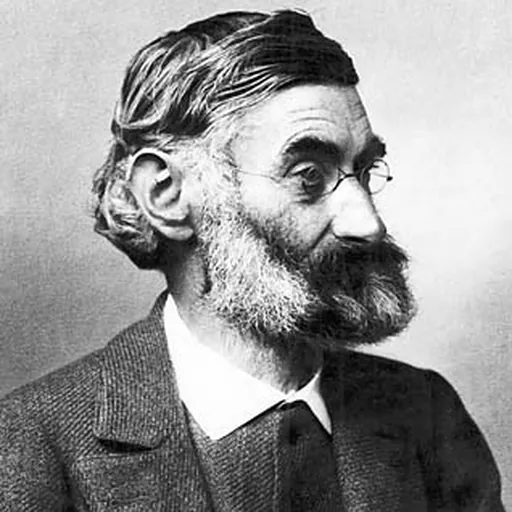
About Ernst Abbe
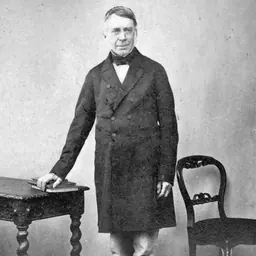
Lived 1840 – 1905 (aged 64). Ernst Abbe was a German physicist, astronomer, university teacher, lens designer, statistician and entrepreneur, known for Abbe number and Abbe refractometer.
Ernst Karl Abbe (23 January 1840 – 14 January 1905), was a German businessman, optical engineer, physicist, and social reformer. Together with Otto Schott and Carl Zeiss, he developed numerous optical instruments. He was also a co-owner of Carl Zeiss AG, a German manufacturer of scientific microscopes, astronomical telescopes, planetariums, and other advanced optical systems.
Personal life
Abbe was born 23 January 1840 in Eisenach, Saxe-Weimar-Eisenach, to Georg Adam Abbe and Elisabeth Christina Barchfeldt. He came from a humble home – his father was a foreman in a spinnery. Supported by his father's employer, Abbe was able to attend secondary school and to obtain the general qualification for university entrance with fairly good grades, at the Eisenach Gymnasium, which he graduated from in 1857. By the time he left school, his scientific talent and his strong will had already become obvious. Thus, in spite of the family's strained financial situation, his father decided to support Abbe's studies at the Universities of Jena (1857–1859) and Göttingen (1859–1861). This was followed by two short assignments at the Göttingen observatory and at Physikalischer Verein in Frankfurt (an association of citizens interested in physics and chemistry that was founded by Johann Wolfgang von Goethe in 1824 and still exists today). In 1871, he married Else Snell, daughter of the mathematician and physicist , one of Abbe's teachers, (Some sources give his wife's name as Elisabeth.)
Life work
Ernst Abbe, relief at his graveIn 1866, he became a research director at the Zeiss Optical Works, and in 1868 he invented the apochromatic lens, a microscope lens which eliminates both the primary and secondary color distortion. He developed the laws of image of non-luminous objects by 1872. He created the Abbe number, a measure of any transparent material's variation of refractive index with wavelength and Abbe's criterion, which tests the hypothesis, that a systematic trend exists in a set of observations (in terms of resolving power this criterion stipulates that an angular separation cannot be less than the ratio of the wavelength to the aperture diameter, see angular resolution). Already a professor in Jena, he was hired by Carl Zeiss to improve the manufacturing process of optical instruments, which back then was largely based on trial and error.
Abbe was the first to define the term numerical aperture, as the sine of the half angle multiplied by the refractive index of the medium filling the space between the cover glass and front lens.
Abbe is credited by many for discovering the resolution limit of the microscope, and the formula (published in 1873)
although in a publication in 1874, Helmholtz states this formula was first derived by Joseph Louis Lagrange, who had died 61 years prior. Helmholtz was so impressed as to offer Abbe a professorship at the University of Berlin, which he declined because of his ties to Zeiss. Abbe states that the resolution of a microscope is inversely dependent on its aperture, but without proposing a formula for the resolution limit of a microscope.
In 1876, Abbe was offered a partnership by Zeiss and began to share in the considerable profits. In this publication, Abbe states that both his theoretical and experimental investigations confirmed . Abbe's contemporary Henry Edward Fripp, English translator of Abbe's and Helmholtz's papers, puts their contributions on equal footing. He also perfected the interference method by Fizeau, in 1884. and in 1900, introduced the eight-hour workday, in remembrance of the 14-hour workday of his own father.
The crater Abbe on the Moon was named in his honour.
Don’t just read it —
keep it.
Full-length biographies made to live with: read them, listen on the way to work, watch them tonight.
- E-book
- Audio
- Video
Instant download · yours to keep · every purchase keeps this site free
Important facts
People in Ernst Abbe's life
Named in this biography and alive at the same time


Related people
Same field, nearest in time



Contemporaries
People whose lives overlapped Ernst Abbe's

Frequently asked questions
Who was Ernst Abbe?
German physicist (1840-1905)
When was Ernst Abbe born?
Ernst Abbe was born on 23 January 1840 in Eisenach.
When did Ernst Abbe die?
Ernst Abbe died on 14 January 1905 in Jena.
What was Ernst Abbe's occupation?
Ernst Abbe was a physicist, astronomer, university teacher, lens designer, statistician and entrepreneur.
What was Ernst Abbe known for?
Ernst Abbe was known for Abbe number and Abbe refractometer.
What nationality was Ernst Abbe?
Ernst Abbe was German.
Sources & further reading
Cite this page
APA: Biography.guide. (2026). Ernst Abbe. https://biography.guide/ernst-abbe/
MLA: "Ernst Abbe." Biography.guide, https://biography.guide/ernst-abbe/.
Chicago: "Ernst Abbe." Biography.guide. https://biography.guide/ernst-abbe/.
Data last updated: 2026-09-21 · Spot an error? Report a correction.
Portrait: Wikimedia Commons · author & licence
Page generated 2026-09-27 05:01 UTC