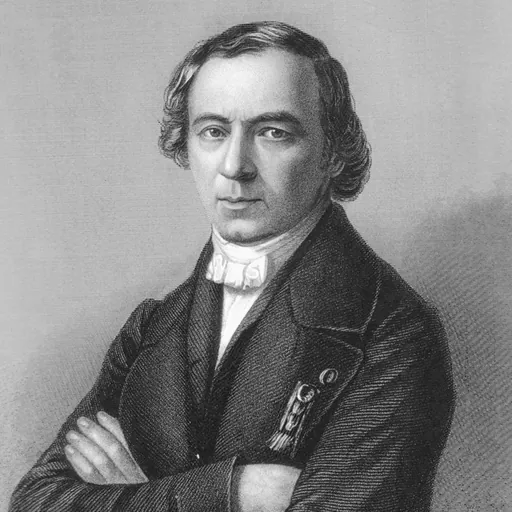
About Jean-Baptiste Dumas
Lived 1800 – 1884 (aged 83). Jean-Baptiste Dumas was a French chemist, politician, university teacher, pharmacist and botanical collector, known for Atomic weight.
Jean Baptiste André Dumas (; 14 July 180010 April 1884) was a French chemist, best known for his works on organic analysis and synthesis, as well as the determination of atomic weights (relative atomic masses) and molecular weights by measuring vapor densities. He also developed a method for the analysis of nitrogen in compounds.
Biography Dumas was born in Alès (Gard), and became an apprentice to an apothecary in his native town. In 1816, he moved to Geneva, where he attended lectures by M. A. Pictet in physics, C. G. de la Rive in chemistry, and A. P. de Candolle in botany, and before he had reached his majority, he was engaged with Pierre Prévost in original work on problems of physiological chemistry and embryology. In 1822, he moved to Paris, acting on the advice of Alexander von Humboldt, where he became professor of chemistry, initially at the Lyceum, later (1835) at the École polytechnique. He was one of the founders of the École centrale des arts et manufactures (later named École centrale Paris) in 1829.
In 1832 Dumas became a member of the French Academy of Sciences. From 1868 until his death in 1884 he would serve the academy as the permanent secretary for its department of Physical Sciences. In 1838, Dumas was elected a foreign member of the Royal Swedish Academy of Sciences. The same year he became correspondent of the Royal Institute of the Netherlands and, when that became the Royal Netherlands Academy of Arts and Sciences in 1851, he joined as a foreign member. Dumas was president of Société d'encouragement pour l'industrie nationale from 1845 to 1864. He was elected to the American Philosophical Society in 1860.
After 1848, he exchanged much of his scientific work for ministerial posts under Napoléon III. He became a member of the National Legislative Assembly. He acted as minister of agriculture and commerce for a few months in 1850–1851, and subsequently became a senator, president of the municipal council of Paris, and master of the French mint, but his official career came to a sudden end with the fall of the Second Empire.
Dumas died at Cannes in 1884, and is buried at the Montparnasse Cemetery in Paris, in a large tomb near the back wall.
Scientific work
Dumas was one of the first to criticise the electro-chemical doctrines of Jöns Jakob Berzelius, which, at the time his work began, were widely accepted as the true theory of the constitution of compound bodies, and opposed a unitary view to the dualistic conception of the Swedish chemist. In a paper on the atomic theory, published in 1826, he anticipated to a remarkable extent some ideas which are frequently supposed to belong to a later period; and the continuation of these studies led him to the ideas about substitution (metalepsis) which were developed about 1839 into the theory (Older Style Theory) that in organic chemistry there are certain types which remain unchanged even when their hydrogen is replaced by an equivalent quantity of a halide element. The classification of organic compounds into homologous series was advanced as one consequence of his researches into the acids generated by the oxidation of the alcohols.
In an 1826 paper, he described his method for ascertaining vapour densities, and the redeterminations which he undertook by its aid of the atomic weights of carbon and oxygen proved the forerunners of a long series which included some thirty of the elements, the results being mostly published in 1858–1860.
Dumas established new values for the atomic mass of thirty elements, setting the value for hydrogen to 1.
Determination of nitrogen
In 1833, Dumas developed a method for estimating the amount of nitrogen in an organic compound, founding modern analysis methods. He made important revisions to the existing combustion methods with a sophisticated pneumatic trough. These revisions were the flushing of the combustion tube with carbon dioxide and the addition of potassium hydroxide in the pneumatic trough. Flushing with carbon dioxide eliminated the nitrogen present in the air that previously occupied the combustion tube, eliminating the need for correction due to nitrogen in the air. The potassium hydroxide dissolved the passing carbon dioxide gas, which left nitrogen as the only gas in the collection tube. though a stronger acid. Dumas extended this to a theory (sometimes considered a law) which states that in an organic compound, a hydrogen atom may be substituted for any halogen.
Family
He married Herminie Brongniart, daughter of Alexandre Brongniart, in 1826.
Honours Dumas is one of the 72 names inscribed on the Eiffel tower.
Don’t just read it —
keep it.
Full-length biographies made to live with: read them, listen on the way to work, watch them tonight.
- E-book
- Audio
- Video
Instant download · yours to keep · every purchase keeps this site free
Important facts
People in Jean-Baptiste Dumas's life
Named in this biography and alive at the same time


Related people
Same field, nearest in time



Contemporaries
People whose lives overlapped Jean-Baptiste Dumas's






Frequently asked questions
Who was Jean-Baptiste Dumas?
French chemist (1800–1884)
When was Jean-Baptiste Dumas born?
Jean-Baptiste Dumas was born on 14 July 1800 in Alès.
When did Jean-Baptiste Dumas die?
Jean-Baptiste Dumas died on 2 April 1884 in Cannes.
What was Jean-Baptiste Dumas's occupation?
Jean-Baptiste Dumas was a chemist, politician, university teacher, pharmacist and botanical collector.
What was Jean-Baptiste Dumas known for?
Jean-Baptiste Dumas was known for Atomic weight.
What nationality was Jean-Baptiste Dumas?
Jean-Baptiste Dumas was French.
Sources & further reading
· Wikipedia: Jean-Baptiste Dumas
· DBpedia: Jean-Baptiste Dumas
Cite this page
APA: Biography.guide. (2026). Jean-Baptiste Dumas. https://biography.guide/jean-baptiste-dumas/
MLA: "Jean-Baptiste Dumas." Biography.guide, https://biography.guide/jean-baptiste-dumas/.
Chicago: "Jean-Baptiste Dumas." Biography.guide. https://biography.guide/jean-baptiste-dumas/.
Data last updated: 2026-09-23 · Spot an error? Report a correction.
Portrait: Wikimedia Commons · author & licence
Page generated 2026-09-27 05:05 UTC