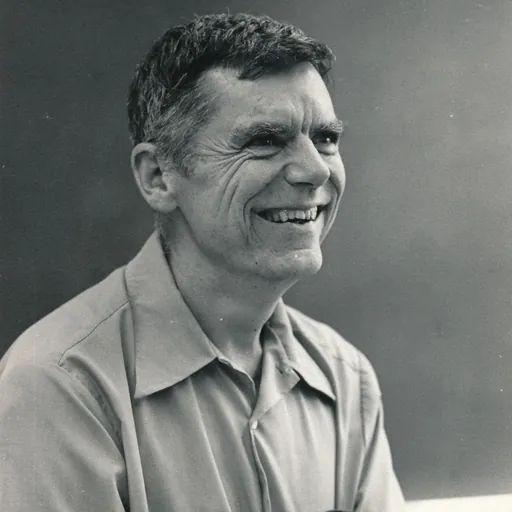
Philip G. Hodge
American applied mathematician
About Philip G. Hodge
Lived 1920 – 2014 (aged 94). Philip G. Hodge was an American university teacher, mechanical engineer, scientist and mathematician.
Philip Gibson Hodge Jr. (November 9, 1920 – November 11, 2014) was an American engineer who specialized in mechanics of elastic and plastic behavior of materials. His work resulted in significant advancements in plasticity theory including developments in the method of characteristics, limit-analysis, piecewise linear isotropic plasticity, and nonlinear programming applications. Hodge was the technical editor of American Society of Mechanical Engineers Journal of Applied Mechanics from 1971-1976. From 1984 to 2000 he was the secretary of the U. S. National Committee on Theoretical and Applied Mechanics, its longest serving Secretary. In 1949 he became assistant professor of Mathematics at UCLA, then moved on to become associate professor of applied mechanics at Polytechnic Institute of Brooklyn in 1953, Professor of Mechanics at Illinois Institute of Technology in 1957, and professor of mechanics at the University of Minnesota in 1971, where he remained until he retired in 1991. After retirement he was professor emeritus at the University of Minnesota and visiting professor emeritus at Stanford University.
Education Philip Hodge received a BA in mathematics from Antioch College in 1943. During World War II, he joined the US Merchant Marine, where he served throughout the war. Upon his return he earned a PhD from Brown University in Applied Mathematics in 1949, where he was a student of William Prager.
Awards 2000 - ASME Daniel C. Drucker Medal by the American Society of Mechanical Engineers 1987 - ASME Medal by the American Society of Mechanical Engineers 1985 - Theodore von Karman Medal by the American Society of Civil Engineers 1984 - Distinguished Service Award by the American Academy of Mechanics 1983 - Euler Medal by the USSR Academy of Sciences 1975 - Worcester Reed Warner Medal by the American Society of Mechanical Engineers
Memberships and fellowships Member of the United States National Academy of Engineering elected in 1977
Books
Personal life He married Thea D. Hodge (née Theresa E. Drell) in 1943, and they have three children.
Other Achievements 1982 Twin Cities Marathon, Winner Master's Division Men 60-69
Don’t just read it —
keep it.
Full-length biographies made to live with: read them, listen on the way to work, watch them tonight.
- E-book
- Audio
- Video
Instant download · yours to keep · every purchase keeps this site free
Important facts
People in Philip G. Hodge's life
Named in this biography and alive at the same time


Related people
Same field, nearest in time




Contemporaries
People whose lives overlapped Philip G. Hodge's





Frequently asked questions
Who was Philip G. Hodge?
American applied mathematician
When was Philip G. Hodge born?
Philip G. Hodge was born on 9 November 1920 in New Haven.
When did Philip G. Hodge die?
Philip G. Hodge died on 11 November 2014 in Sunnyvale.
What was Philip G. Hodge's occupation?
Philip G. Hodge was a university teacher, mechanical engineer, scientist and mathematician.
What nationality was Philip G. Hodge?
Philip G. Hodge was American.
Sources & further reading
Cite this page
APA: Biography.guide. (2026). Philip G. Hodge. https://biography.guide/philip-g-hodge/
MLA: "Philip G. Hodge." Biography.guide, https://biography.guide/philip-g-hodge/.
Chicago: "Philip G. Hodge." Biography.guide. https://biography.guide/philip-g-hodge/.
Data last updated: 2026-09-22 · Spot an error? Report a correction.
Portrait: Wikimedia Commons · author & licence
Page generated 2026-09-27 05:03 UTC