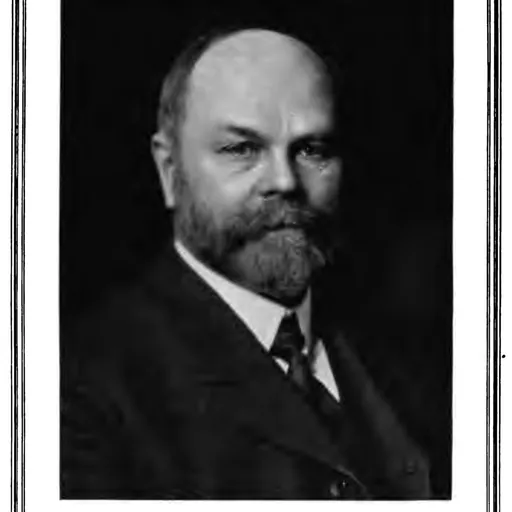
About Worcester Reed Warner
Lived 1846 – 1929 (aged 83). Worcester Reed Warner was an American astronomer, engineer and businessperson, known for Warner & Swasey Company.
Worcester Reed Warner (May 16, 1846 – June 25, 1929) was an American mechanical engineer, entrepreneur, manager, astronomer, and philanthropist. With Ambrose Swasey he cofounded the Warner & Swasey Company. The crater Warner on the Moon is named after him.
Biography Life and career Warner was born and grew up on a farm near Cummington, Massachusetts. He met Swasey at the Exeter Machine Works where both were apprentices. In 1870, both entered the employ of Pratt & Whitney in Hartford, Connecticut.
In 1880, Warner and Swasey co-founded a business to manufacture sewing machines and lathes, but quickly turned to manufacturing telescopes, because Warner was always interested in astronomy. In 1880, Beloit College purchased one of its telescopes, which helped establish the company's name in the telescope-building industry, which experienced rapid growth at the time. Warner & Swasey would design and build the framework and the mounting for the 36-inch refracting telescope installed at Lick Observatory in 1888, which was the world's largest refractor telescope at the time. The company later built telescopes that were used in Canada and Argentina.
The company and its founders prospered, but not from telescope-building. While it was astronomical telescopes that made Warner & Swasey famous, its profits came from machine tools, especially turret lathes, and military instruments. Telescope-making "essentially amounted to astronomical philanthropy," describes the firm's giant-telescope-building work as unprofitable overall but a labor of technological love.
Further activities Warner was a charter member of the American Society of Mechanical Engineers (ASME), Warner served as president and chairman of the board, but retired in 1911. ASME elected him an honorary member in 1925.
Both Warner and Ambrose Swasey also became trustees of the Case School of Applied Science. They donated to the school their private observatory, which they had built between their neighboring houses in East Cleveland. Relocated to a new building, this became the Warner and Swasey Observatory. The Warners and Blair opted for intricate scrollwork, fifteen-foot windows, Ionic columns, Grecian figural urns flanking the entrance, and an oculus in the lobby ceiling inspired by the Roman Pantheon. ). A precision-instrument engineer, he specifically devised them so that the heavy door could be opened easily with a single finger. Warner articulated the library’s mission as follows: "The measure of any community’s culture ... is the books it has and reads. Therefore, helpful books should be made accessible to all."
Family In 1890, he married Cornelia Blakemore of Philadelphia, , who applied her large inheritance to continuing her father's philanthropic legacy. Alongside a family friend, John D. Rockefeller Jr., she played a major role in the saving and restoring of the historic Philipsburg Manor House in Sleepy Hollow. She established the prestigious Helen B. Warner Prize for Astronomy, awarded annually by the American Astronomical Society. In memory of her father, who was born in Cummington, Massachusetts, she founded the Cummington Museum, now known as the Kingman Tavern Historical Museum. She was also a benefactor of the Cleveland Museum of Art and the Phelps Hospital. It was established by Warner's bequest in 1930. Some of the recipients are:
1933: Dexter S. Kimball 1934: Ralph Flanders 1935: Stephen Timoshenko 1943: Igor Sikorsky 1945: Joseph M. Juran 1947: Arpad L. Nadai 1949: Fred B. Seely 1951: Jacob Pieter Den Hartog 1954: Joseph Henry Keenan 1956: James Keith Louden 1957: William Prager 1960: Lloyd H. Donnell 1965: Ascher H. Shapiro 1967: Nicholas J. Hoff 1969: Hans W. Liepmann 1970: Wilhelm Flügge 1971: Stephen H. Crandall 1975: Philip G. Hodge, Jr. 1979: Darle W. Dudley 1980: Olgierd Zienkiewicz 1984: Yuan-Cheng Fung 1985: Richard H. Gallagher 1990: J. Tinsley Oden 1992: J. N. Reddy 1997: Zdenek P. Bazant 1998: Thomas J. R. Hughes 1999: Yogesh Jaluria 2007: Portonovo Ayyaswamy 2016: Isaac Elishakoff 2017: Michael Paidoussis 2018: Martin Ostoja-Starzewski 2019: Arun Srinivasa 2020: Marco Amabili 2021: Hanqing Jiang 2022: K. R. Rajagopal
Don’t just read it —
keep it.
Full-length biographies made to live with: read them, listen on the way to work, watch them tonight.
- E-book
- Audio
- Video
Instant download · yours to keep · every purchase keeps this site free
Important facts
People in Worcester Reed Warner's life
Named in this biography and alive at the same time





Related people
Same field, nearest in time


Contemporaries
People whose lives overlapped Worcester Reed Warner's


Frequently asked questions
Who was Worcester Reed Warner?
American engineer (1846–1929)
When was Worcester Reed Warner born?
Worcester Reed Warner was born on 16 May 1846 in Cummington.
When did Worcester Reed Warner die?
Worcester Reed Warner died on 25 June 1929 in Eisenach.
What was Worcester Reed Warner's occupation?
Worcester Reed Warner was an astronomer, engineer and businessperson.
What was Worcester Reed Warner known for?
Worcester Reed Warner was known for Warner & Swasey Company.
What nationality was Worcester Reed Warner?
Worcester Reed Warner was American.
Sources & further reading
· Wikipedia: Worcester Reed Warner
· DBpedia: Worcester Reed Warner
Cite this page
APA: Biography.guide. (2026). Worcester Reed Warner. https://biography.guide/worcester-reed-warner/
MLA: "Worcester Reed Warner." Biography.guide, https://biography.guide/worcester-reed-warner/.
Chicago: "Worcester Reed Warner." Biography.guide. https://biography.guide/worcester-reed-warner/.
Data last updated: 2026-09-24 · Spot an error? Report a correction.
Portrait: Wikimedia Commons · author & licence
Page generated 2026-09-27 05:09 UTC