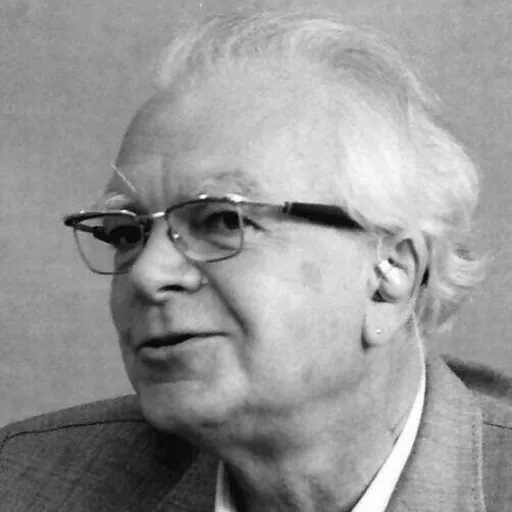
About Peter D. Mitchell
Lived 1920 – 1992 (aged 71). Peter D. Mitchell was a British biochemist, chemist and university teacher, known for Adenosine triphosphate.
Early life and education Mitchell was born in Mitcham, Surrey on 29 September 1920.
Career and research In 1955 he was invited by Professor Michael Swann to set up a biochemical research unit, called the Chemical Biology Unit, in the Department of Zoology, at the University of Edinburgh, where he was appointed a Senior Lecturer in 1961, then Reader in 1962, although institutional opposition to his work coupled with ill health led to his resignation in 1963.
Chemiosmotic hypothesis In the 1960s, ATP was known to be the energy currency of life, but the mechanism by which ATP was created in the mitochondria was assumed to be by substrate-level phosphorylation. Mitchell's chemiosmotic hypothesis was the basis for understanding the actual process of oxidative phosphorylation. At the time, the biochemical mechanism of ATP synthesis by oxidative phosphorylation was unknown. In chemiosmosis, ions move down their electrochemical gradient across a membrane. Mitchell realised that the movement of ions across an electrochemical potential difference could provide the energy needed to produce ATP. His hypothesis was derived from information that was well known in the 1960s. He knew that living cells had a membrane potential; interior negative to the environment. The movement of charged ions across a membrane is thus affected by the electrical forces (the attraction of positive to negative charges). Their movement is also affected by thermodynamic forces, the tendency of substances to diffuse from regions of higher concentration. He went on to show that ATP synthesis was coupled to this electrochemical gradient. The discovery of ATP synthase vindicated Mitchell's hypothesis. Today, it is well-accepted that chemiosmosis of H+ ions power the synthesis of ATP, and other biochemical processes. His hypothesis was confirmed by the discovery of ATP synthase, a membrane-bound protein that uses the potential energy of the electrochemical gradient to make ATP; and by the discovery by André Jagendorf that a pH difference across the thylakoid membrane in the chloroplast results in ATP synthesis.
Protonmotive Q-cycle Later, Peter Mitchell also hypothesized some of the complex details of electron transport chains. He conceived of the coupling of proton pumping to quinone-based electron bifurcation, which contributes to the proton motive force and thus, ATP synthesis.
Awards and honours In 1978 he was awarded the Nobel Prize in Chemistry "for his contribution to the understanding of biological energy transfer through the formulation of the chemiosmotic theory." He was elected a Fellow of the Royal Society (FRS) in 1974.
Don’t just read it —
keep it.
Full-length biographies made to live with: read them, listen on the way to work, watch them tonight.
- E-book
- Audio
- Video
Instant download · yours to keep · every purchase keeps this site free
Important facts
People in Peter D. Mitchell's life
Named in this biography and alive at the same time


Related people
Same field, nearest in time



Contemporaries
People whose lives overlapped Peter D. Mitchell's





Frequently asked questions
Who was Peter D. Mitchell?
British biochemist (1920-1992)
When was Peter D. Mitchell born?
Peter D. Mitchell was born on 29 September 1920 in Surrey.
When did Peter D. Mitchell die?
Peter D. Mitchell died on 10 April 1992 in Bodmin.
What was Peter D. Mitchell's occupation?
Peter D. Mitchell was a biochemist, chemist and university teacher.
What was Peter D. Mitchell known for?
Peter D. Mitchell was known for Adenosine triphosphate.
What nationality was Peter D. Mitchell?
Peter D. Mitchell was British.
Sources & further reading
· Wikipedia: Peter D. Mitchell
Cite this page
APA: Biography.guide. (2026). Peter D. Mitchell. https://biography.guide/peter-d-mitchell/
MLA: "Peter D. Mitchell." Biography.guide, https://biography.guide/peter-d-mitchell/.
Chicago: "Peter D. Mitchell." Biography.guide. https://biography.guide/peter-d-mitchell/.
Data last updated: 2026-09-23 · Spot an error? Report a correction.
Portrait: Wikimedia Commons · author & licence
Page generated 2026-09-27 05:06 UTC