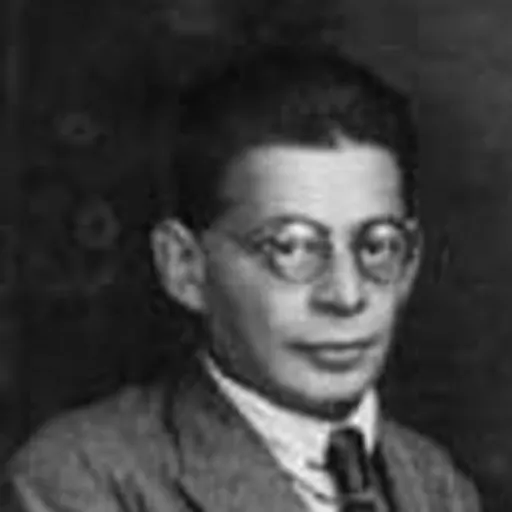
About Otto Rank
Lived 1884 – 1939 (aged 55). Otto Rank was an Austrian psychologist, existential therapist and psychoanalyst, known for Creative will, Doppelgänger and Existential therapy.
Otto Rank (; ; né Rosenfeld; 22 April 1884 – 31 October 1939) was an Austrian psychoanalyst, writer, and philosopher. Born in Vienna, he became one of Sigmund Freud's closest collaborators, served as secretary of the Vienna Psychoanalytic Society, and edited leading psychoanalytic journals while publishing studies of myth and creativity. His book The Trauma of Birth proposed that the anxiety of separation at birth precedes the Oedipus complex, coined the term "pre-Oedipal," and triggered a decisive break with Freud's father-centered developmental theory. Rank established psychotherapy practices in Paris and New York, where he promoted a relationship-based way of being that called for the therapist to show authenticity, empathy and unconditional respect for the client. He influenced existential, interpersonal and humanistic therapy, social work, and action learning, and his ideas on creativity and the double continue to inform psychological and cultural criticism to the present.
Early life and Freud's circle Rank was born Otto Rosenfeld in 1884 to an Austrian-Jewish artisan family in Vienna. He impressed Freud in 1905 with a study of the artist (published in 1907), which led to Rank's appointment as secretary of the Vienna Psychoanalytic Society and the movement's first salaried post.
Freud maintained that emotion is an expression of libido and likened analytic work to "the draining of the Zuyder Zee," whereas Rank asserted that Freud had confused sexuality and emotions.
In Das Trauma der Geburt Rank was the first to see the powerful mother as the primal source of the super-ego, a role that Freud had reserved for the powerful father. In a 1930 self-analysis of his writings, Rank observed that the "pre-Oedipal super-ego" had been emphasized by Melanie Klein without crediting his priority.
Therapeutic innovations Between 1920 and 1924 Rank collaborated with Sándor Ferenczi on approaches that favored immediacy and emotional reciprocity in the "here-and-now" of the consulting room. They warned that Freud's technical recommendations produced "an unnatural elimination of all human factors in the analysis" and called for therapy grounded in lived experience. Freud described libido as the engine of emotion and likened the analytic task to draining feelings from the patient, reinforcing distance over an authentic person-to-person relationship.
Later life and influence Rank left Vienna in 1926 and divided his time between Paris and the United States, where he lectured, practiced psychotherapy, and continued to write on art, myth, and the will. "I became infected with Rankian ideas," Rogers later said, and credited Rank's American lectures with shaping client-centered therapy.
Co-creator with Rogers and Abraham Maslow of humanistic therapy, Rollo May described Rank as "the great unacknowledged genius in Freud's circle" in the foreword to Rank's American lectures.
Summary of core ideas
Therapeutic philosophy Rank interpreted psychotherapy as a collaborative process of learning and unlearning that keeps emotional experience at the center. He argued that the therapeutic relationship lets people discover more creative ways to think, feel, and act in the present while releasing patterns that have turned destructive, treating neurosis as a failure of creativity rather than a retreat from sexuality. In a 1938 lecture, he described life as "a succession of separations" that begins with birth and continues through each stage of adaptation, warning that people who cannot release worn out identities become trapped in earlier phases of growth.
Legacy Rank's emphasis on will, relationship, and creativity continues to inform modern psychotherapy, organizational practice, and cultural criticism. His analysis of creativity in Art and Artist linked artistic renewal to the ability to "step out of the frame" of settled ideology, a theme that informs Robert Kramer's work on transformative action learning and leadership development.
Ernest Becker drew on Rank's dialectic of "life fear" and "death fear," which later inspired terror management theory experiments by Sheldon Solomon, Jeff Greenberg, and Tom Pyszczynski. Rank's legacy also reaches into spiritual and transpersonal movements through thinkers such as Matthew Fox and Stanislav Grof, philosophers including Maxine Sheets-Johnstone, and contemporary cultural critics like Naomi Klein, who revisit his ideas about creativity, mortality, and the double. and acknowledge his influence on the emergence of interpersonal psychoanalysis. There are links between contemporary relational psychoanalysis and Rank’s theory of birth trauma, as Rank’s ideas foreshadowed developments in the direction of Wilfred Bion’s and Donald Winnicott’s conceptions, as well as later elaborations of field theory and thirdness.
Rank's exploration of creativity continues to shape action learning, an inquiry driven method for problem solving, leadership development, and organizational learning. Drawing on Art and Artist, action learning coaches help teams create a safe container, pose challenging questions, and "step out of the frame of the prevailing ideology" so members can examine assumptions and reframe their choices. The process mirrors Rank's view of artistic growth as an ongoing effort to bring new perspectives into being. In organizational settings, action learning uses these insights to help individuals and teams question deeply held identities, experiment with alternative frames, and practice the skill of unlearning together.
Major publications By date of first publication
Don’t just read it —
keep it.
Full-length biographies made to live with: read them, listen on the way to work, watch them tonight.
- E-book
- Audio
- Video
Instant download · yours to keep · every purchase keeps this site free
Important facts
Family & relationships
People in Otto Rank's life
Named in this biography and alive at the same time



Related people
Same field, nearest in time



Contemporaries
People whose lives overlapped Otto Rank's



Frequently asked questions
Who was Otto Rank?
Austrian psychoanalyst (1884–1939)
When was Otto Rank born?
Otto Rank was born on 22 April 1884 in Vienna.
When did Otto Rank die?
Otto Rank died on 31 October 1939 in New York City.
What was Otto Rank's occupation?
Otto Rank was a psychologist, existential therapist and psychoanalyst.
What was Otto Rank known for?
Otto Rank was known for Creative will, Doppelgänger, Existential therapy and The Myth of the Birth of the Hero.
What nationality was Otto Rank?
Otto Rank was Austrian.
Sources & further reading
Cite this page
APA: Biography.guide. (2026). Otto Rank. https://biography.guide/otto-rank/
MLA: "Otto Rank." Biography.guide, https://biography.guide/otto-rank/.
Chicago: "Otto Rank." Biography.guide. https://biography.guide/otto-rank/.
Data last updated: 2026-09-21 · Spot an error? Report a correction.
Portrait: Wikimedia Commons · author & licence
Page generated 2026-09-27 05:01 UTC