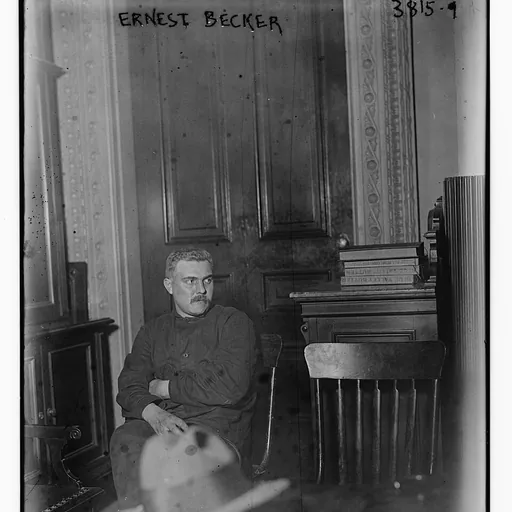
About Ernest Becker
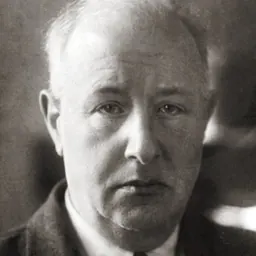
Lived 1924 – 1974 (aged 49). Ernest Becker was an American anthropologist, psychologist, writer and existential therapist, known for Terror Management Theory.
Ernest Becker (September 27, 1924 – March 6, 1974) was an American cultural anthropologist and author of the 1973 Pulitzer Prize-winning book The Denial of Death.
Biography Early life Ernest Becker was born in Springfield, Massachusetts, to Jewish immigrant parents. Serving in the infantry during World War II, he would help liberate a Nazi concentration camp. After he completed his military service, Becker attended Syracuse University in New York. Upon graduation he joined the U.S. Embassy in Paris as an administrative officer.
In his early 30s, he returned to Syracuse University to pursue graduate studies in cultural anthropology, and would complete his PhD in 1960. Initially, he taught anthropology in the Department of Psychiatry at the Upstate Medical College in Syracuse, New York, but was summarily fired, along with other non-tenured professors, for supporting tenured Professor Thomas Szasz in a dispute with the administration over academic freedom. After a year in Italy, Becker was hired back at Syracuse University, this time in the School of Education.
In 1965, Becker acquired a lecturer position at the University of California, Berkeley in the anthropology program. However, trouble again arose between Becker and the administration, leading to his departure from the university. At the time, thousands of students petitioned to keep Becker at the school and offered to pay his salary,
Becker's insistence on interdisciplinary work, along with the fact that students flocked to his lectures, which were marked by a high level of theatricality, did not endear him to many of his colleagues. Referring to his insistence on the importance symbolism plays in the human animal, he wrote, "I have tried to correct... bias by showing how deep theatrical 'superficialities' really go."
Death In November 1972, Becker was diagnosed with colon cancer. Sixteen months later, on 6 March 1974, he would die from the disease at age 49 in Burnaby, British Columbia. Shortly before his death, he participated in a series of interviews with Sam Keen for Psychology Today.
Ideas and concepts
As related above, Becker did not attain tenure when he was fired from his first academic position at Upstate Medical College in Syracuse, NY. This was a result of a dispute the school had with "anti-psychiatrist" Thomas Szasz, with whom Becker sided. This may be the reason Szasz's views are sometimes imputed to Becker. However, Becker's support of Szasz was limited to the issue of academic freedom: that is, whether or not Szasz (who had tenure) had the right to teach his views to psychiatry students.
During the final decade of his life, Becker drew upon the ideas and concepts developed by many different writers and thinkers to formulate his own theories, including Søren Kierkegaard, Sigmund Freud, Wilhelm Reich, Norman O. Brown, Erich Fromm, Georg Wilhelm Friedrich Hegel, and especially Otto Rank.
The Birth and Death of Meaning The Birth and Death of Meaning, published in 1962 and then extensively revised and republished in 1971, was "Becker's first attempt to explain the human condition." It takes its title from the concept of mankind progressing from simple-minded ape to a world of symbols and illusions, and then deconstructing those illusions through our own evolving intellect.
Revolution in Psychiatry During this early period, Becker was formulating a "fully transactional" view of mental health that eventually formed the basis of his book, Revolution in Psychiatry (1964). Although Szasz is cited on a few key points in this book, Becker pursues a very distinct path.
The Denial of Death In his 1973 book The Denial of Death, Becker came to believe that an individual's character is essentially formed around the process of denying one's own mortality, that this denial is a necessary component of functioning in the world, and that this character-armor masks and obscures genuine self-knowledge. Much of the evil in the world, he believed, was a consequence of this need to deny death. suggested was Becker's greatest achievement: the writing of Escape from Evil, left unfinished at the time of Becker's death, but posthumously published in 1975. has turned Becker's views on the cultural influence of death anxiety into a scientific theory that helps to explain such diverse human phenomena as self-esteem, prejudice, and religion.
After his death, the Ernest Becker Foundation was founded, focused on multidisciplinary inquiries into human behavior. The foundation would focus on reducing violence in human society, using Becker's basic ideas to support research and application at the interfaces of science, the humanities, social action, and religion.
Flight From Death (2003) is a documentary film directed by Patrick Shen, based on Becker's work, and partially funded by the Ernest Becker Foundation.
Works Books 1961. Zen: A Rational Critique. New York: W. W. Norton. 1962. The Birth and Death of Meaning: An Interdisciplinary Perspective in Psychiatry and Anthropology. New York: The Free Press of Glencoe. 1964. Revolution in Psychiatry: The New Understanding of Man. New York: Free Press. 1967. Beyond Alienation: A Philosophy of Education for the Crisis of Democracy. New York: George Braziller. 1968. The Structure of Evil: An Essay on the Unification of the Science of Man. New York: George Braziller. 1969. Angel in Armor: A Post-Freudian Perspective on the Nature of Man. New York: George Braziller. This book is a collection of shorter essays, lectures, and reviews written between 1962 and 1968. 1971. The Lost Science of Man. New York: George Braziller. 1971. The Birth and Death of Meaning: An Interdisciplinary Perspective on the Problem of Man (2nd ed.). New York: Free Press. 1973. The Denial of Death. New York: Free Press. 1975. Escape from Evil. New York: Free Press.
Essays 1974. "The spectrum of loneliness." Humanitas 10:237–46. 1974. "Toward the merger of animal and human studies." Philosophy of the Social Sciences 4:235–54.
Don’t just read it —
keep it.
Full-length biographies made to live with: read them, listen on the way to work, watch them tonight.
- E-book
- Audio
- Video
Instant download · yours to keep · every purchase keeps this site free
Important facts
People in Ernest Becker's life
Named in this biography and alive at the same time





Related people
Same field, nearest in time





Contemporaries
People whose lives overlapped Ernest Becker's


Frequently asked questions
Who was Ernest Becker?
American cultural anthropologist (1924–1974)
When was Ernest Becker born?
Ernest Becker was born on 27 September 1924 in Springfield.
When did Ernest Becker die?
Ernest Becker died on 6 March 1974 in Vancouver.
What was Ernest Becker's occupation?
Ernest Becker was an anthropologist, psychologist, writer and existential therapist.
What was Ernest Becker known for?
Ernest Becker was known for Terror Management Theory.
What nationality was Ernest Becker?
Ernest Becker was American.
Sources & further reading
Cite this page
APA: Biography.guide. (2026). Ernest Becker. https://biography.guide/ernest-becker-anthropologist/
MLA: "Ernest Becker." Biography.guide, https://biography.guide/ernest-becker-anthropologist/.
Chicago: "Ernest Becker." Biography.guide. https://biography.guide/ernest-becker-anthropologist/.
Data last updated: 2026-09-24 · Spot an error? Report a correction.
Portrait: Wikimedia Commons · author & licence
Page generated 2026-09-27 05:09 UTC