Nikos Beloyannis
Greek politician and resistance leader
About Nikos Beloyannis
Lived 1915 – 1952 (aged 36). Nikos Beloyannis was a Greek politician, resistance fighter, communist and political commissar.
Nikos Beloyannis (; 1915 – 30 March 1952) was a Greek resistance leader and leading member of the Greek Communist Party.
Biography Beloyannis was born in Amaliada (Peloponnese, Greece) in 1915. He came from a relatively prosperous family and went on to study law in Athens, but before being able to graduate, he was arrested and jailed in an Akronauplia prison by the Ioannis Metaxas regime in the 1930s. He was transferred to the Germans after the Axis occupation of Greece in 1941. He escaped in 1943 and joined the Greek People's Liberation Army (ELAS) in Peloponnese on the side of Aris Velouchiotis. After becoming Political Commissioner of the Democratic Army of Greece (DSE) during the Greek Civil War, he was one of the last to leave the country after its defeat in 1949.
In June 1950, Beloyannis returned to Greece in order to re-establish the Communist Party of Greece (KKE) in Athens, which had been declared illegal. He was arrested on 20 December 1950 and court-martialed on charges of violating Compulsory Law 509/1947, which criminalized the KKE. He was accused of treason, allegedly having transmitted information to the Soviet Union. The Beloyannis trial started in Athens on 19 October 1951. In total, 94 people were accused. One of the three members of the court-martial was Georgios Papadopoulos who later became the leader of the military dictatorship of 1967-1974. Beloyannis denied all accusations and stressed the patriotic nature of his actions during the anti-Nazi resistance, the British intervention, and the Greek Civil War. He became globally known as the "Man with the Carnation" and as such, he was depicted in a famous Pablo Picasso sketch. Beloyannis defended the achievements of the resistance and exposed that people who had fought the Nazis were persecuted for their left-wing views, while Nazi collaborators were rewarded with posts in the Greek government in the onset of the Cold War.
Despite national and international appeals for clemency, between 15 and 16 November, the court-martial sentenced Beloyannis and eleven of his comrades to death. On 1 March 1952, Beloyannis and seven others were sentenced. Within a week, the Greek government received hundreds of thousands of international telegrams protesting the death sentence, while an international campaign—with the participation of personalities like Picasso, Charlie Chaplin, Jean Paul Sartre, Paul Éluard, Nazim Hikmet and others—asked for the cancellation of the military tribune's verdict. Four prisoners, including Beloyannis, were taken from Kallithea on the early morning of Sunday, 30 March 1952, and executed in the Goudi camp. The sentences of the other prisoners were commuted to life imprisonment, and by the mid-1960s, all were released from prison.
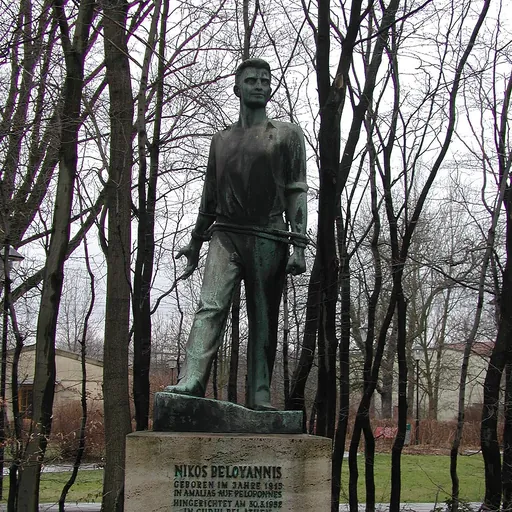
Beloyannis was one of the most prominent of the Greeks who collaborated with the Soviet Union after World War II. His name was given to the village of Beloiannisz, Hungary, which housed Greek left-wing refugees that fled Greece at the end of the civil war until they were allowed to return to Greece by the first Andreas Papandreou government in the early 1980s. A monument of Nikos Beloyannis in former Communist East Berlin.
Writings In his last letter, written from death-row, Beloyannis mentions two books that he appears to have written on the economic development of Greece and the country's history of literature. The manuscripts of the former were published in 2010 under the title Foreign Capital in Greece (Το Ξένο Κεφάλαιο στην Ελλάδα, To Kseno Kefaleo stin Ellada). Through the detailed analysis of Greece's external borrowing, its history is presented as one of subjection to foreign powers and financial institutions who ended up controlling most of its economy and resources to the dismay of the working class.
Cultural references Pablo Picasso created a sketch named The Man with the Carnation honouring Beloyannis, inspired by a portrait of him. Peter de Francia painted The Execution of Beloyannis in 1953. It was sold to a private collector in 2011 by James Hyman Gallery It has since become part of the Tate collection. Nikos Tzimas' movie The Man with the Carnation (1980) dramatises the arrest, trial, and execution of Beloyannis. Turkish poet Nâzım Hikmet wrote a poem called The Man with the Carnation in 1952 about Beloyannis.
Don’t just read it —
keep it.
Full-length biographies made to live with: read them, listen on the way to work, watch them tonight.
- E-book
- Audio
- Video
Instant download · yours to keep · every purchase keeps this site free
Important facts
Family & relationships
People in Nikos Beloyannis's life
Named in this biography and alive at the same time


Related people
Same field, nearest in time





Contemporaries
People whose lives overlapped Nikos Beloyannis's


Frequently asked questions
Who was Nikos Beloyannis?
Greek politician and resistance leader (1915–1952)
When was Nikos Beloyannis born?
Nikos Beloyannis was born on 27 October 1915 in Amaliada.
When did Nikos Beloyannis die?
Nikos Beloyannis died on 30 March 1952 in Goudi.
What was Nikos Beloyannis's occupation?
Nikos Beloyannis was a politician, resistance fighter, communist and political commissar.
What nationality was Nikos Beloyannis?
Nikos Beloyannis was Greek.
Sources & further reading
Cite this page
APA: Biography.guide. (2026). Nikos Beloyannis. https://biography.guide/nikos-beloyannis/
MLA: "Nikos Beloyannis." Biography.guide, https://biography.guide/nikos-beloyannis/.
Chicago: "Nikos Beloyannis." Biography.guide. https://biography.guide/nikos-beloyannis/.
Data last updated: 2026-09-22 · Spot an error? Report a correction.
Portrait: Wikimedia Commons · author & licence
Page generated 2026-09-27 05:03 UTC