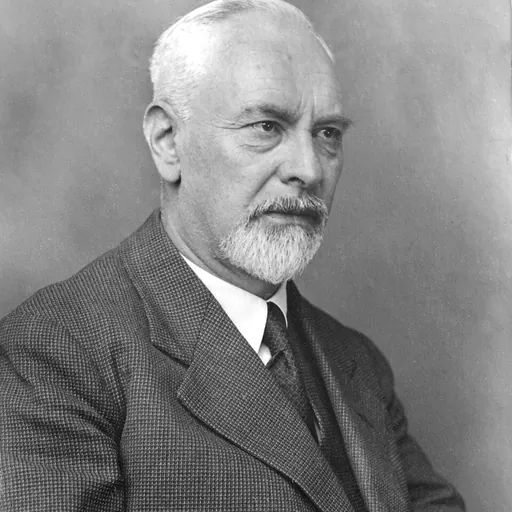
About Ludwig Prandtl
Lived 1875 – 1953 (aged 78). Ludwig Prandtl was a German physicist, university teacher and engineer, known for Boundary layer, Lifting-line theory and Membrane analogy.
Ludwig Prandtl (; 4 February 1875 – 15 August 1953) was a German fluid dynamicist, physicist and aerospace scientist. He was a pioneer in the development of rigorous systematic mathematical analyses which he used for underlying the science of aerodynamics, which have come to form the basis of the applied science of aeronautical engineering. In the 1920s, he developed the mathematical basis for the fundamental principles of subsonic aerodynamics in particular; and in general up to and including transonic velocities. His studies identified the boundary layer, thin-airfoils, and lifting-line theories. The Prandtl number was named after him.
Early years Prandtl was born in Freising, near Munich, on 4 February 1875. His thesis was "On Tilting Phenomena, an Example of Unstable Elastic Equilibrium" (1900).
Later years In 1901 Prandtl became a professor of fluid mechanics at the technical school in Hannover, later the Technical University Hannover and then the University of Hannover. It was here that he developed many of his most important theories. In this paper, he described the boundary layer and its importance for drag
Due to the complexity of Prandtl's boundary layer ideas in his 1904 paper, the spread of the concept was initially slow. Many people failed to adopt the idea due to lack of understanding. There was a halt on new boundary layer discoveries until 1908 when two of his students at Gottingen, Blasius and Boltze, released their dissertations on the boundary layer. Blasius' dissertation explained what happened with the boundary layer when a flat plate comes in parallel contact with a uniform stream. Boltze's research was similar to Blasius' but applied Prandtl's theory to spherical shapes instead of flat objects. Prandtl expanded upon the ideas in his student's dissertations to include a thermal boundary layer associated with heat transfer.
There would be three more papers from Gottingen researchers regarding the boundary layer released by 1914. Due to similar reasons to Prandtl's 1904 paper, these first 7 papers on the boundary layer would be slow to spread outside of Gottingen. Partially due to World War I, there would be a lack of papers published regarding the boundary layer until another of Prandtl's students, Theodore Von Karman, published a paper in 1921 on the momentum integral equation across the boundary layer. However, this new lift distribution drew less interest than the elliptical distribution and was initially ignored in most practical aircraft designs. This concept has been rediscovered by other researchers and has become increasingly important (see also the Prandtl-D experimental aircraft).
Prandtl and his student Theodor Meyer developed the first theories of supersonic shock waves and flow in 1908. The Prandtl–Meyer expansion fans allowed for the construction of supersonic wind tunnels. He had little time to work on the problem further until the 1920s, when he worked with Adolf Busemann and created a method for designing a supersonic nozzle in 1929. Today, all supersonic wind tunnels and rocket nozzles are designed using the same method. A full development of supersonics would have to wait for the work of Theodore von Kármán, a student of Prandtl at Göttingen.
Prandtl developed the concept of "circulation" which proved to be particularly important for the hydrodynamics of ship propellers. He did most of the experimental work at his lab in Göttingen from 1910-1918 with his assistant Albert Betz and student Max Munk. Most of his discoveries related to circulation would be kept secret from the western world until after World War I.
Prior to World War I, the Society of German Natural Scientists and Physicians (GDNÄ) was the only opportunity for applied mathematicians, physicists, and engineers in German speaking countries to discuss. In 1920, they met in Bad Nauheim and came to the conclusion that there was a need for a new umbrella for applied sciences due to their experience during the war. This journal advertised the common goals of Prandtl, Theodore von Kármán, Richard von Mises, and Hans Reissner.
Following Prandtl's investigation into instabilities from 1921-1929, he then moved to exploring developed turbulence. This was also being investigated by Kármán, resulting in a race to formulate a solution for the velocity profile in developed turbulence. Around 1930, the race ended in a draw as both men concluded that the inverse square of skin friction was related to the logarithmic value of the product of Reynold's number and skin friction as seen below where k and C are constants.
Prandtl and von Kármán's work on the boundary was influential and adopted by aerodynamic and hydrodynamic experts around the world after WWI. In May 1932, the International Conference on Hydromechanical Problems of Ship Propulsion was held in Hamburg. Günther Kempf showcased a number of experiments at the conference which confirmed many of the theoretical discoveries of von Kármán and Prandtl.
As a member of the German Physical Society (DPG), Prandtl assisted Carl Ramsauer in drafting the DPG Petition in 1941. The DPG Petition would be published in 1942 and argued that physics in Germany was falling behind that of the United States due to rejection of "Jewish Physics" (relativity and quantum theory) from German physicists. After publication of the DPG Petition, the belief of "German Physics" superiority deteriorated to allow for German students to study these new fields in school.
Publications Paul Peter Ewald, Theodor Pöschl, Ludwig Prandtl; authorized translation by J. Dougall and W.M. Deans The Physics of Solids and Fluids: With Recent Developments Blackie and Son (1930).
Death and afterwards
Prandtl worked at Göttingen until he died on 15 August 1953. His work in fluid dynamics is still used today in many areas of aerodynamics and chemical engineering. He is often referred to as the father of modern aerodynamics.
The crater Prandtl on the far side of the Moon is named in his honor.
The Ludwig-Prandtl-Ring is awarded by Deutsche Gesellschaft für Luft- und Raumfahrt in his honor for outstanding contribution in the field of aerospace engineering.
In 1992, Prandtl was inducted into the International Air & Space Hall of Fame at the San Diego Air & Space Museum.
Notable students
Jakob Ackeret Albert Betz Paul Richard Heinrich Blasius Adolf Busemann Kurt Hohenemser Theodore von Kármán Lu Shijia (Hsiu-Chen Chang-Lu) Hubert Ludwieg Hilda M. Lyon (1932–33) Hans Multhopp Max Munk Johann Nikuradse Reinhold Rudenberg Hermann Schlichting Walter Tollmien Victor Vâlcovici Vishnu Madav Ghatage Karl Wieghardt Theodor Meyer
Don’t just read it —
keep it.
Full-length biographies made to live with: read them, listen on the way to work, watch them tonight.
- E-book
- Audio
- Video
Instant download · yours to keep · every purchase keeps this site free
Important facts
more
Prandtl–Batchelor theorem, Prandtl–Glauert singularity, Prandtl–Glauert transformation, Prandtl–Meyer expansion fan, Prandtl–Meyer function, Tomlinson modelPeople in Ludwig Prandtl's life
Named in this biography and alive at the same time



Related people
Same field, nearest in time


Contemporaries
People whose lives overlapped Ludwig Prandtl's


Frequently asked questions
Who was Ludwig Prandtl?
German physicist (1875-1953)
When was Ludwig Prandtl born?
Ludwig Prandtl was born on 4 February 1875 in Freising.
When did Ludwig Prandtl die?
Ludwig Prandtl died on 15 August 1953 in Göttingen.
What was Ludwig Prandtl's occupation?
Ludwig Prandtl was a physicist, university teacher and engineer.
What was Ludwig Prandtl known for?
Ludwig Prandtl was known for Boundary layer, Lifting-line theory, Membrane analogy, Mixing length model, Prandtl condition and Prandtl number.
What nationality was Ludwig Prandtl?
Ludwig Prandtl was German.
Sources & further reading
Cite this page
APA: Biography.guide. (2026). Ludwig Prandtl. https://biography.guide/ludwig-prandtl/
MLA: "Ludwig Prandtl." Biography.guide, https://biography.guide/ludwig-prandtl/.
Chicago: "Ludwig Prandtl." Biography.guide. https://biography.guide/ludwig-prandtl/.
Data last updated: 2026-09-22 · Spot an error? Report a correction.
Portrait: Wikimedia Commons · author & licence
Page generated 2026-09-27 05:03 UTC