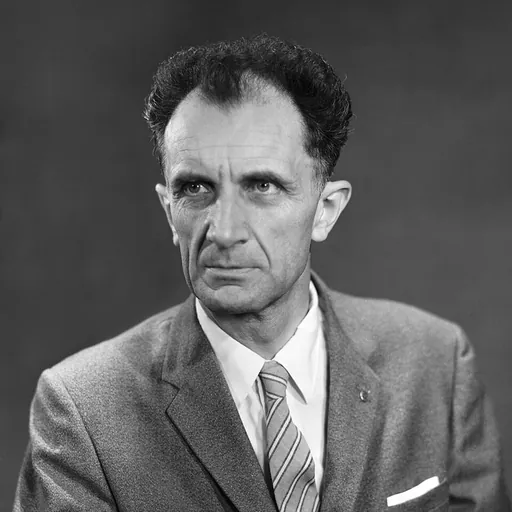
About Adolf Busemann
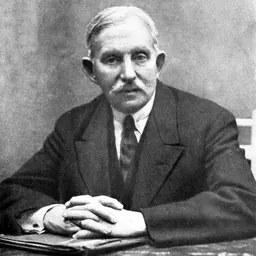
Lived 1901 – 1986 (aged 85). Adolf Busemann was a German and American military flight engineer, engineer, university teacher and physicist.
Adolf Busemann (20 April 1901 – 3 November 1986) was a German-American aerospace engineer and influential Nazi-era pioneer in aerodynamics, specialising in supersonic airflows. He introduced the concept of swept wings and, after emigrating in 1947 to the United States under Operation Paperclip, invented the shockwave-free supersonic Busemann biplane.
Education and early life Born in Lübeck, Germany, Busemann attended the Technical University of Braunschweig, receiving his Ph.D. in engineering in 1924.
Career and research The next year he was given the position of aeronautical research scientist at the Max-Planck Institute where he joined the famed team led by Ludwig Prandtl, including Theodore von Kármán, Max Munk and Jakob Ackeret. In 1930 he was promoted to professor at University of Göttingen. He held various positions within the German scientific community during this period, and during the war he was the director of the Braunschweig Laboratory, a famous research establishment.
Busemann discovered the benefits of the swept wing for aircraft at high speeds, presenting a paper on the topic at the Fifth Volta Conference in Rome on October 3, 1935, the very day of Italian invasion of Ethiopia which caused a delay of his talk. The paper concerned only supersonic lift. At the time of his proposal, flight much beyond 300 miles per hour had not been achieved and it was considered an academic curiosity (in fact, Busemann was initially planning to present a talk on supersonic wind tunnels, but had to swap topics with Jakob Ackeret because of the "sensitive developments" for the Luftwaffe
At Langley, he worked primarily on the problems of sonic booms, and spent a considerable amount of effort looking at ways to characterize them, and potentially eliminate them. He later invented Busemann's Biplane, a supersonic design he originally proposed in 1936 that emits no shock waves and has no wave drag, albeit at the cost of having no lift. Busemann also did early work on magneto-hydrodynamics in the 1920s, as well as on cylindrical focusing of shock waves and non-steady gas dynamics.
Busemann held a professorship at the University of Colorado from 1963 and suggested the use of ceramic tiles on the Space Shuttle, which were adopted by NASA.
Awards and honors He was awarded the Ludwig-Prandtl-Ring from the Deutsche Gesellschaft für Luft- und Raumfahrt (German Society for Aeronautics and Astronautics) for "outstanding contribution in the field of aerospace engineering" in 1966. He died at age 85 in Boulder, Colorado.
Don’t just read it —
keep it.
Full-length biographies made to live with: read them, listen on the way to work, watch them tonight.
- E-book
- Audio
- Video
Instant download · yours to keep · every purchase keeps this site free
Important facts
People in Adolf Busemann's life
Named in this biography and alive at the same time



Related people
Same field, nearest in time


Contemporaries
People whose lives overlapped Adolf Busemann's



Frequently asked questions
Who was Adolf Busemann?
German engineer (1901–1986)
When was Adolf Busemann born?
Adolf Busemann was born on 20 April 1901 in Lübeck.
When did Adolf Busemann die?
Adolf Busemann died on 3 November 1986 in Boulder.
What was Adolf Busemann's occupation?
Adolf Busemann was a military flight engineer, engineer, university teacher and physicist.
What nationality was Adolf Busemann?
Adolf Busemann was German and American.
Sources & further reading
Cite this page
APA: Biography.guide. (2026). Adolf Busemann. https://biography.guide/adolf-busemann/
MLA: "Adolf Busemann." Biography.guide, https://biography.guide/adolf-busemann/.
Chicago: "Adolf Busemann." Biography.guide. https://biography.guide/adolf-busemann/.
Data last updated: 2026-09-23 · Spot an error? Report a correction.
Portrait: Wikimedia Commons · author & licence
Page generated 2026-09-27 05:05 UTC