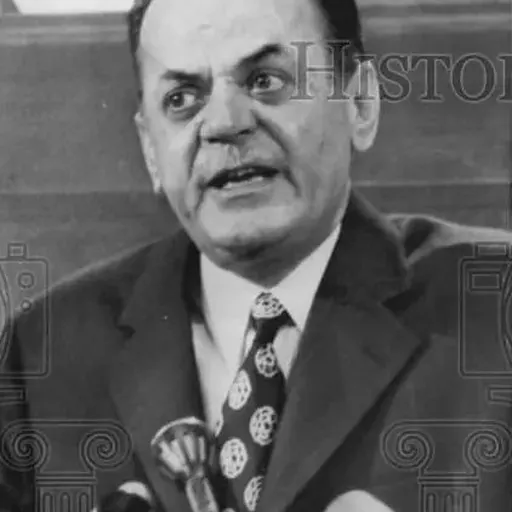
Georgios Papadopoulos
Dictator of Greece from 1967 to 1973
About Georgios Papadopoulos
Lived 1919 – 1999 (aged 80). Georgios Papadopoulos was a Greek military personnel, military officer, dictator and politician.
Georgios Papadopoulos (, ; 5 May 1919 – 27 June 1999) was a Hellenic Army officer and military dictator who ruled Greece from 1967 to 1973. He led the military junta that overthrew Prime Minister Panagiotis Kanellopoulos in 1967 and established his dictatorship. He was proclaimed Prime Minister of Greece from 1967 and served until 1973. He was elected President of Greece under the junta in June 1973, following a referendum. However, after causing a massacre by deploying military riflemen and a tank brigade to attack non-violent protestors to suppress the Athens Polytechnic uprising, he was overthrown by hardliner Dimitrios Ioannidis, in a string of events that would culminate in the fall of regime in 1974. His and dictatorship's legacy, as well as its methods he constructed and effects on Greek economy and society as a whole, are still fiercely debated.
He joined the Hellenic Army during the Second World War and initially helped resist the Italian invasion of Greece in the Greco-Italian War. He is widely believed to have later collaborated as a member of the Axis-aligned Security Battalions. After the war, he rose to the rank of colonel.
In April 1967, Papadopoulos and a group of other mid-level Army officers overthrew the democratic government and established a military junta that lasted until 1974. Assuming dictatorial powers, he led an authoritarian, anti-communist and ultranationalist regime which eventually ended the Greek monarchy and established a republic, with himself as President. In 1973, he was overthrown and arrested by his co-conspirator Brigadier General Dimitrios Ioannidis. After the Metapolitefsi which restored democracy in 1974, Papadopoulos was tried for his part in the crimes of the junta and sentenced to death, but his sentence was commuted to life imprisonment. Refusing several offers of clemency in exchange for admitting guilt, he spent the remainder of his life in prison.
Early life and military career Papadopoulos was born in Elaiohori, a small village in the Prefecture of Achaea in the Peloponnese, to local schoolteacher Christos Papadopoulos and his wife Chrysoula. He was the eldest son and had two brothers, Konstantinos and Haralambos. After finishing high school in 1937, he enrolled in the Hellenic Military Academy, completing its three-year programme in 1940.
His biographical notes, published as a booklet by his supporters in 1980, mention that he took a civil engineering course at the Polytechneion but did not graduate.
Resistance and acquiescence During the Second World War, Papadopoulos saw field action as an artillery second lieutenant against both Italian and Nazi German forces that attacked Greece on 6 April 1941.
Papadopoulos is believed by most historians to have later become a member of the collaborationist Security Battalions in Patras under the command of Colonel Kourkoulakos, which "hunted down" Greek resistance fighters. This is contested by Greek historians Evanthis Hatzivassiliou and Leonidas F. Kallivretakis. It has also been argued that Papadopoulos, at the end of the Axis occupation of Greece, entered Organisation X, but Kallivretakis considers that this information has not been proven.
Along with other right-wing military officers, he participated in the creation of the nationalist right-wing secret IDEA organisation in the autumn of 1944, shortly after the country's liberation. Those 1940 officers who took refuge in the Kingdom of Egypt along with King Geórgios II immediately after the German invasion, had become generals when their still-colonel former classmates undertook the coup of 1967.
Post-Second World War career During the Greek Civil War, Papadopoulos was promoted to captain in 1946, and promoted to major in 1949. He served in the KYP Intelligence Service from 1959 to 1964 as the main contact between the KYP and the top CIA operative in Greece, John Fatseas, after training at the CIA in 1953.
The Beloyannis trials
Papadopoulos was also a member of the court-martial in the first trial of Greek communist leader Nikos Beloyannis, in 1951. At that trial, Beloyannis was sentenced to death for the crime of being a member of the Communist Party of Greece (KKE), which was banned following the Greek Civil War. The death sentence was not carried out, but Beloyannis was put on trial again in early 1952, this time for alleged espionage, following the discovery of radio transmitters used by undercover Greek communists to communicate with the exiled leadership of the Party in the Soviet Union. At the end of this trial, he was sentenced to death and immediately taken out and shot. Papadopoulos was not involved in this second trial.
Rise to colonel in the 1960s In 1956, Papadopoulos took part in a failed coup attempt against King Pávlos. In 1958, he helped create the Office of Military Studies, a surveillance authority, under General Gogousis. It was from this same office that the subsequently successful coup of 21 April 1967 emanated.
In 1964, Papadopoulos was transferred to an artillery division in Western Thrace by a decree of Defense Minister Garoufalias, a member of the Centre Union (EK). In June 1965, days before the onset of the major political turmoil known as Iouliana, he made national headlines after arresting two soldiers under his command and eight leftist civilians from settlements near his military camp, on charges that they had conspired to sabotage army vehicles by pouring sugar into the vehicles' petrol tanks. The ten were imprisoned and tortured, but it was eventually proven that Papadopoulos himself had sabotaged the vehicles. Even after this scandal, Papadopoulos was not discharged from the army since the Prime Minister, Geórgios Papandreou, forgave him as a compatriot of his father. The term Aprilianoi has become synonymous with the term "dictators of 1967–1974".
Regime of the Colonels
King Constantine appointed a new government nominally headed by Konstantinos Kollias. However, from the early stages, Papadopoulos was the strongman of the new regime. He was appointed Minister of National Defense and Minister of the Presidency in the Kollias government, and his position was further enhanced after the King's abortive counter-coup on 13 December, when Papadopoulos replaced Kollias as Prime Minister. Not content with that, on 21 March 1972, he nominated himself Regent of Greece, succeeding General Geórgios Zoitakis. Torture of political prisoners in general, and communists in particular, was not out of the question. Examples included severe beatings, isolation and, according to some sources, pulling out fingernails.
"Patient in a cast" and other metaphors Throughout his tenure as the junta strongman, Papadopoulos often employed what have been described by the BBC as gory surgical metaphors, where he or the junta assumed the role of the "medical doctor". The "patient" was Greece. Typically, Papadopoulos or the junta portrayed themselves as the "doctor" who operated on the "patient" by putting the patient's "foot" in an orthopedic cast and applying restraints on the "patient", tying him on a surgical bed and putting him under anesthesia to perform the "operation" so that the life of the "patient" would not be "endangered" during the operation. In one of his famous speeches, Papadopoulos mentioned: Translated as:
In the same speech Papadopoulos continued: which translates as follows:
Other metaphors contained religious imagery related to the resurrection of Christ at Easter: "Χριστός Ανέστη – Ελλάς Ανέστη" translating as "Christ has risen – Greece has risen", alluding that the junta would "save" Greece and resurrect her into a greater, new Land. He had declared at the time that he did not want the Revolution of 21 April (as the coup was called by the junta's supporters) to become a 'regime'. Around the same time, he had reached out to some old-line politicians, such as Spyros Markezinis. On 1 July 1973, The Observer published an investigative journalism article that accused the Central Intelligence Agency (CIA) of engineering the 1967 coup, further writing that Papadopoulos was known among senior officials in the Joint United States Military Aid Assistance Group in Athens as "the first CIA agent to become Premier of a European country".
A day after the Observer article was published, during CIA agent William Colby's confirmation hearings to be Director of Central Intelligence, Colby was asked in response to the article if there was any justification for the assertions. Colby denied that the CIA had engineered the coup or that Papadopoulos was either a CIA agent or otherwise paid by the CIA, but stating that "[Papadopoulos] has been an official of the Greek Government at various times, and in those periods from time to time we worked with him in his official capacity.".
Fall of the Papadopoulos regime After the events of the student uprising of 17 November at the National Technical University of Athens (see Athens Polytechnic uprising), Papadopoulos was overthrown on 25 November 1973 by hardline elements in the Army. The outcry over Papadopoulos's extensive reliance on the army to quell the student uprising gave Brigadier Dimitrios Ioannidis a pretext to oust him and replace him as the new strongman of the regime. Papadopoulos was put under house arrest at his villa, while Greece returned to an "orthodox" military dictatorship.
After democracy was restored in 1974, during the period of Metapolitefsi ("regime change"), Papadopoulos and his cohorts were arrested and were eventually put on trial for high treason, mutiny, torture, and other crimes and misdemeanors.
On 23 August 1975, he and several others were found guilty and were sentenced to death, which was later commuted to life imprisonment.
Personal life In 1942, after 3 years of courtship and 6 months of engagement, he married Niki Vasileiadi (died 2015), originally from Ilion of Asia Minor. Together they had a son, Christos (b. 1943), a chemist, who lives in the United States and Chrysoula (1945–2004). In 1954, he met and entered into a relationship with Despina Sereti (née Gaspari) (1930–2023), an employee of the Hellenic Intelligence Service and the Geographical Service of the Greek Army, at the time Papadopoulos was posted to the Artillery Division of the VI Division, with the rank of Major. Together, they had a daughter out of wedlock, Hypermachia. Since then, he was estranged from Vasileiadi.
Divorce by decree rumors The separation, however lengthy, could not lead to divorce at first because, under Greece's restrictive divorce laws of that era, spousal consent was required. It is claimed that, as a remedy to the issue, in 1970, as Prime Minister of the dictatorship, he decreed a custom-made divorce law with a strict time limit (and a built-in sunset clause) that enabled him to get the divorce. After having served its purpose, the law eventually expired automatically. Those reports are contradicted by a 1975 article by Makedonia, which claims that Vasiliadi had filed for divorce on 19 September 1969, with the divorce being granted by the Athens Court of First Instance on 27 October of the same year on "joint liability" grounds. Makedonia's claims are further corroborated by the failure of newer sources to provide the decree specifics (type, number, Efimeris tis Kyverniseos Issue number). Such rumors are baseless in the case of Papadopoulos' divorce, but in 1972 a bill that would allow divorces on the basis of long-term separation (featuring a built-in sunset clause) was put forward by the government, only to meet the opposition of the Church of Greece. Such a law (but without a sunset clause) came to be only in 1979, a decade after the divorce of Vasileiadi and Papadopoulos.
In March 1970, he married Gaspari, with whom he lived throughout the years of his separation from Vasileiadi. Gaspari, immediately after the wedding, informally assumed the role of First Lady of Greece, until his overthrow in November 1973. They remained married until his death.
Death His health had been failing by 1994, in Korydallos prison, as he was diagnosed with amyotrophic lateral sclerosis (ALS) and prostate cancer, which soon spread to all his organs. He showed no remorse and steadfastly refused to apply for parole or amnesty or to use the leniency provisions that allowed him to be released on the grounds of ill health, as did several of his associates, such as Pattakos, Makarezos, and Zoitakis. He had been hospitalized at Laiko General Hospital since August 1996 and by April 1999, due to a tracheotomy he had undergone, he was unable to speak and communicated only through notes. He died of a heart attack in the intensive care unit, on 27 June 1999, at age 80. He was buried at the First Cemetery of Athens on 1 July 1999, in the presence of old associates and regime sympathisers.
Legacy Today, Papadopoulos is a symbol of authoritarianism and xenophobia. After the restoration of democracy, some support for his type of politics remained which was, for a time, bolstered by the National Political Union (EPEN), a small political party that declared him its honorary leader.
Don’t just read it —
keep it.
Full-length biographies made to live with: read them, listen on the way to work, watch them tonight.
- E-book
- Audio
- Video
Instant download · yours to keep · every purchase keeps this site free
Important facts
more
Yiórgos PapadópoulosPeople in Georgios Papadopoulos's life
Named in this biography and alive at the same time






Related people
Same field, nearest in time



Contemporaries
People whose lives overlapped Georgios Papadopoulos's



Frequently asked questions
Who was Georgios Papadopoulos?
dictator of Greece from 1967 to 1973 (1919–1999)
When was Georgios Papadopoulos born?
Georgios Papadopoulos was born on 5 May 1919 in Elaiochori.
When did Georgios Papadopoulos die?
Georgios Papadopoulos died on 27 June 1999 in Laiko General Hospital of Athens.
What was Georgios Papadopoulos's occupation?
Georgios Papadopoulos was a military personnel, military officer, dictator and politician.
What nationality was Georgios Papadopoulos?
Georgios Papadopoulos was Greek.
Sources & further reading
· Wikipedia: Georgios Papadopoulos
· DBpedia: Georgios Papadopoulos
Cite this page
APA: Biography.guide. (2026). Georgios Papadopoulos. https://biography.guide/georgios-papadopoulos/
MLA: "Georgios Papadopoulos." Biography.guide, https://biography.guide/georgios-papadopoulos/.
Chicago: "Georgios Papadopoulos." Biography.guide. https://biography.guide/georgios-papadopoulos/.
Data last updated: 2026-09-23 · Spot an error? Report a correction.
Portrait: Wikimedia Commons · author & licence
Page generated 2026-09-27 05:08 UTC