
About Jakub Berman
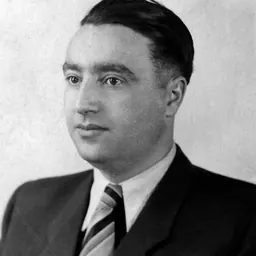
Lived 1901 – 1984 (aged 82). Jakub Berman was a Polish politician and jurist, known for Ministry of Public Security (Poland).
Jakub Berman (23 December 1901 – 10 April 1984) was a Polish communist politician. An activist during the Second Polish Republic, in post-war communist Poland he was a member of the Politburo of the Polish Workers' Party (PPR) and then of the Polish United Workers' Party (PZPR). From 1948, he was considered the second most powerful politician in Poland after President Bolesław Bierut, until he was removed from power in 1956, following Bierut's death.
Alongside Bierut, Berman was responsible for party oversight of the Stalinist Ministry of Public Security, commonly known as the "UB". Under Berman's leadership, 200,000 people were imprisoned for alleged political crimes, and 6,000 were executed.
Early career
Jakub Berman was born into a middle-class Jewish family in Warsaw on 23 December 1901. His younger brother was Adolf Berman. Jakub became a member of the Communist Youth Union and in 1928 joined the Communist Party of Poland (KPP). He received a law degree in 1925 from the University of Warsaw. He wrote a magister thesis entitled Służba domowa w Warszawie w końcu w. XVIII oraz próby jej zrzeszenia się zawodowego ('Domestic servantry in Warsaw at the end of the 18th century and its attempts to establish a trade association'). Berman's academic adviser, Marxist sociologist Prof. Ludwik Krzywicki, wanted to hire Berman at the university as his assistant, but this was not allowed because of Berman's Jewish origin. Krzywicki's efforts to find Berman a mainstream non-university job also failed and Berman ended up working for a Jewish agency, in a poorly paid position.
Berman's social contacts in Warsaw included many communist sympathizing members of the Polish intelligentsia; Janina and Władysław Broniewski, as well as Wanda Wasilewska, were among his associates. Between 1935 and 1936, he worked with Aleksander Wat (as his tutor on behalf of the KPP) in an attempt to establish a leftist periodical, with the intention of the cooperation of the communists with other leftist forces in Poland (mostly the Polish Socialist Party (PPS)), within the popular front.
World War II
On 6 September 1939, after the invasion of Poland by Nazi Germany, Berman followed government directions for "able-bodied men" and took a train going in an easterly direction. He went to Białystok, occupied by the Soviet Union after the Soviet invasion of Poland. With his friend Alfred Lampe, Berman was active in Polish-communist circles there and became a Soviet citizen. In March 1941 he moved to Minsk, where he worked as an editor at Sztandar Wolności ('The Banner of Freedom'), a Polish-language bulletin published by the Communist Party of Byelorussia.
After the German invasion of the Soviet Union in 1941, Berman escaped to Moscow. He later became an instructor at the International Lenin School, the Comintern school, where he trained displaced Polish communists, activists for the new Soviet-sponsored Polish Workers' Party (PPR). With the help from Georgi Dimitrov and Jerzy Borejsza, Berman was able to bring his wife and daughter Lucyna there too.
In 1945, after a survey suggested that 4.8 million Polish citizens including 3 million Jews had died in the war, Berman stated "if we accept that 3 million Jews were murdered, we must significantly increase the number of Polish victims". He declared that 3 million non-Jewish Poles had died, in order to equalize the numbers, to make them acceptable to Polish public opinion.
Political career in communist-ruled Poland
In the summer of 1944, Berman joined the Politburo of the Polish Workers' Party (PPR) and returned to Poland.
In January 1945, with the conquest of Warsaw from the Nazis by the Red Army, the Provisional Government of the Republic of Poland (formerly the PKWN) moved from Lublin to the Praga district of Warsaw. Berman, as a member of the Politburo of the PPR, was charged with oversight of the state security apparatus (the Ministry of Public Security). In post-war Poland Berman organized state censorship, supervised the development of, and permissions for political parties and organizations, and was the main liaison between the PPR and the PKWN. Berman's decisions had to be consulted with and could be vetoed by two resident Soviet advisers, who remained in Poland until 1953 and 1954.
In late 1949, Stalin attempted to remove Berman from his position of power, accusing him of participation in an international anti-communist conspiracy and illicit foreign contacts, but the effort did not succeed. In 1952 Berman's friend Wasilewska, having found out Stalin's plan to eliminate Berman, traveled from Kyiv to Warsaw to warn him. Berman attributed his own survival to Bierut's protection.
In August 1951, Gomułka was arrested, probably on Stalin's and Lavrentiy Beria's orders; they demanded his quick trial. Berman and Bierut, however, managed to keep delaying the proceedings to the point that the trial never took place. Berman helped Tadeusz Sygietyński organize the folk ensemble Mazowsze. Following Berman's repeated interventions with Vyacheslav Molotov and other Soviet authorities, the Ossolineum collections were transferred from Lviv to Wrocław in 1946 and 1947. In the spring of 1955, Berman authorized the creation of the Crooked Circle Club, a free discussion forum in Warsaw, which marked the gradual departure from Stalinism.
While Berman was one of the officials responsible for party oversight of the security apparatus, at least 200,000 people were imprisoned and some 6,000 executed on political charges. He was earlier incriminated by Józef Światło, a former official in the Ministry of Public Security, who defected to the West. He was considered responsible for the "Stalinist-era errors and distortions" by which they meant dogmatic and sectarian party attitudes and breaking the rule of law.
Retirement
For two years Bermam remained without steady employment and supported himself by accepting various assignments, such as translations of works by Karl Marx and Friedrich Engels. In September 1958, Berman was placed by the party in the state-run Książka i Wiedza ('Book and Knowledge') publishing house, where he worked until he was retired by the authorities in 1968. His wife was removed from her position at the Rheumatology Institute. For the first time, according to his daughter Lucyna Tychowa, Berman could enjoy normal life with his family and friends. He engaged in activities, such as reading or attending films and theatrical productions. In the autumn of 1981, he was hit by a car and permanently injured while he attempted to cross a street. He died in Warsaw in April 1984 and was buried at Powązki Cemetery.
Awards and decorations
Don’t just read it —
keep it.
Full-length biographies made to live with: read them, listen on the way to work, watch them tonight.
- E-book
- Audio
- Video
Instant download · yours to keep · every purchase keeps this site free
Important facts
People in Jakub Berman's life
Named in this biography and alive at the same time


Related people
Same field, nearest in time





Contemporaries
People whose lives overlapped Jakub Berman's



Frequently asked questions
Who was Jakub Berman?
Polish politician (1901-1984)
When was Jakub Berman born?
Jakub Berman was born on 26 December 1901 in Warsaw.
When did Jakub Berman die?
Jakub Berman died on 10 April 1984 in Warsaw.
What was Jakub Berman's occupation?
Jakub Berman was a politician and jurist.
What was Jakub Berman known for?
Jakub Berman was known for Ministry of Public Security (Poland).
What nationality was Jakub Berman?
Jakub Berman was Polish.
Sources & further reading
Cite this page
APA: Biography.guide. (2026). Jakub Berman. https://biography.guide/jakub-berman/
MLA: "Jakub Berman." Biography.guide, https://biography.guide/jakub-berman/.
Chicago: "Jakub Berman." Biography.guide. https://biography.guide/jakub-berman/.
Data last updated: 2026-09-22 · Spot an error? Report a correction.
Page generated 2026-09-27 05:27 UTC