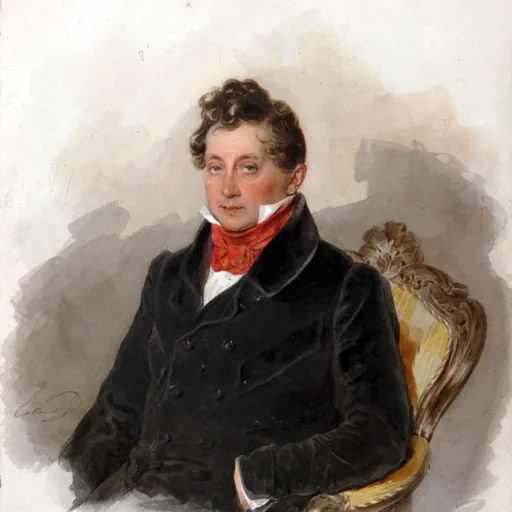
About Mikhail Vielgorsky
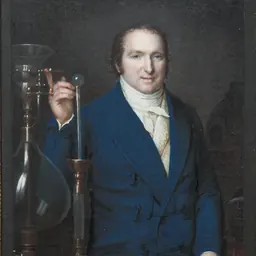
Lived 1787 – 1856 (aged 68). Mikhail Vielgorsky was a Russian composer, hofmeister and cellist.
Count Mikhail Vielgorsky (, ) ; (22 November 1788 – 21 September 1856) was a Russian official and composer of Polish descent. He composed romances, symphonies, an opera and was an amateur singer, violinist, and patron of the arts. ), an amateur cellist who founded the Society of Lovers of Music with Prince Nikolai Borisovich Galitzin (also a friend of Beethoven) in 1828. His mother was Countess Sophia Dmitrievna Matyushkina (1755–1796), lady in waiting to Catherine the Great.
Education Mikhail Vielgorsky had a special passion for music and was known to be an excellent performer and composer. And although an amateur, according to Schumann, was "a genius amateur." He also had said that Vielgorsky was "the most ingenious dilettante I have ever known." Already in childhood, he showed outstanding musical abilities: he played the violin well and tried to compose. Vielgorski received a comprehensive musical education and studied music theory and harmony with the Spanish composer Vincente Martin-y-Soler, as well as composition with the German conductor and pianist Wilhelm Taubert. Back in 1804, when living Riga with his family, Vielgorsky took part in music-making in the evenings: the part of the first violin was performed by his father, the viola - by himself, and the cello part - by his brother Matvey, another musician-performer. Vielgorsky continued his studies of composition in Paris with Luigi Cherubini.
Profession Mikhail Vielgorsky, alongside his compositional work and musicianship, acted as an Actual Privy Councilor to Catherine II or Catherine The Great. Vielgorsky managed to attract many musicians to his Luizino estate in the Kursk province. In the 1820s, all nine of Beethoven's symphonies were performed on his estate during his evening salons. Vielgorsky showed appreciation for Glinka's music and considered his opera Ivan Susanin, later more commonly named A Life for the Tsar, a masterpiece.
Vielgorsky provided support to many progressive figures in Russia. In 1838, together with the poet Vladimir Zhukovsky, he organized a lottery, the proceeds from which went to the ransom from the serfdom of the Ukrainian poet and outspoken political figure Taras Grigorovich Shevchenko.
Mikhail Vielgorsky died on 9 September 1856, in Moscow. His son-in-law Count Vladinmir Sollogub eulogised his mild and unassuming personality:
He is buried in the Lazarevskoye Cemetery of the Alexander Nevsky Lavra in St. Petersburg.
Friendship with Maria Sergeyevna Durnovo Mikhail Vielgorsky knew Maria Sergeyevna Durnovo (Griboyedova), a skilled piano performer and sister of famous Russian writer Alexander Griboyedov. According to the memoirs of Maria Durnovo: "Very often, the writer came to the sister's room. In the spring of 1823, whereas famed comedy remained a secret to public and majority of friends, Mikhail Vielgorsky, stumbled on several sheets of poem, written by the hand of Alexander Griboyedov, while assembling pages of sheet music on the piano of Maria Sergeyevna. Maria wanted to hide the accidentally discovered pages, but it was too late. The news of the new comedy rapidly spread around Moscow from the mouth of the well-known at the time musician". That poem was Woe from Wit, still considered to be "golden classic" in Russia and other Russian-speaking countries.
Family The first wife of Mikhail Vielgorsky was Princess Catherine Biron von Courland (1792–1813), maid of honor the Empress of Russia, and the niece of the last Duke of Courland. This marriage was facilitated by Empress Maria Feodorovna, with the wedding taking place February 1812 in the Great Church of the Winter Palace. This marriage strengthened Vielgorsky's position at court.
In the memoirs of a contemporary, Ekaterina Biron is described as a sweet, naive child who loved lace and outfits. After the wedding, the Vielgorskys moved to Moscow, shortly before the Patriotic War began. Fleeing from the city during the french invasion, they left for one of their country estates. In January 1813, the Vielgorskys decided to return to Moscow whilst Catherine was heavily pregnant. Having hardly reached Moscow, the Vielgorskys settled in the house of Prince Golitsyn, where Catherine died as a result of complications arising during childbirth, most likely puerperal fever. Their relative wrote about this tragedy:
Second Marriage In 1816, Mikhail Vielgorsky secretly married the elder sister of his first wife Princess Louise Biron von Courland (1791–1853), the maid of honor of the Empress Maria Feodorovna. Such a marriage according to church rules was considered illegal. By this, he incurred disgrace and was forced to leave for his estate Luizino in the Kursk province. The Vielgorskys lived in this estate for several years. Their children were born there:
Joseph Mikhailovich (1817–1839), a friend of Gogol, died of consumption in Rome, his short life is devoted to the book and an excerpt of Gogol "Nights at the Villa." Apollinaria Mikhailovna (5 November 1818 – 1884), baptized on November 8, 1818, in the Church of the Ascension, goddaughter of Count G I Chernyshev and V I Lanskoy; since 1843 she was married to A. V. Venevitinov, brother of the poet D. V. Venevitinov. Sofya Mikhailovna (1820–1878), since 1840 the wife of the writer V. A. Sollogub. Mikhail Mikhailovich (1822– 21 November 1855), state councilor, full member of the Red Cross Society, from 1853 by the Imperial decree was called Count Vielgorsky-Matyushkin. Died of brain inflammation in Simferopol. Anna Mikhailovna (1823–1861), since 1858 the wife of Prince Alexander Ivanovich Shakhovsky (1822–1891). According to some memoirists, N. V. Gogol was in love with her. Gogol allegedly wanted to marry her, but knowing that Louise Vielgorskaya would not agree to an unequal marriage for her daughter, he did not make an offer.
Compositions
Vocal works
1885-1887: Collection of Russian Romances, for voice and piano Бывало, for voice and piano Люблю я, for voice and piano Два романса, for voice and piano «Старый муж, грозный муж, for voice and piano Ворон к ворону летит, for voice and piano
Symphonies
Symphony No. 1 [?]
Orchestral works
Theme and Variations, for cello and orchestra
Don’t just read it —
keep it.
Full-length biographies made to live with: read them, listen on the way to work, watch them tonight.
- E-book
- Audio
- Video
Instant download · yours to keep · every purchase keeps this site free
Important facts
People in Mikhail Vielgorsky's life
Named in this biography and alive at the same time

Related people
Same field, nearest in time



Contemporaries
People whose lives overlapped Mikhail Vielgorsky's

Frequently asked questions
Who was Mikhail Vielgorsky?
Russian composer
When was Mikhail Vielgorsky born?
Mikhail Vielgorsky was born on 11 November 1787 in Saint Petersburg.
When did Mikhail Vielgorsky die?
Mikhail Vielgorsky died on 21 September 1856 in Moscow.
What was Mikhail Vielgorsky's occupation?
Mikhail Vielgorsky was a composer, hofmeister and cellist.
What nationality was Mikhail Vielgorsky?
Mikhail Vielgorsky was Russian.
Sources & further reading
· Wikipedia: Mikhail Vielgorsky
Cite this page
APA: Biography.guide. (2026). Mikhail Vielgorsky. https://biography.guide/mikhail-vielgorsky/
MLA: "Mikhail Vielgorsky." Biography.guide, https://biography.guide/mikhail-vielgorsky/.
Chicago: "Mikhail Vielgorsky." Biography.guide. https://biography.guide/mikhail-vielgorsky/.
Data last updated: 2026-09-23 · Spot an error? Report a correction.
Portrait: Wikimedia Commons · author & licence
Page generated 2026-09-27 05:05 UTC