
About François-Joseph Fétis
Lived 1784 – 1871 (aged 87). François-Joseph Fétis was a Belgian composer, librarian, musicologist, pedagogue, conductor and music educator.
François-Joseph Fétis (; 25 March 1784 – 26 March 1871) was a Belgian musicologist, critic, teacher and composer. He was among the most influential music intellectuals in continental Europe. His enormous compilation of biographical data in the Biographie universelle des musiciens remains an important source of information today.
Family Fétis was born in Mons, Hainaut, eldest son of Antoine-Joseph Fétis and Élisabeth Desprets, daughter of a noted surgeon. He had nine brothers and sisters. His father was titular organist of the noble chapter of Saint-Waltrude. His grandfather was an organ manufacturer. He was trained as a musician by his father and played at young age on the choir organ of Saint Waltrude.
In October 1806 he married Adélaïde Robert, daughter of the French politician Pierre-François-Joseph Robert and Louise-Félicité de Kéralio, friend of Robespierre. They had two sons: the elder son helped his father with the editions of Revue Musicale and became member of the Royal Academy, while the younger son was a composer and professor.
In 1866 his wife died, and he withdrew from the Brussels society and court. When his father died, Eduard inherited his complete library and collection of musical instruments.
Career His talent for composition manifested itself at the age of seven, and at nine years old he was an organist at Saint Waltrude, Mons. In 1800 he went to Paris and completed his studies at the Conservatory under such masters as Boïeldieu, Jean-Baptiste Rey and Louis-Barthélémy Pradher.
In 1806 he undertook the revision of the Roman liturgical chants in the hope of discovering and establishing their original form. In this year he also began his Biographie universelle des musiciens, the most important of his works, which did not appear until 1834. He also was the founder, and, until his death, the conductor of the celebrated concerts attached to the conservatory of Brussels, and he inaugurated a free series of lectures on musical history and philosophy.
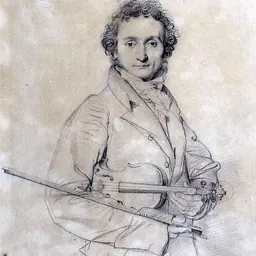
Fétis was a contemporary of Niccolò Paganini, Robert Schumann, and Hector Berlioz, and he collaborated with the violin maker Jean-Baptiste Vuillaume. His writings serve as a primary source for researchers, dealers, and musicians studying the musical practices and instruments of the 19th century.
More important perhaps than his compositions are his writings on music. They are partly historical, such as the Curiosités historiques de la musique (Paris, 1850), and the Histoire générale de la musique (Paris, 1869—1876); and partly theoretical, such as the Méthode des méthodes de piano (Paris, 1840), written in conjunction with Moscheles. he wrote of the Symphonie Fantastique:
Berlioz, who had proof-read Fétis' editions of the first eight Beethoven symphonies for the publisher Troupenas, commented that
Troupenas did in fact remove Fétis' editorial marks, but Berlioz was still unsatisfied. He went on to criticize Fétis in one of the monologues of Lélio, ou le Retour à la vie, the 1832 sequel to Symphonie Fantastique:
Not one to be outdone, Fétis may have had the last word in this debate. In the 1845 edition of his treatise La musique mise à la porte de tout le monde, he describes the word "fantastique" saying that "this word has even slid into music. ‘Fantastique' music is composed of instrumental effects with no melodic line and incorrect harmony."
Theoretical work Although known primarily for his contributions to musicology and criticism, Fétis had effects on the realm of music theory as well. In 1841 he put together the first history of harmonic theory, his Esquisse de l'histoire de l'harmonie. Assembled from individual articles that Fétis published in the Revue et Gazette musicale de Paris around 1840, the book predates Hugo Riemann's more well known Geschichte der Musiktheorie by fifty years. The Esquisse, as the title implies, is a general outline rather than an exhaustive study. Fétis is attempting to show the "facts, errors, and truths" of previous theories and theorists, as he interprets them, in order to provide a solid grounding for other scholars and to prevent subsequent interpretive mistakes.
Fétis' main theoretical work and the culmination of his conceptual frameworks of tonality and harmony is the Traité complet de la théorie et de la pratique de l'harmonie of 1844. This book has influenced later theorists and composers including Paul Hindemith, Ernst Kurth, and Franz Liszt. In the Musik-Lexicon of 1882, Hugo Riemann states that "to [Fétis'] meditations we are indebted for the modern concept of tonality…he found himself emancipated from the spirit of a particular age, and able to render justice to all the various styles of music." Though some other theorists, most notably Matthew Shirlaw, have had decidedly negative views, Riemann's assessment captures the two key features of Fétis' text. Though he did not coin the term "tonality," Fétis developed the concept into its present-day form. He claimed that "tonalité" is the primary organizing agent of all melodic and harmonic successions and that the efforts of other theorists to find the fundamental principle of music in "acoustics, mathematics, aggregations of intervals, or classifications of chords have been futile."
The majority of the Traité complet is devoted to explaining how tonalité organizes music. The primary factor of determining tonality is the scale. It sets out the order of the succession of tones in major and minor (the only two "tonal" modes which he recognizes), the distances which separate the tones, and the resultant melodic and harmonic tendencies. Tonality is not only a governed and conditioned state, but it is a socially conditioned one. Scales are cultural manifestations, resulting from shared experience and education. Nature provides the elements of tonalité, but human understanding, sensibility, and will determine particular harmonic systems. This concept was called a "Metaphysical principle" by Fétis, though Carl Dahlhaus argues that the term is used in this case to denote an anthropological, culturally relative sense in his 1990 book Studies on the Origin of Harmonic Tonality, and theorist Rosalie Schellhous posits that the Kantian term "transcendental" might be more appropriate.
In his comparative work, Fétis attempted "a new method of classifying human races according to their musical systems" following contemporary trends of social darwinism in the emerging fields of ethnology and anthropology.
Harmonic and rhythmic modulation However, if one wishes to interpret Fétis' metaphysical theory, one of his unique theoretical ideas is laid out in book 3 of the Traité complet, that of harmonic modulation. Fétis argues that tonality has evolved over the course of time through four distinct phases, or ordres:
Unitonic – Resulting from plainchant tonality, the unitonic phase consists mainly of consonant triads with no possibility for modulation due to the lack of the tritone between the 4th and 7th scale degrees. This phase is also referred to by Fétis as tonalité ancienne. Transitonic – Order which began with the introduction of the dominant 7th chord into harmonic discourse, sometime between Zarlino and Monteverdi. This development is also directly related to the codification of cadential systems and periodic phrase structure. Pluritonic – Modulation is achieved through enharmonic relationships in which one note of a chord is considered the point of contact between different scales. Fétis claims that Mozart was the first to use such modulations as a means of expression. In this order, the diminished 7th and augmented 6th chords become important as they can modulate to several different tonalities. Omnitonic – The final phase of tonality, and one embodied for Fétis by Wagner, where the alteration of the intervals of natural chords and modification by substitution of notes is so complex that it becomes impossible to identify the original chord. This is seen as a period of extremes, and undesirable compared to the moderately chromatic music of Meyerbeer.
Fétis later applied this same system of ordres to rhythm, "the least advanced part of music...[where] great things remain to be discovered." Though he did not publish these theories in any of his treatises, they appear in several articles for the Revue musicale and in some lectures which had a profound impact on Liszt. Though music had not yet made it past the first phase, Unirhythm, by Fétis' time, he argues that composers may be able to "mutate" from one meter to another within the same melodic phrase. Though Liszt may have been an open disciple of the ideas of the Omnitonic and Omnirhythmic, the influence of such thinking can perhaps be seen most clearly in the music of Brahms, where hemiola and mixing of time signatures is a common occurrence.
"Se i miei sospiri" The Italian art song, "Se i miei sospiri", appeared in a Paris concert organized by Fétis in 1833. Fétis published the piece for voice and strings in 1838 and then again in 1843 for voice and piano with alternate lyrics ("Pietà, Signore"). It is these alternate lyrics with which the piece is now typically associated. Fétis attributed the song to Alessandro Stradella and claimed to possess an original manuscript of the work but never produced it for examination. As early as 1866, musicologists were questioning the authenticity of the song, and when Fétis' library was acquired by the Royal Library in Brussels after his death, no such manuscript could be found. Owing to this and the fact that the style of the piece is inconsistent with Stradella's own period, the authorship of the piece is now typically attributed to Fétis himself. The original Italian text for the song (Se i miei sospiri) was found set to different music by Alessandro Scarlatti in his 1693 oratorio "The Martyrdom of St. Theodosia".
Publications Biographies de Joseph et Michael Haydn (Paris, n.d.) Méthode elementaire et abregée d'harmonie et d'accompagnement (Paris: Petit, 1823) Traité du contrepoint et de la fugue... (Paris: Charles Michael Ozu, 1824) Revue musicale (Paris, 1827–35) Curiosités historiques de la musique, complément nécessaire de la musique mise à la portée de tout le monde (Paris: Janet et Cotelle, 1830) Biographie universelle des musiciens et bibliographie générale de la musique (Brussels, 1833–1844 [8 vols.]) Traité du chant en choeur (Paris, 1837) Esquisse de l'histoire de l'harmonie considérée comme art et comme science systématique (Paris, 1840). Traité complet de la théorie et de la pratique de l'harmonie (Paris and Brussels, 1844) Antoine Stradivari, luthier célèbre (Paris, 1856) Histoire générale de la musique (Paris, 1869–76; 5 vls., unfinished)
Honours Master of the Royal Music. Grand Officer in the Order of Leopold. Commander in the Order of the Oak Crown. Knight of the Order of the Red Eagle. Officer of the Legion of Honour. Academic Honours Member of the Royal Academy of Science, Letters and Fine Arts of Belgium. Member of the Academy of Rome. Member of the Academy of Berlin. Member of the Academy of Vienna. Member of the Academy of Stockholm. Member of the Academy of London.
Compositions
Ensembles String Quartet No. 1 String Quartet No. 2 Grand Sextet, Op. 5
Overtures Ouverture de concert à grand orchestre
Concertos 1869: Flute Concerto in B minor
Symphonies 1862: Symphony No. 1 in E-flat major Symphonic Fantasy for organ and orchestra
Masses Messe di Requiem
Songs Se i miei sospiri
Don’t just read it —
keep it.
Full-length biographies made to live with: read them, listen on the way to work, watch them tonight.
- E-book
- Audio
- Video
Instant download · yours to keep · every purchase keeps this site free
Important facts
People in François-Joseph Fétis's life
Named in this biography and alive at the same time


Related people
Same field, nearest in time



Contemporaries
People whose lives overlapped François-Joseph Fétis's

Frequently asked questions
Who was François-Joseph Fétis?
Belgian composer (1784-1871)
When was François-Joseph Fétis born?
François-Joseph Fétis was born on 25 March 1784 in Mons.
When did François-Joseph Fétis die?
François-Joseph Fétis died on 26 March 1871 in Brussels.
What was François-Joseph Fétis's occupation?
François-Joseph Fétis was a composer, librarian, musicologist, pedagogue, conductor and music educator.
What nationality was François-Joseph Fétis?
François-Joseph Fétis was Belgian.
Sources & further reading
· Wikipedia: François-Joseph Fétis
· DBpedia: François-Joseph Fétis
Cite this page
APA: Biography.guide. (2026). François-Joseph Fétis. https://biography.guide/francois-joseph-fetis/
MLA: "François-Joseph Fétis." Biography.guide, https://biography.guide/francois-joseph-fetis/.
Chicago: "François-Joseph Fétis." Biography.guide. https://biography.guide/francois-joseph-fetis/.
Data last updated: 2026-09-20 · Spot an error? Report a correction.
Page generated 2026-09-27 05:33 UTC