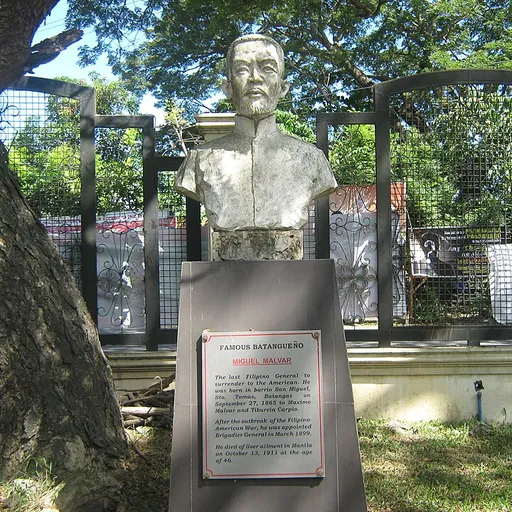
About Miguel Malvar
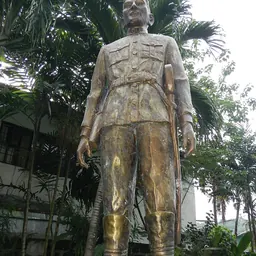
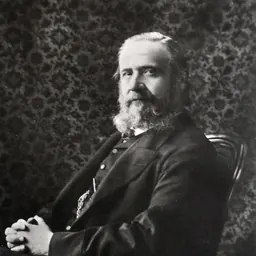
Lived 1865 – 1911 (aged 46). Miguel Malvar was a Filipino politician, military personnel and soldier.
Miguel Malvar y Carpio (September 27, 1865 – October 13, 1911) was a Filipino general who served during the Philippine Revolution and, subsequently, during the Philippine–American War. He assumed command of the Philippine revolutionary forces during the latter, following the capture of resistance leader Emilio Aguinaldo by the Americans in 1901. According to some, he could have been listed as one of the presidents of the Philippines. However, is not recognized as such by the Philippine government.
Early life Malvar was born on September 27, 1865, in San Miguel, a barrio in Santo Tomas, Batangas, to Máximo Malvar (locally known as Capitán Imoy) and Tiburcia Carpio (locally known as Capitana Tibo). Malvar's family was well known in town not only for their wealth but for their generosity and diligence as well.
Valerio Malabanan established a school that helped poor Filipino children as well as prominent children of wealthy Batangueños have a quality academic experience that was secular in nature.
For his education, Malvar attended the town school in Santo Tomas. He later attended a private school run by Father Valerio Malabanan in Tanauan, Batangas, a well-regarded educational institution in Batangas at the time. Here, Malvar had fellow revolutionary Apolinario Mabini as his classmate. He then transferred to another school in Bauan, Batangas. He decided not to pursue higher education in Manila and preferred to settle down as a farmer instead. Instead, he helped his more studious younger brother, Potenciano, study medicine in Spain. Malvar was later elected as Capitán municipal of his hometown. Malvar had the habit of bringing his family with him as he went to battle during the Philippine Revolution and the Philippine–American War. The Bonifacio brothers were murdered on May 10, 1897, in the mountains of Maragondon.
After Bonifacio was murdered, the Spanish offensive resumed, now under Governor-General Fernando Primo de Rivera, and forced Aguinaldo out of Cavite. Aguinaldo slipped through the Spanish cordon and, with 500 picked men, proceeded to Biak-na-Bató, a wilderness area at the tri-boundaries of the towns of San Miguel, San Ildefonso and Doña Remedios in Bulacan. When news of Aguinaldo's arrival there reached the towns of central Luzon, men from the Ilocos provinces, Nueva Ecija, Pangasinan, Tarlac, and Zambales, renewed their armed resistance against the Spanish. By the end of 1897, Governor-General Primo de Rivera accepted the impossibility of quelling the revolution by force of arms. In a statement to the Cortes Generales, he said, "I can take Biak-na-Bato, any military man can take it, but I can not answer that I could crush the rebellion." Desiring to make peace with Aguinaldo, he sent emissaries to Aguinaldo seeking a peaceful settlement. Nothing was accomplished until Pedro A. Paterno, a distinguished lawyer from Manila perhaps wanting a Spanish nobility title, volunteered to act as negotiator. On August 9, 1897, Paterno proposed a peace based on reforms and amnesty to Aguinaldo. In succeeding months, practicing shuttle diplomacy, Paterno traveled back and forth between Manila and Biak-na-Bato carrying proposals and counterproposals. Paterno's efforts led to a peace agreement called the Pact of Biak-na-Bato. This consisted of three documents, the first two being signed on December 14, 1897, and the third being signed on December 15; effectively ending the Republic of Biak-na-Bato.
Malvar, along with other generals like Mariano Trías, Paciano Rizal, Manuel Tinio, and Artemio Ricarte, as opposed to the pact, believing it was a ruse of the Spanish to get rid of the Revolution easily, and therefore resumed military offensives. Aguinaldo, seeing the stiff resistance of Malvar and his sympathizers, issued a circular ordering the revolutionary generals to stop fighting. On January 6, 1898, Malvar ceased his offensives. During the following months, Malvar harassed American troops south of Manila as he and his 3,000-man brigade conducted offensives in Muntinlupa. By July 1899, the Americans under General Robert Hall captured Calamba, Laguna. With ten companies (around 2,000 men) of American troops in the town, Malvar unsuccessfully besieged Calamba from August to December 1899. This change in tactics was not as successful as it had been against the Spaniards, and Aguinaldo was captured on March 23, 1901, by General Frederick Funston with help from some Macabebe scouts. General Trías, Aguinaldo's chosen successor as president and Commander-In-Chief of the Filipino forces, had already surrendered on March 15, 1901. Therefore, as designated in Aguinaldo's decreed line of succession, Malvar became President of the Philippine Republic. The Hong Kong Junta affirmed Malvar's authority in succeeding Aguinaldo. Some sources may give differing dates. in Rosario, Batangas, mainly due to desertion of his top officers and to put an end to the sufferings of his countrymen. He died in Manila on October 13, 1911.
Attributions as president On September 18, 2007, Oriental Mindoro 1st district representative Rodolfo Valencia filed House Bill No. 2594, which declared Malvar as the second Philippine president, alleging that it is incorrect to consider Manuel L. Quezon as the second president of the Philippine Republic serving after Emilio Aguinaldo: "General Malvar took over the revolutionary government after General Emilio Aguinaldo, first president of the Republic, was captured on March 23, 1901, and [was] exiled in Hong Kong by the American colonial government—since he was next in command." In October 2011, Vice President Jejomar Binay sought the help of historians in proclaiming revolutionary General Miguel Malvar as the rightful second president of the Philippines.
Commemoration The Philippine Navy had named ships after him; the previous patrol corvette BRP Miguel Malvar (PS-19), and the current guided missile frigate BRP Miguel Malvar (FFG-06). Extra Mile Productions conducted the General Miguel Malvar Essay Writing Contest in commemoration of the 100th Death Anniversary of General Miguel Malvar. Malvar, Batangas, a second class municipality in the Philippines, was named after him. Various streets were also named after him. In 2015, the National Historical Commission of the Philippines will open a museum in Santo Tomas to celebrate the 150th anniversary of Malvar's birthday on September 27. In 2015, the Bangko Sentral ng Pilipinas (BSP) released the 10-peso commemorative coin in honor of Malvar's 150th birth anniversary.
Don’t just read it —
keep it.
Full-length biographies made to live with: read them, listen on the way to work, watch them tonight.
- E-book
- Audio
- Video
Instant download · yours to keep · every purchase keeps this site free
Important facts
People in Miguel Malvar's life
Named in this biography and alive at the same time



Related people
Same field, nearest in time




Contemporaries
People whose lives overlapped Miguel Malvar's



Frequently asked questions
Who was Miguel Malvar?
Filipino general (1865–1911)
When was Miguel Malvar born?
Miguel Malvar was born on 27 September 1865 in Batangas, Captaincy General of the Philippines, Santo Tomas, Batangas, Spanish Empire.
When did Miguel Malvar die?
Miguel Malvar died on 13 October 1911 in Manila.
What was Miguel Malvar's occupation?
Miguel Malvar was a politician, military personnel and soldier.
What nationality was Miguel Malvar?
Miguel Malvar was Filipino.
Sources & further reading
Cite this page
APA: Biography.guide. (2026). Miguel Malvar. https://biography.guide/miguel-malvar/
MLA: "Miguel Malvar." Biography.guide, https://biography.guide/miguel-malvar/.
Chicago: "Miguel Malvar." Biography.guide. https://biography.guide/miguel-malvar/.
Data last updated: 2026-09-20 · Spot an error? Report a correction.
Portrait: Wikimedia Commons · author & licence
Page generated 2026-09-27 04:58 UTC