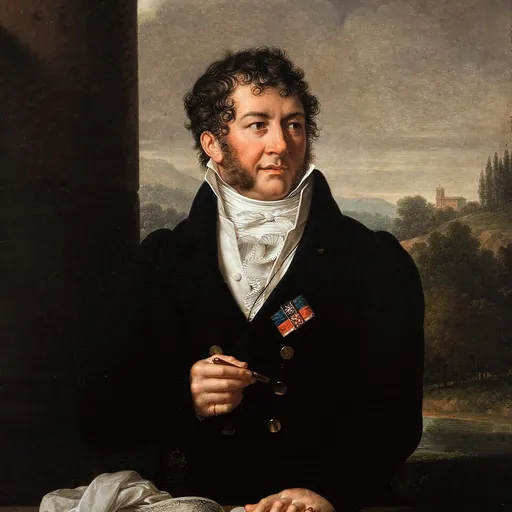
Michał Kleofas Ogiński
Polish composer, diplomat and politician
About Michał Kleofas Ogiński
Lived 1765 – 1833 (aged 68). Michał Kleofas Ogiński was a Polish, Russian and Italian composer, diplomat, politician and minister.
Michał Kleofas Ogiński (25 September 1765 – 15 October 1833) was a Polish-Lithuanian diplomat and politician, Grand Treasurer of Lithuania, and a senator of Tsar Alexander I. He was also a composer of late Classical and early Romantic music.
Early life
It is claimed by some sources that Ogiński was born in Guzów in Mazovia (west of Warsaw) in the Kingdom of Poland. Nevertheless, in 2025 Lithuanian researchers found records in metrics of the Salantai Church of the Assumption where it is stated that Ogiński was born in the surroundings of Salantai (present-day Kretinga District Municipality of Lithuania) and was baptized in the Salantai Church of the Assumption. His father, Andrzej, was a Polish-Lithuanian nobleman from the Ogiński family and Trakai governor of the Grand Duchy of Lithuania. Hence, some sources indicate that Michał Ogiński was Lithuanian. His mother, Paulina Szembek (1740–1797), was the daughter of Polish magnate, Marek Szembek, whose ancestors were Austrian, and Jadwiga Rudnicka, who was of Lithuanian descent. His first introduction to music arose during a visit to relatives at Słonim where Michał Kazimierz Ogiński had a contemporary European theatre that hosted opera and ballet productions.
Michał Kleofas received an Enlightenment gentleman's education. He studied music with Józef Kozłowski and took violin lessons from Giovanni Battista Viotti, Pierre Baillot, and Ivan Mane Jarnović. Since his father's diplomatic mission to Vienna in 1772, the prince's tutor was Jean Rolay, later tutor to Emperor Leopold II. Michał Kleofas learned French, German and Latin. Years later, Ogiński erected a monument to his tutor at the palace in Zaliessie as a token of his gratitude.
Michał Kleofas had an older sister, Józefa, and half-brothers, his mother's sons from previous marriages: Feliks Łubieński and Antoni Protazy Potocki.
Career
Aged only 20, Ogiński was chosen as an envoy of the Polish–Lithuanian Commonwealth. He served as an adviser to King Stanisław August Poniatowski and supported him during the Great Sejm of 1788–1792.
Great Sejm In 1788 he received the Order of Saint Stanislaus and in 1789 - the Order of the White Eagle, Poland's highest order. In 1790 he was dispatched as a diplomatic representative to the United Kingdom, where he met with Lord Mansfield who warned him about the danger posed by the tri-partite powers about to dismember the Kingdom of Poland. After 1790, he was sent to The Hague as a diplomatic representative of Poland to the Netherlands and was Polish agent in Constantinople and Paris. In 1793, he was nominated to the office of Vice-Treasurer of Lithuania.
Kościuszko Uprising During the Kościuszko Uprising in 1794, Ogiński commanded his own unit. After the insurrection was suppressed, he emigrated to Constantinople and later to France, where he sought support for the Polish-Lithuanian Commonwealth.
Napoleonic Wars At that time he saw the creation of the Duchy of Warsaw by the Emperor as a stepping stone to the eventual full independence of the Commonwealth. He dedicated his only opera, Zelis et Valcour, to Napoleon. In 1810, Ogiński withdrew from political activity in exile and, disappointed with Napoleon, returned to Vilnius. Adam Jerzy Czartoryski introduced him to Tsar Alexander I, who made Ogiński a Russian Senator. Ogiński tried in vain to convince the Tsar to reconstitute the former Commonwealth. Disillusioned, he moved abroad in 1815. He died in Florence in 1833.
Works
The polonaise Farewell to the Homeland (Pożegnanie Ojczyzny) is commonly attributed to Ogiński, allegedly written in 1794 in the Zalesie region (then part of the Polish-Lithuanian Commonwealth, today in Belarus), on the occasion of his emigration after the suppression of the Kościuszko Uprising. There is however no manuscript or document to support this attribution. Recent research shows that, although the real composer of the piece has not been identified, it is by all means not a composition by Ogiński.
Ogiński admired French and Italian opera as well as the works of Haydn and Mozart. He was a violinist, and played the clavichord and the balalaika. He began composing marches and military songs in the 1790s that gained popularity among the rebels of 1794. He composed some 20 polonaises, piano pieces, mazurkas, marches, romances and waltzes.
Some of his other popular works and compositions include: Opera Zelis et Valcour, ou 'Bonaparte au Caire' (1799). Treatise 'Letters about music' (1828). 'Mémoires sur la Pologne et les Polonais, depuis 1788 jusqu'à la fin de 1815' ('Memories of Poland and the Poles, from 1788 until the end of 1815'), published in Paris.
Don’t just read it —
keep it.
Full-length biographies made to live with: read them, listen on the way to work, watch them tonight.
- E-book
- Audio
- Video
Instant download · yours to keep · every purchase keeps this site free
Important facts
People in Michał Kleofas Ogiński's life
Named in this biography and alive at the same time




Related people
Same field, nearest in time


Contemporaries
People whose lives overlapped Michał Kleofas Ogiński's




Frequently asked questions
Who was Michał Kleofas Ogiński?
Polish composer, diplomat and politician (1765-1833)
When was Michał Kleofas Ogiński born?
Michał Kleofas Ogiński was born on 25 September 1765 in Guzów.
When did Michał Kleofas Ogiński die?
Michał Kleofas Ogiński died on 15 October 1833 in Florence.
What was Michał Kleofas Ogiński's occupation?
Michał Kleofas Ogiński was a composer, diplomat, politician and minister.
What nationality was Michał Kleofas Ogiński?
Michał Kleofas Ogiński was Polish, Russian and Italian.
Sources & further reading
· Wikipedia: Michał Kleofas Ogiński
· DBpedia: Michał Kleofas Ogiński
Cite this page
APA: Biography.guide. (2026). Michał Kleofas Ogiński. https://biography.guide/michal-kleofas-oginski/
MLA: "Michał Kleofas Ogiński." Biography.guide, https://biography.guide/michal-kleofas-oginski/.
Chicago: "Michał Kleofas Ogiński." Biography.guide. https://biography.guide/michal-kleofas-oginski/.
Data last updated: 2026-09-22 · Spot an error? Report a correction.
Portrait: Wikimedia Commons · author & licence
Page generated 2026-09-27 05:02 UTC